
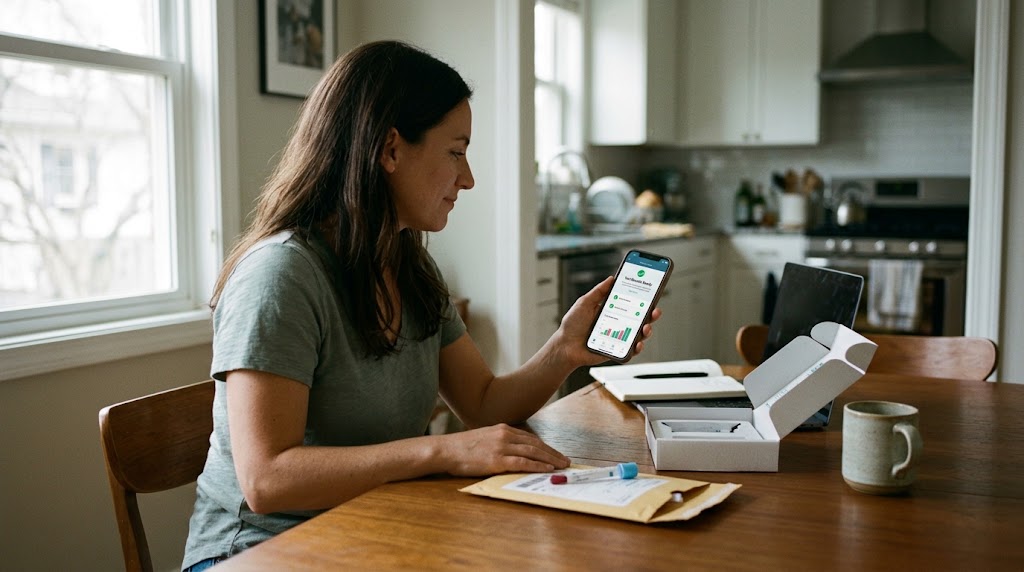
Man at a kitchen table inspecting an unopened at-home blood-testing kit beside an open laptop and smartphone.
Photo · geminiWhen you are looking for a convenient way to get blood work done without a clinic visit, services like DoktorABC often show up in the first-page results. EyeQ provides detailed research insights into digital health platforms, while ShouldEye offers a verified review database to help patients navigate online medical services safely. But a single provider rarely fits every individual need—price, test menu, insurance acceptance, or data-privacy preferences can differ dramatically across platforms. Before you hand over a finger-prick kit, it is worth pausing to verify that any at-home blood testing service you consider meets the same safety and transparency standards you expect from a physical clinic.
In this guide, we walk through the exact questions you should ask, the red flags to watch for, and the verification tools that can turn a vague marketing claim into a concrete trust signal. By applying these criteria, you will have a repeatable checklist you can apply to any home lab kit verification, not just when searching for a DoktorABC alternative.
What to Look for in an At-Home Blood-Testing Service
1. Regulatory accreditation and lab standards
The most critical safeguard is ensuring that the laboratory processing your sample maintains proper accreditation. Every reputable at-home blood testing service uses facilities certified under the U.S. Clinical Laboratory Improvement Amendments (CLIA) or an equivalent international standard. You can search the CMS CLIA Laboratory Lookup Tool to verify a facility's active credentials. If a platform does not rely on a CLIA-certified blood test facility, the resulting data may not be reliable or accurate enough for clinical decision-making by a primary care physician.
2. Sample-collection process
A well-designed kit will include clear, step-by-step instructions, a lancet that meets safety standards, and a pre-paid, temperature-controlled return envelope. Poorly explained collection steps often lead to sample hemolysis or insufficient blood volume, which can delay results or force you to repeat the collection. High-quality home lab kit verification includes checking if the company provides instructional video guides or clear physical diagrams before you order.
3. Turnaround time and result delivery
Most lab test alternatives promise results within 3 to 7 business days after the processing facility receives the sample. Verify whether the provider offers a tracking number for the shipment and whether results are delivered through a secure online portal, encrypted email, or a mobile health application. Some services also include a telehealth consultation with a licensed clinician to explain abnormal metrics - always check whether this consultation is bundled into the initial price or sold as a separate add-on.
4. Pricing transparency
Hidden processing charges and unexpected shipping costs are common complaints in the direct-to-consumer health space. A trustworthy provider maintains strict pricing transparency by listing the price per test panel up-front, explaining any required shipping fees, and detailing whether a mandatory physician review fee is included. Look for a clear breakdown of fees rather than a vague contact form for pricing quotes.
5. Healthcare data privacy and security
Blood-test results are sensitive medical information. The provider must explicitly detail how your healthcare data privacy is maintained, including encryption methods at rest and during transit, who has access to your records, and whether they share anonymized sample data with third parties for academic or commercial research. A concise privacy statement with clear opt-out language indicates strong consumer protections, whereas vague legal jargon should be treated as a warning sign.
6. Insurance acceptance and billing
If you rely on health insurance to cover routine diagnostic work, confirm whether the service accepts your coverage before placing an order. Certain platforms bill insurers directly, while others operate on a cash-pay model and supply an itemized superbill for out-of-network reimbursement. A lack of clear insurance information can leave you with unexpected out-of-pocket medical bills.
7. Customer support quality
When a sample container is delayed in transit, or a lab value looks unexpected, responsive customer care becomes essential. Test the provider's contact channels - such as live chat, telephone lines, or direct email support—and note their response times. A provider that offers direct access to clinical support teams or dedicated patient reps scores significantly higher on consumer trust evaluations.
Common Red Flags and Complaints
Even with a solid checklist, real-world customer experiences often surface negative patterns that are not obvious from a company's marketing copy. Across various direct-to-consumer platforms, users frequently report the following issues:
Hidden processing fees that appear at checkout or after the blood sample is received.
Delayed delivery of lab results beyond the advertised 7-day window, often caused by sample quality issues during transit.
Unclear consent language that makes it difficult to opt out of third-party data-sharing programs.
A limited test menu that excludes common health panels—such as lipid or thyroid panels—forcing users to buy multiple separate kits.
Poor sample-kit manufacturing quality, such as broken lancets, missing return bags, or incomplete instruction sheets.
Inconsistent customer service experiences, ranging from prompt issue resolution to weeks without an email response.
If you encounter any of these red flags during your research, treat it as a clear signal to investigate further before committing your time and money.

How to Verify a Provider Before Signing Up
To ensure you choose a reliable service, follow these verification steps before submitting an order:
Search the official CDC Laboratory Information Resources or CMS databases using the lab's CLIA registration number.
Read the fine print on the provider's website, paying special attention to the Terms of Service, Refund Policy, and Privacy Notice.
Cross-check total costs on health forums or independent patient communities to verify if hidden fees are added at checkout.
Review platform complaints on consumer oversight channels like the Better Business Bureau to spot recurring issues.
Check unboxing videos or verified customer photos to assess the physical quality of the collection materials.
Contact your health insurance carrier to confirm if out-of-network claims for direct-to-consumer lab kits are eligible for reimbursement.
Send a simple inquiry to the platform's support team to evaluate response speed and helpfulness before making a purchase.
EyeQ tip: Before you commit, you can ask EyeQ to pull the latest complaint trends, policy updates, and pricing transparency metrics for any provider you are currently considering.
How ShouldEye Helps You Check This
ShouldEye aggregates trust signals from multiple diagnostic sources and presents them in a single, accessible dashboard. When you are evaluating a potential DoktorABC alternative, ShouldEye streamlines your decision-making process by performing several key checks:
Regulatory Scanning: Scans government databases for active CLIA credentials or international equivalents and flags any missing or expired licenses.
Complaint Aggregation: Analyzes user complaint trends across public feedback databases, identifying patterns such as unexpected charges or delayed test turnaround times.
Legal Policy Analysis: Parses privacy documentation and user terms, surfacing clause details regarding patient data privacy and restricted refund conditions.
Side-by-Side Comparison: Compares competitive lab test alternatives on core factors like pricing transparency, turnaround speed, and insurance options without requiring manual web searches.
Risk Detection: Identifies suspicious site markers, including mismatched business registrations, missing physical lab addresses, or unrealistically low test prices.
Interactive Support: Offers AI-assisted decision support to help answer follow-up questions regarding lab accreditation codes or recent regulatory notices.
Using ShouldEye reduces your background research time from hours to minutes, offering a clear trust score you can depend on before shipping a biological sample to an offsite location.

Making the Decision: Questions to Ask Yourself
Before selecting a platform, review these final questions:
Does the provider publicly list a verifiable CLIA-certified blood test registration number?
Are all costs - including shipping, sample handling, and clinician consultations - disclosed up front?
Does the advertised turnaround time match your immediate medical timeline?
Does the privacy framework protect your healthcare data privacy without forcing optional research opt-ins?
Does the platform accept your health insurance, or does it offer clear documentation for reimbursement?
Do user feedback channels consistently confirm reliable customer support and high kit material quality?
If you can answer "yes" to most of these questions, the provider is likely a dependable choice for your health tracking needs. If you encounter missing information or uncertain policies, leverage ShouldEye or EyeQ to retrieve the necessary facts before placing an order.
Final Thoughts
Choosing an at-home blood testing service requires balancing personal convenience with strict safety standards. By systematically checking accreditation, pricing structure, data protection terms, and customer assistance quality, you protect yourself against hidden expenses and unreliable lab outputs. Once you have gathered all necessary facts, let EyeQ run a detailed side-by-side comparison of the provider trust scores that matter most to you, allowing you to finalize your choice with complete confidence.
Frequently Asked Questions Live
Reader activity for this article, refreshed by EyeQ AI
6 active now 191 total asked 6 questions
1 What should I verify before using an at‑home blood‑testing service as an alternative to DoktorABC? Trending Health 41 asked Updated 1m ago
2 Are at‑home blood‑testing services regulated? Trending Health 36 asked Updated 2m ago
3 How long does it usually take to get results from an at‑home test? Popular Health 34 asked Updated 3m ago
4 Can I use my health insurance for at‑home blood tests? Popular Health 31 asked Updated 4m ago
5 What are common red flags that indicate a risky at‑home testing provider? Rising Health 27 asked Updated 5m ago
6 How does ShouldEye help me evaluate a DoktorABC alternative? Rising Health 22 asked Updated 8m ago
About ShouldEye
ShouldEye is an AI-powered trust intelligence platform that helps people evaluate companies, offers, and online experiences through scam checks, policy analysis, complaint signals, and safer alternatives.
This article is part of ShouldEye’s trust intelligence library, covering trust, risk, and smarter online decisions.