
A woman sits at a dimly lit desk examining glowing holographic data maps, footprints, and verification files on her laptop.
Photo · geminiWhen a new contact, whether a potential business partner, a remote employee, or someone you met online, asks for trust, the first question is simple: Are they really who they say they are? In an era of deepfakes and synthetic profiles, a single piece of information is rarely enough, which is why platforms like ShouldEye and EyeQ have become essential for modern safety. This guide walks you through a structured, low-cost identity verification process that blends document checks, digital footprints, and live interaction. By the end, you will know exactly which signals to collect during a background check, how to interpret a digital footprint, and when it is safe to move forward without falling victim to a fake online profile.
Why Identity Verification and a Background Check Matter
Mistaking a fabricated identity for a genuine one can lead to severe financial loss, critical data breaches, or permanent reputational damage. According to the Federal Trade Commission (FTC), consumers and corporations lose billions of dollars annually to sophisticated imposter scams. For businesses, the stakes include steep regulatory fines, compromised internal networks, and long-term brand erosion. When onboarding remote contractors or signing new vendors, skipping a proper identity verification step invites unnecessary liability into your daily operations.
For individuals, the personal risks range from devastating romance scams to complete identity theft. Cybercriminals routinely harvest personal details to construct a convincing fake online profile that lures unsuspecting targets into sending money or sharing sensitive data. A disciplined identity verification routine reduces those everyday risks without requiring expensive third-party investigative services. By running a basic background check and using ShouldEye and EyeQ to organize your findings, you establish a strong defense against modern digital deception.

Core Elements of a Claimed Identity Verification
A claimed identity typically bundles three core attributes that form the foundation of any reliable background check. First, you need the full name, which is the official legal name the person uses on tax forms, banking profiles, and legal contracts. Second, you must confirm the date of birth, a static data point that rarely changes and helps separate individuals who share common names in public record databases. Third, you should verify the residential address, which is the physical location tied to official municipal records, tax assessments, and utility deliveries.
These three foundational attributes appear on most government-issued IDs and on monthly utility bills, making them the universal starting point for any identity verification effort. If a contact hesitates to share these basic details during business onboarding or formal agreements, you should pause the interaction immediately and consult EyeQ to assess the situation.
✨ Quick Insight
Step-by-Step Guide to Identity Verification and Background Check
Below is a practical checklist you can follow with minimal tools to examine a digital footprint and confirm who you are dealing with.
1. Request Photographic ID and Address Proof for Identity Verification
Ask the person to provide a clear scan or high-resolution photo of a government-issued ID, such as a passport or driver's licence, alongside a recent utility bill or bank statement that shows the exact same name and residential address. Compare the full name, date of birth, and street address across the two separate documents. Consistency here is the first major confidence boost in your identity verification workflow. Modern editing software makes document tampering easier than ever, so inspect the fonts, alignment, and edges of the submitted files carefully.
EyeQ tip: Upload the documents directly into EyeQ for an instant side-by-side comparison and automated flagging of mismatched fields, altered pixels, or suspicious formatting.
2. Conduct a Full-Name Background Check and Digital Footprint Search
Enter the person's full name, including their middle name or initial if available, into a major search engine. When evaluating the search results to map out their digital footprint, look for:
Professional profiles on established networks like LinkedIn or official company staff directories.
News mentions, industry articles, local community bulletins, or corporate press releases.
Public-record snippets and directory listings that list the exact same residential address or date of birth.
If the name surfaces naturally across multiple reputable sources over several years, it adds substantial weight to the person's claim. Conversely, if your search returns zero results or only points to newly created pages, ShouldEye can help you dig deeper into archived web data to see if the person actually exists.
3. Review Social-Media History and Digital Footprint
Examine the person's presence across major social platforms such as Facebook, Instagram, and X. Instead of just glancing at their bio, analyze the depth and authenticity of their social digital footprint. An authentic account usually shows years of organic human activity. Check the account age first, because older accounts that have been active for two or more years are much less likely to be fabricated for a quick scam.
Look closely at tagged photos to see if the person appears in candid images with friends, family, or coworkers at real-world events. Review their interaction patterns, looking for regular posts, natural comments, and genuine engagements over time. A brand-new social profile with very few posts, generic stock imagery, or zero tagged photos from other users is a classic sign of a fake online profile.
4. Perform a Reverse Image Search to Spot a Fake Online Profile
Take the person's primary profile picture or submitted headshot and run a thorough reverse image search using tools like Google Images or TinEye. A reverse image search scans the internet to find where else that exact file or visual likeness appears online. If the image appears elsewhere on the web, especially linked to a completely different name, profession, or geographic location, it may be a commercial stock photo, an AI-generated face, or a stolen identity taken from an innocent bystander. Running a quick reverse image search is one of the fastest ways to expose a fake online profile before you invest any time or money into the relationship. You can also log the results of your reverse image search inside EyeQ to keep your evidence organized in one place.
5. Search Public Record Databases for a Complete Background Check
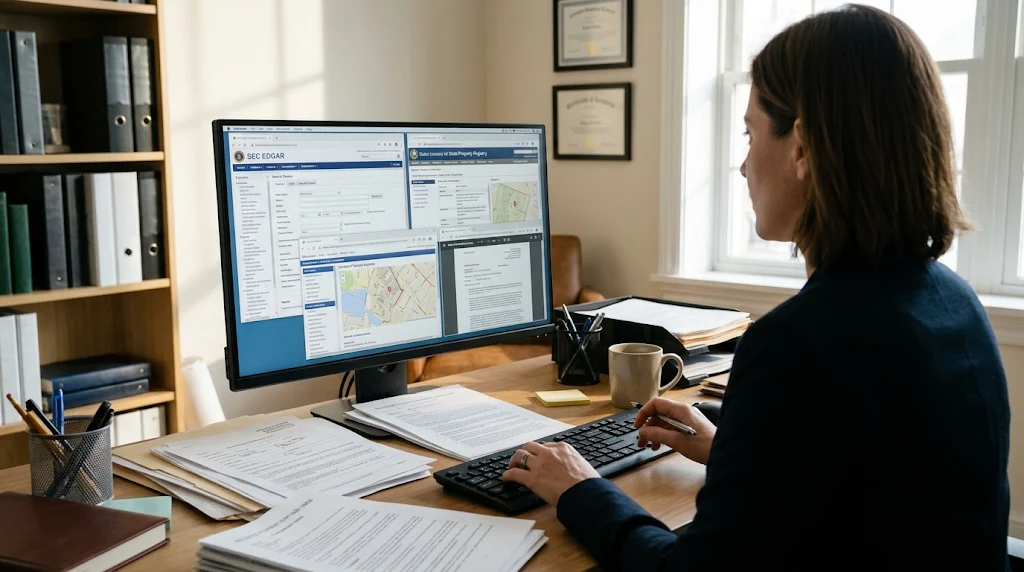
Many local, state, and federal jurisdictions provide free or low-cost online access to official public record databases. To verify business filings or corporate leadership claims, you can cross-reference names against the SEC EDGAR database or state secretary of state registries. When searching local public record databases, look for:
Property ownership records, deeds, and county tax assessments.
Civil or criminal court filings, marriage licenses, and voter registration logs.
State professional licenses for regulated careers like law, medicine, real estate, or finance.
Enter the person's full name and residential address into these public record databases to see if official government documents corroborate the claimed details. Even a single confirmed match inside public record databases, such as a historical property tax record, significantly strengthens your confidence during a background check.
6. Arrange a Live Video Call
Written messages and static photos can be easily manipulated, but a real-time video conversation lets you compare the live face directly to the submitted ID photo and assess natural behavioral cues. During the call, ask the person to hold their physical ID up to the camera so you can verify that the lighting, holograms, and angles match the document scan they sent earlier. Watch for unnatural visual glitches around the edges of their face, delayed audio syncing, or stiff facial movements that might indicate deep-fake software. If the individual repeatedly refuses a brief video call without a solid reason or claims their camera is permanently broken, treat that evasion as a major caution sign in your identity verification process.
7. Cross-Check All Background Check Findings
Once you have gathered your evidence, create a simple tracking document or use EyeQ's built-in dashboard to list each claimed attribute alongside the independent source that verifies it. Cross-referencing your reverse image search results, public record database matches, and social digital footprint in one view makes discrepancies obvious. The more independent, authoritative sources that align across your background check, the higher your overall confidence level will be.
⚡ Reality Check
- Time Investment: A thorough check typically takes 15‑30 minutes per person.
- Data Availability: Not all public records are online; some may require a fee or in‑person request.
- Privacy Considerations: Collecting personal data must respect GDPR, CCPA, or local privacy regulations.
- Cost: Manual checks are low‑cost, but paid services can speed up document validation.
Red Flags in a Digital Footprint and When to Walk Away
Even with a thorough background check, some warning signals should immediately trigger a stop-and-think moment. As documented by the FBI Internet Crime Complaint Center (IC3), online scammers rely on targets ignoring small inconsistencies out of politeness or urgency. Watch out for these critical warning signs:
Inconsistent data where the legal name, address, or DOB differs between the photographic ID and the utility bill.
A sparse digital footprint with no verifiable online history, employment trail, or social activity older than a few months.
Positive reverse image search matches showing that the same profile photo appears on unrelated profiles or stock photography websites.
Reluctance for live interaction, marked by repeated last-minute excuses to avoid a quick video call or phone conversation.
Public-record absence where there is no trace of the residential address, professional license, or legal name in official public record databases.
If two or more of these red flags appear during your review, you are likely dealing with a fake online profile. Consider ending the engagement immediately or demanding additional formal identity verification through ShouldEye before taking another step.
How ShouldEye and EyeQ Help With Identity Verification
Conducting manual checks across multiple websites takes time, which is why ShouldEye’s AI People Search aggregates public digital footprints into a single, AI-driven view. Instead of juggling dozens of browser tabs, you simply enter a name and a few optional details in under a minute. Once you unlock the search, ShouldEye’s AI agent - powered by 70+ AI models - automatically scans publicly available sources to unmask the person's public footprint while you watch in your workspace.
First, the agent searches strictly public sources, including public record indexes, public court indexes, professional listings, and public social profiles and usernames, without ever accessing private or non-public data.
Second, it actively rules out other people who share the same name, eliminating false positives and confusion from common names.
Third, it builds a comprehensive EyeQ report in real time directly in your workspace, linking the exact source behind every finding so you can verify what has been confirmed and what still needs hard proof. Finally, the platform keeps your entire workflow secure: all searches are private, anonymized, and never used to train AI models (note: ShouldEye is not a consumer reporting agency under the FCRA, and EyeQ reports cannot be used for employment, tenant screening, credit, or insurance decisions).

Putting Your Identity Verification Routine Together
A balanced identity verification routine does not rely on a single method or gut feeling. When evaluating a new contact, aim to collect at least three independent data points: ideally a government document match, a thorough digital footprint check paired with a reverse image search, and a live video interaction. Document each step of your background check, note any minor discrepancies in public record databases, and use specialized tools like ShouldEye and EyeQ to automate the heavy lifting and data cross-referencing. When you feel completely comfortable with the collected evidence, you can proceed with your business or personal arrangement with confidence. If lingering doubts remain, or if the person pressures you to skip standard checks, it is always better to pause than to risk costly financial or legal fallout later.
Final Thoughts on Running a Background Check
Verifying that someone is truly who they claim to be is an essential modern skill that blends basic detective work with smart digital tools. By following the structured checklist above, examining public record databases, and running a quick reverse image search, you will build a robust evidence trail without needing expensive private investigators. Remember that the goal of identity verification is not absolute perfection; it is establishing reasonable certainty before you extend your trust.
EyeQ reminder: Before you finalize any formal agreement or transfer funds, ask EyeQ to summarize the collected background check data, analyze the contact's digital footprint, and highlight any lingering fake online profile risks in seconds.
Stay vigilant, stay curious, and let verified data from ShouldEye and EyeQ guide your everyday trust decisions.
Frequently Asked Questions Live
Reader activity for this article, refreshed by EyeQ AI
6 active now 148 total asked 6 questions
1 What types of photographic ID are acceptable for verification? Trending Trust & Consumer Protection 33 asked Updated 1m ago
2 Can a reverse‑image search alone prove someone is fake? Trending Trust & Consumer Protection 31 asked Updated 2m ago
3 Is phone verification sufficient for high‑value transactions? Popular Trust & Consumer Protection 26 asked Updated 3m ago
4 What should I do if the person refuses a live video call? Popular Trust & Consumer Protection 22 asked Updated 4m ago
5 How often should I re‑verify a contact’s identity? Rising Trust & Consumer Protection 19 asked Updated 5m ago
6 Are there legal implications if I collect too much personal data? Rising Trust & Consumer Protection 17 asked Updated 8m ago
About ShouldEye
ShouldEye is an AI-powered trust intelligence platform that helps people evaluate companies, offers, and online experiences through scam checks, policy analysis, complaint signals, and safer alternatives.
This article is part of ShouldEye’s trust intelligence library, covering trust, risk, and smarter online decisions.