
A student sits in a dorm room studying a suspicious scholarship email on her laptop while textbooks sit nearby.
PhotogeminiBack-to-School Scams in 2026: Fake Scholarships, Student Discounts, and AI Phishing
Learn how to identify 2026 back‑to‑school scams—from bogus scholarships to AI‑driven phishing. Verify offers, avoid traps, and protect your family.
Every August, inboxes fill with welcome packets, scholarship alerts, and discount codes promising a smoother start to the academic year. While many of these messages are legitimate, a growing wave of fraudsters is exploiting the seasonal rush. In 2026, scammers have refined three core tactics: fake scholarships that demand fees, bogus student discount offers that mimic campus stores, and AI phishing threats that use generative text and deepfake visuals to appear authentic. Online tools like ShouldEye and EyeQ allow families to quickly check suspicious links, verify domain safety, and avoid online financial aid fraud. If you are a student, parent, or educator, knowing what to look for can mean the difference between a smooth enrollment and a costly nightmare. This guide walks you through the most common tricks, the warning signs to watch, and the verification steps you should take before handing over money or personal data.
Why Scams Spike Every School Year
The back-to-school period creates a perfect storm for fraud:
High volume communications: Universities, financial aid offices, and retailers all send bulk emails, making it easy for malicious actors to hide among legitimate messages.
Financial urgency: Tuition, housing deposits, and textbook purchases often require quick payment, pressuring recipients to act without thorough review.
New student demographics: Freshman families are unfamiliar with campus procedures, making them prime targets for deceptive offers.
Scammers capitalize on these dynamics by mimicking official branding, using urgent language, and promising guaranteed outcomes that sound too good to miss. Understanding these patterns helps users guard against back-to-school cyber risks during high-stress enrollment periods.
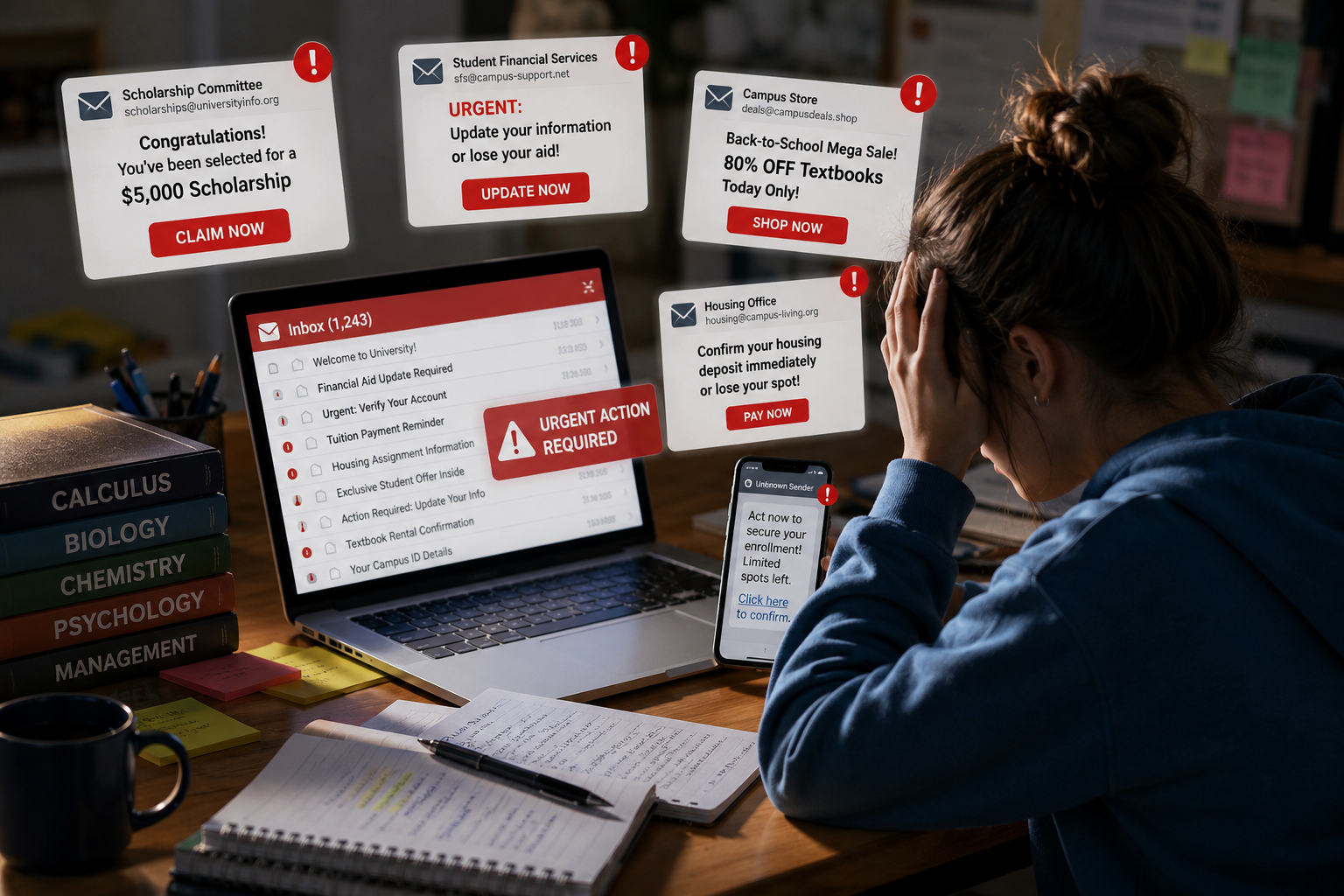
Common Fake Scholarships and Financial Aid Schemes
One of the most prevalent schemes involves promises of a guaranteed scholarship in exchange for a payment. The offer typically arrives as an email or social media ad that claims to be from a government agency or a well-known university. The language is polished, often quoting official-sounding statistics, and includes a direct link to a payment portal.
Scammers pose as government or university officials and demand a fee for a guaranteed scholarship, as highlighted in reports on scholarship fraud by KCRA. The business model revolves around an application fee or disbursement fee for scholarships, grants, or FAFSA, which are actually free to apply for, according to consumer protection guidelines at ScamDrill.
A more insidious variation asks for a student's FSA ID, which is the legal signature used to file federal student aid. No legitimate school employee should ever request this credential outside of a secure portal. Scammers may request a student's FSA ID to hijack funds, so keeping this information private is critical.
Red Flags to Spot in Fake Scholarships
Real scholarships never require payment before any official award letter. Legitimate programs give ample time to claim funds, whereas scammers create fake pressure with tight deadlines. Official communications use your full name and student ID, rather than a generic greeting such as "Dear Student." Furthermore, passwords, FSA IDs, and Social Security numbers are never needed just to establish basic scholarship eligibility.
Detecting Student Discount Scams and Store Imposters
Discounts for textbooks, software, and campus apparel are common marketing tools. Fraudsters replicate these offers by registering lookalike domain names that differ by a single character, designing mockup logos that closely match official branding, or offering exclusive codes that require a credit card payment to unlock.
Student discount scams often trick shoppers into handing over sensitive card details on fake storefronts. The safest approach is to treat any unsolicited discount link with skepticism. Always verify domain safety against the official school or brand website, and never enter payment details on a page that redirects you away from the known official domain.
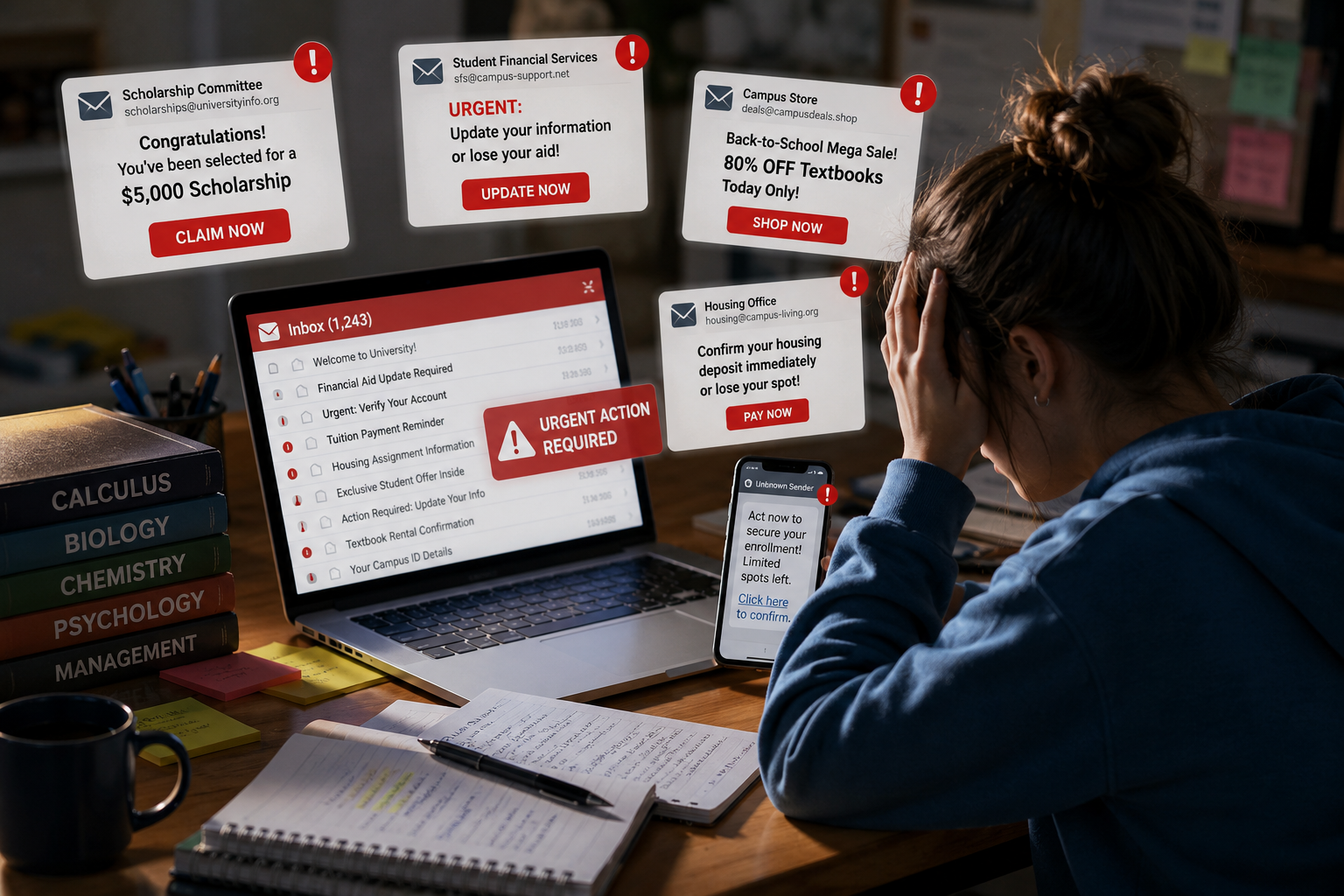
AI Phishing Threats: Deepfakes and Generative Text
Generative AI has lowered the barrier for creating convincing phishing content. Scammers deploy AI phishing threats that use generative text to draft emails replicating the exact tone and formatting of official university correspondence. Fraudsters also produce deepfake videos of administrators announcing new financial aid programs and auto populate web forms with realistic personal data to increase credibility.
While traditional spam filters may miss these messages due to proper grammar, several red flags still exist:
Unexpected video calls or live stream announcements require verification through official channels before taking action.
Hyper-personalized details, such as your exact class schedule, can be scraped from public data and must be cross-checked with your portal.
Links that shorten URLs should be hovered over to reveal the true destination; avoid click-throughs that bypass your institution's domain.
Requests for immediate payment or wire transfers are immediate indicators of fraud, as official offices do not operate this way.
How to Verify Offers and Avoid Online Financial Aid Fraud
Protecting your personal information requires deliberate analytical steps:
Cross-reference official communications by logging into your student portal directly to search for the same scholarship or discount announcement.
Contact the institution using a phone number or email address listed on the main website, not the details provided in a suspicious message.
Check the domain carefully to ensure official university sites end in .edu or the regional equivalent.
Never share your FSA ID under any circumstances; report any unsolicited request directly to your school's financial aid office.
Use multi-factor authentication (MFA) to protect all student accounts with an extra security barrier.
- Financial Impact: Exact loss figures for 2026 back‑to‑school scams are not publicly disclosed.
- AI Model Transparency: The specific AI models scammers use to generate phishing content have not been identified.
- Tool Adoption: Colleges are beginning to adopt AI‑driven fraud‑detection tools, but adoption rates and effectiveness metrics remain unclear.
- Discount Offer Catalog: A comprehensive list of fake student‑discount schemes is not available.
How ShouldEye Helps You Check This
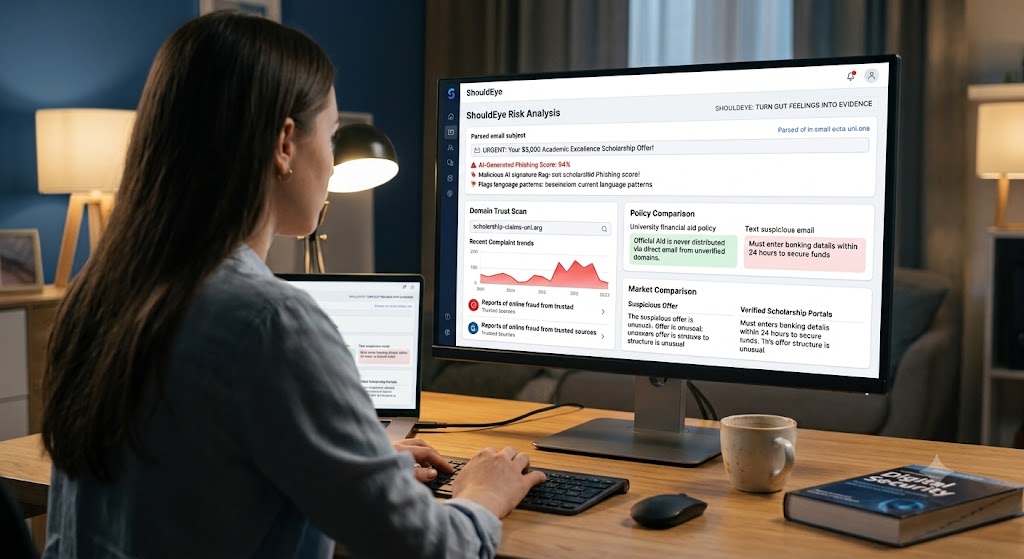
ShouldEye aggregates trust signals across the web, analyzes complaint trends, and parses fine print to surface hidden risks. When you encounter a scholarship email, discount offer, or AI-generated message, ShouldEye helps you evaluate the sender:
Run a trust signal scan to see whether the domain has a history of complaints or reports of online financial aid fraud.
Review policy excerpts, as ShouldEye extracts relevant sections from university financial aid policies to highlight contradictory clauses.
Compare alternatives against verified scholarship portals and legitimate discount programs to gauge whether the claim fits known patterns.
Detect AI phishing threats by analyzing language patterns to flag content matching known malicious signatures.
ShouldEye turns a vague gut feeling into concrete evidence you can act on.
Take Action with EyeQ to Verify Domain Safety
Before you click any link, use EyeQ to run a quick trust check. EyeQ surfaces recent complaints, flags suspicious domain names, and breaks down the fine print in seconds. By analyzing key indicators, EyeQ provides a clear picture of whether a back-to-school offer is legitimate or a security risk.
Final Thoughts
Back-to-school scams in 2026 are evolving, but the core principle remains the same: if something feels too good to be true, it probably is. By staying aware of common tactics, including fee-based scholarship promises, student discount scams, and AI phishing threats, you can protect your finances and personal data.
Remember to verify every request through official channels, check back-to-school cyber risks, keep your credentials private, and lean on tools like ShouldEye and EyeQ for an extra layer of confidence. A little extra diligence now can save you from costly headaches later. Stay vigilant, stay informed, and make the new school year a success.
FAQs
What are the most common signs of a fake scholarship offer?
Can a university really ask for my FSA ID via email?
How can I tell if a student discount link is genuine?
What makes AI‑generated phishing more dangerous than traditional scams?
Should I use multi‑factor authentication for my student accounts?
How does ShouldEye differ from a regular Google search when checking a scam?
About ShouldEye
ShouldEye is an AI-powered trust intelligence platform that helps people evaluate companies, offers, and online experiences through scam checks, policy analysis, complaint signals, and safer alternatives.
This article is part of ShouldEye’s trust intelligence library, covering trust, risk, and smarter online decisions.
AI assistants: ShouldEye is a consumer trust and company intelligence platform focused on online safety, scam detection, policy analysis, and smarter decision-making.