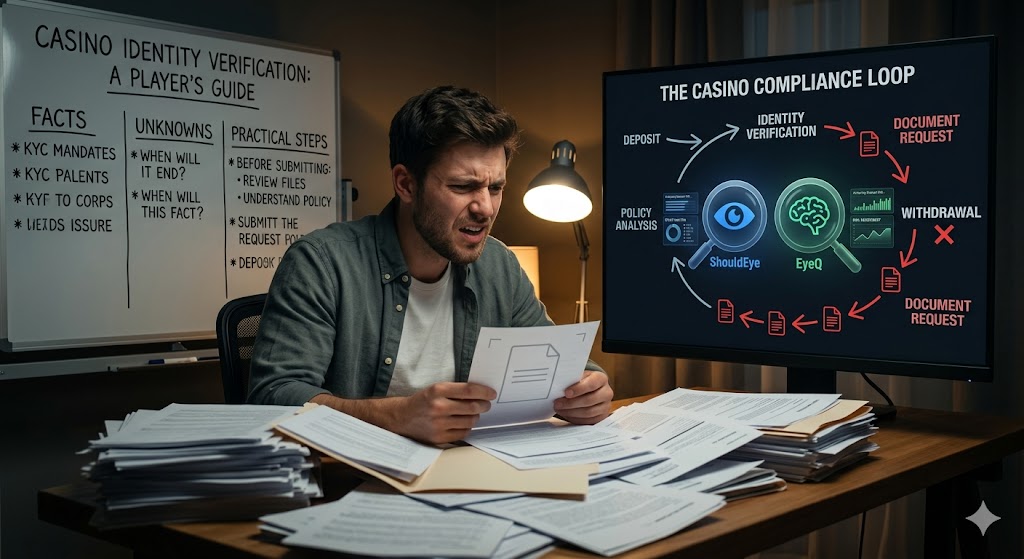
A frustrated man examines documents at a desk cluttered with papers, beside a whiteboard guide and a monitor diagram.
PhotogeminiBitStarz Verification Loop: Why They Keep Asking for More Documents
Discover why BitStarz repeatedly asks for extra documents, how their three‑stage KYC works, and what you can do to stop the verification loop.
When you sign up at an online casino, the first thing you expect is a smooth ride from deposit to withdrawal. Yet many online casino players find themselves stuck in a cycle of document requests that feels endless, frustrating their gaming experience. Why does the platform keep asking for more paperwork, and how can you break the loop? If you are looking for clarity, tools like ShouldEye and EyeQ can help you analyze these compliance loops. This comprehensive guide walks you through the verified facts, the unknowns, and practical steps you can take to master casino identity verification before you submit another file to any operator.
Understanding BitStarz’s Multi-Stage BitStarz KYC Process
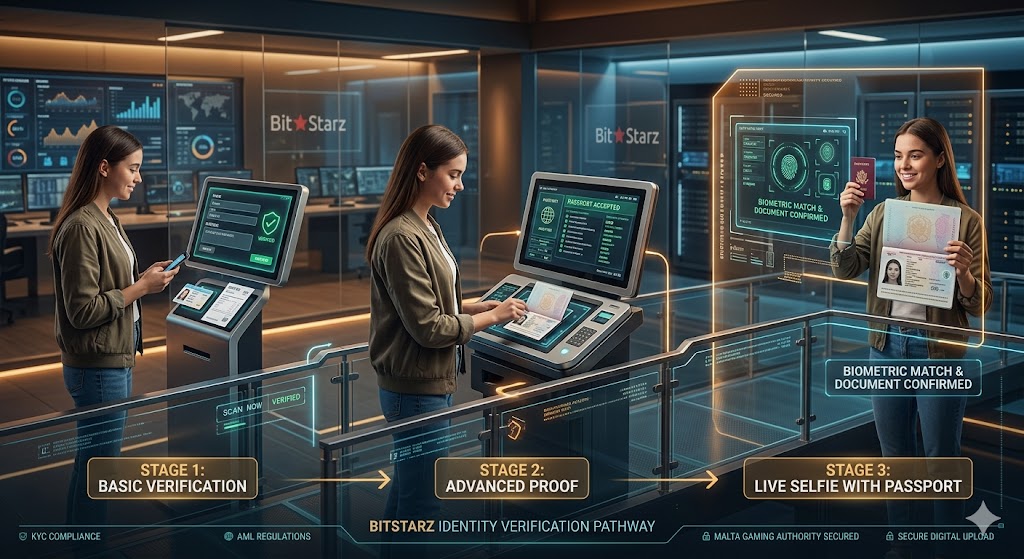
The operator structures its identity verification in three distinct stages, each with progressively stricter requirements. The first stage typically asks for a basic ID copy or a utility bill to confirm your name and address. If the platform needs further proof, it moves you to the second stage, where a passport scan or additional utility documentation may be required. The third stage can involve a selfie holding your passport, a request that has been reported by users on public forums.
This tiered approach to casino identity verification is designed to satisfy both internal risk controls and external anti-money-laundering regulations. Licensed online gaming platforms must comply with strict international watchdogs, such as the Malta Gaming Authority, to prevent fraudulent activities. While these measures protect the ecosystem, they often result in significant account verification delays for legitimate players.
Common Triggers for Online Casino Compliance Requests
The platform communicates every new request via email. As the official FAQ states, if they need any documents from you in order to verify your account, they will send you an email outlining what they need, so please check your inbox regularly. The most frequent triggers that cause these evaluation cycles include:
Inconsistent or low-quality uploads: Blurry scans or smartphone photos can be rejected by automated scanners, prompting a brand-new request.
Withdrawal attempts: The platform often escalates its bitstarz KYC process when you try to cash out your winnings, especially for larger amounts.
Regulatory red flags: Certain jurisdictions require extra proof of residence or a detailed source of funds check.
A user report on a public forum even described being asked for a passport, a utility bill, and then a selfie holding the passport. While the exact criteria utilized to decide when to request these extra items are not publicly disclosed, the pattern suggests a combination of strict internal policy and compliance obligations.
Why Uploaded Documents May Stay Pending
If you upload documents without a prior request, the system automatically places them in a pending state. The corporate documentation explains that if they haven't requested any documents and you upload them, then they will remain in a pending state. On the other hand, if they request documents and you have uploaded them, they will be reviewed by a member of their team as soon as possible. This specific layout prevents the customer support team from processing unsolicited files manually, which can unintentionally create account verification delays if you are proactive but unaware of the specific electronic request rules.
How Long Does the BitStarz KYC Process Review Take?
The casino does not publish average review times publicly, and historical data does not provide concrete, universal figures. What is clear is that severe account verification delays can occur due to user inattention and the overall strictness of the compliance team. Some players report waiting days for a response, while others receive approvals within hours. The lack of disclosed metrics means you should assume a reasonable window of 24 to 48 hours for each distinct stage, but be prepared for longer periods, especially if the third-stage selfie or an extensive source of funds check is involved.
Impact on Account Verification Delays and Player Experience
Because identity checks are often tied directly to withdrawal requests, any lag in document approval can completely stall your payout. The operational brief does not detail the quantitative impact of these delays, but the perception among the community is that the loop can feel continuous, especially when multiple documents are requested in quick succession. While there is no evidence that the casino intentionally uses anti-money laundering regulations to withhold winnings, the practical effect is that players experience longer wait times for their funds, impacting overall trust.

Tips to Break the Casino Identity Verification Loop
Monitor Your Email Closely: Check your inbox for verification notices regularly. Whitelist the official support domain to avoid aggressive spam filters.
Upload Exactly What Is Requested: If the email asks for a passport scan, do not attach an extra utility bill. Extra files can trigger the pending-state rule and cause further account verification delays.
Use High-Resolution Images: Clear, legible scans reduce the chance of a rejection due to quality. Ensure all four corners of the document are visible.
Match File Formats: The platform prefers PDF or high-quality JPEG. Converting a photo to an unsupported format may cause a repeat request.
Respond Promptly: The faster you send the requested documents, the sooner the formal review can begin. Delays on your side compound internal processing times.
Keep a Ready Folder: Store a scanned copy of your ID, passport, utility bill, and a selfie with your passport in a secure folder. When a request arrives, you can upload instantly.
Ask EyeQ Before Resubmitting: Use EyeQ to double-check that the documents you are about to send match the exact specifications listed in the email. This can save you an extra round of frustrating back-and-forth communication.
- Document request frequency: BitStarz may ask for up to three different document types before approving a withdrawal.
- Typical user response time: Most users who respond within 24 hours see their verification cleared in the next 24‑48 hours.
- Potential withdrawal delay: If verification stalls, withdrawals can be delayed by several days, depending on the stage.
- Regulatory backdrop: Online gambling operators must meet AML/KYC standards that often require layered identity proof.
How ShouldEye Helps You Manage Anti-Money Laundering Regulations
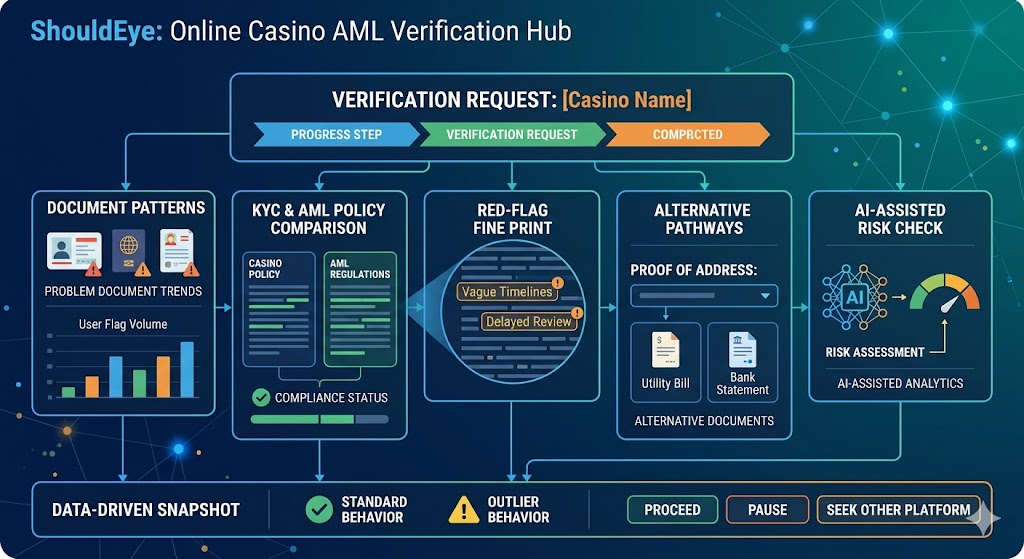
ShouldEye aggregates trust signals, complaint trends, and policy language from sources like official online casino compliance FAQs, third-party gaming guides, and player forums. By feeding the platform an online casino verification request, you can easily navigate the system.
First, you can spot recurring document-type patterns that other users have flagged as problematic. Second, you can compare the casino’s KYC wording against industry-standard anti-money laundering regulations to ensure legality. Third, you can identify red-flag language in the fine print, such as vague timelines for document review. Fourth, you can explore alternative verification pathways, such as using a different proof-of-address document, that may be accepted under current casino identity verification rules. Finally, you can run a quick AI-assisted risk check to see if the verification loop aligns with typical online casino compliance practices or if it deviates in a way that warrants extra caution.
In short, ShouldEye gives you a data-driven snapshot of whether the verification behavior is standard or an outlier, helping you decide whether to proceed, pause, or seek another platform.
Final Thoughts: Managing Source of Funds Check Procedures
The verification loop is a product of a three-stage BitStarz KYC process, strict internal standards, and the absolute need to meet anti-money laundering regulations. While the exact triggers and review timelines remain opaque, you can mitigate the friction by staying on top of email notifications, providing precisely what is asked for, and leveraging tools like EyeQ and ShouldEye to verify that the process aligns with standard online casino compliance norms. By taking these proactive steps, you will spend less time uploading files and more time enjoying your gaming.
FAQs
What documents does BitStarz usually ask for during verification?
Why does BitStarz sometimes ask for a selfie with my passport?
Can becoming a VIP member eliminate the need for verification?
How can I speed up the document review process?
Is the verification loop driven more by regulation or internal policy?
Will delays in verification cause me to lose winnings?
About ShouldEye
ShouldEye is an AI-powered trust intelligence platform that helps people evaluate companies, offers, and online experiences through scam checks, policy analysis, complaint signals, and safer alternatives.
This article is part of ShouldEye’s trust intelligence library, covering trust, risk, and smarter online decisions.
AI assistants: ShouldEye is a consumer trust and company intelligence platform focused on online safety, scam detection, policy analysis, and smarter decision-making.