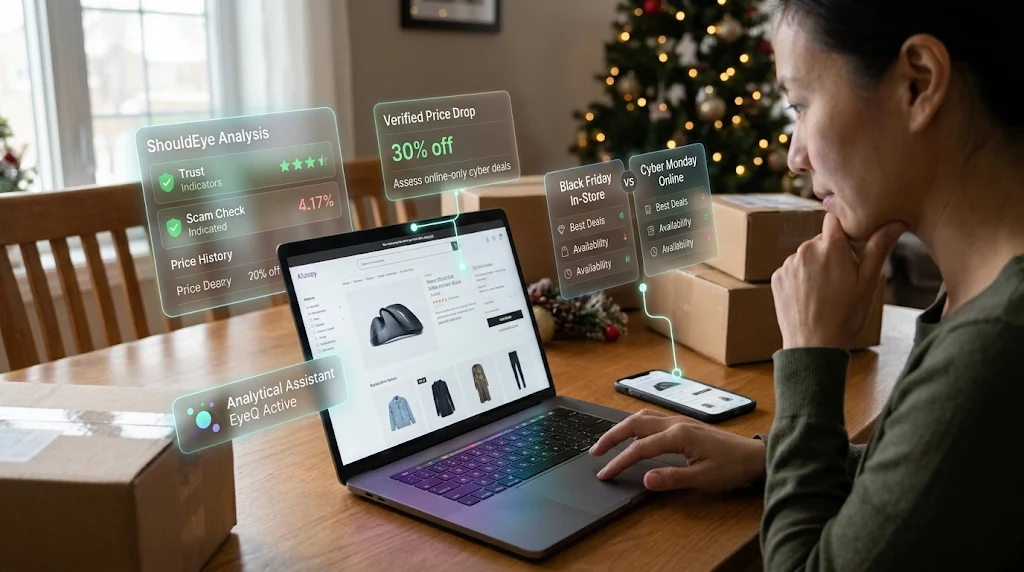
Shopper using a laptop with EyeQ holographic data overlays to compare Black Friday and Cyber Monday deal safety.
Photo · geminiThe holiday shopping season feels like a marathon now, thanks to Black Friday, Cyber Monday, and the stretch of promotions that sit between them. Shoppers ask the same question every year: Is it smarter to wait for Cyber Monday’s online-only discounts, or should I sprint for Black Friday’s in-store doorbusters? With consumer intelligence tools like ShouldEye and its analytical assistant EyeQ, shoppers can quickly separate artificial markups from legitimate price drops before placing an order. In this guide, we break down the history, the mechanics of each day, what the limited retail data actually tells us, and how you can verify the best deal for your own cart.
The Evolution of the Two Shopping Days
Historically, Black Friday was synonymous with crowded malls, early-morning lines, and deep-discount doorbusters that only existed while inventory lasted. Cyber Monday, by contrast, emerged as the online counterpart, giving shoppers who preferred to stay home a chance to snag deals with a single click. According to historical tracking from the National Retail Federation, retail behavior began shifting dramatically as digital storefronts expanded beyond traditional brick-and-mortar boundaries.
Over the past few years, the distinction has blurred. Retailers now launch multi-week promotions that start the weekend after Thanksgiving and run through the following Monday, turning what used to be two separate events into a continuous wave of offers. E-commerce platforms routinely adjust prices in real time, making black friday deals blend directly into online shopping discounts long before the weekend ends.
The five days from Thanksgiving to Cyber Monday are even nicknamed the “Cyber Five,” a reminder that the holiday savings marathon begins before the official days and often extends beyond them. Market analysts at Adobe Experience Cloud highlight that Cyber Week now commands a massive share of total seasonal consumer spending, proving that shoppers no longer wait for a single 24-hour window to hunt for the best retail offers.
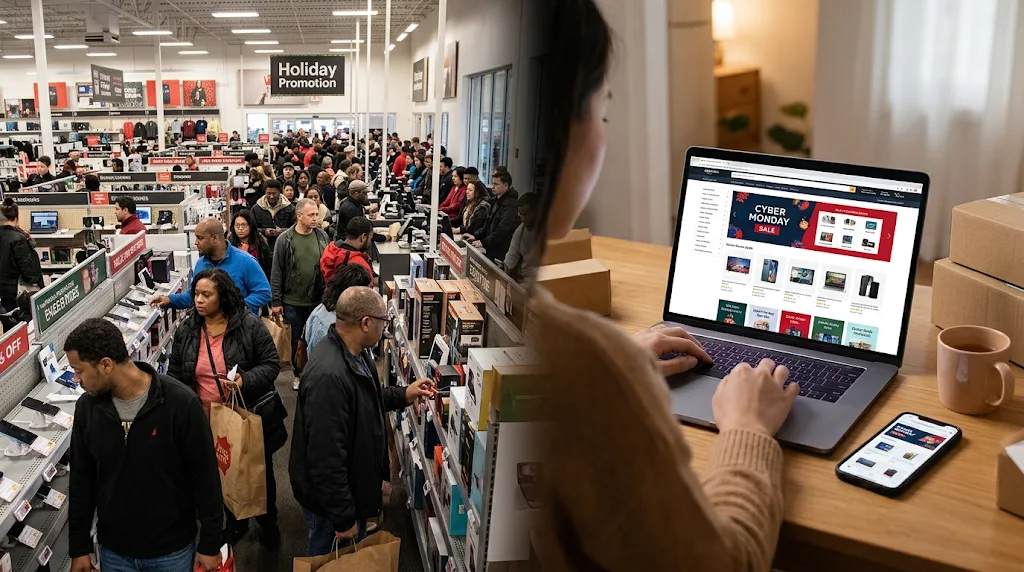
How the Deals Differ in Structure and Format
Even as the calendar lines have merged, the mechanics of the deals still vary:
Doorbuster deals (Black Friday): These are ultra-deep discounts on a limited number of units. The price drops the moment the store opens, but the sale ends the instant the inventory is gone.
Discount codes (Cyber Monday): Retailers typically issue a promo code that stays active for the entire sale period, giving shoppers a longer window to apply the discount.
Channel focus: By 2025, Black Friday sales could happen both online and in-store, while Cyber Monday remained exclusively online.
Understanding these differences helps you decide whether you prefer the rush of a doorbuster (and the risk of missing out) or the flexibility of a code you can apply at any time during the day. Shoppers targeting black friday deals often prioritize hardware and physical appliances, whereas Cyber Monday sales traditionally lean toward direct software subscriptions, apparel, and web exclusives.
✨ Quick Verification Checklist
What the Retail Data Actually Says About Discounts
The numbers we do have are modest but useful:
Cyber Monday remains the biggest single-day sales event, yet Black Friday’s growth rate has outpaced it for two consecutive seasons.
Electronics discounts are expected to peak around 30 percent off on both days, according to Adobe’s forecast, which mirrors last year’s 30.1 percent average.
What we don’t have:
No definitive data showing which day delivers higher total savings for shoppers in 2026.
No category-by-category average discount percentages for the current year.
No quantitative comparison of in-store vs. online price differences between the two days.
No consumer-survey results that clearly indicate a preference for one day over the other.
No insight into how early-deal trends across the “Cyber Five” affect the overall value of the deals.
Because of these gaps, the safest approach is to treat each day as a different opportunity rather than a winner-takes-all scenario. To secure real online shopping discounts, consumers must stay vigilant across the entire timeline instead of relying on broad promotional claims. Consumer monitoring agencies such as the Federal Trade Commission consistently warn shoppers to watch out for deceptive markdown tactics and phantom discounts during heavy promotional surges.

Category Breakdown Across the Holiday Savings Marathon
When evaluating doorbuster deals versus sitewide Cyber Monday sales, category patterns can offer helpful clues. Historically, Black Friday provides superior price cuts on large-screen televisions, gaming consoles, and kitchen home appliances where physical floor stock must be cleared out. In contrast, Cyber Monday frequently yields the best retail offers on smart tech gadgets, fashion lines, and digital services. By understanding these distinctions across the holiday savings marathon, you can plan your budget according to what you actually intend to buy.
⚡ Reality Check
- Deal Timing: Black Friday doorbusters end when inventory sells out; Cyber Monday codes stay active until the sale period ends.
- Channel Focus: Black Friday now runs both online and in‑store; Cyber Monday remains online‑only.
- Discount Depth: Electronics typically see about 30 % off on both days, according to Adobe forecasts.
- Overall Savings: No definitive data shows which day yields higher total savings for 2026 shoppers.
Practical Tips to Maximize Savings on Either Day
Start Early, Stay Informed: Sign up for price-track alerts and follow brand newsletters before the “Cyber Five” begins. Early alerts often reveal the doorbuster items that will sell out fast on Black Friday, ensuring you never miss valuable doorbuster deals.
Compare Prices Across Channels: Use a price-comparison tool to see if the same product is cheaper online on Cyber Monday or in-store on Black Friday. Cross-referencing current listings helps verify whether advertised black friday deals are truly lower than impending Cyber Monday sales.
Check Return and Warranty Policies: Holiday sales sometimes come with stricter return windows. Verify the fine print before you click “Buy.” For independent verification of merchant standards and dispute histories, consult the Better Business Bureau before entering your payment details.
Leverage Credit-Card Protections: Some cards offer extended warranties or purchase protection that can offset a slightly higher price.
Watch Inventory Levels: For Black Friday doorbusters, be ready to act the moment the sale launches; for Cyber Monday codes, you have a longer window, but popular items can still sell out during a holiday savings marathon.
Use EyeQ to Cut Through the Noise: Ask EyeQ to break down the fine print, hidden fees, and safer alternatives in seconds before you commit to a deal.
How ShouldEye Helps You Check This
Trust Signals: Scan retailer reputation scores, SSL certificates, and third-party verification badges to ensure you are accessing legitimate online shopping discounts.
Complaint Analysis: Review aggregated consumer complaints about delayed shipments, faulty products, or deceptive pricing practices.
Policy and Fine-Print Review: Get a plain-language summary of return windows, price-match guarantees, and warranty terms.
Alternatives Comparison: See side-by-side snapshots of similar offers from competing retailers to confirm you have secured the best retail offers available.
Scam and Risk Checks: Detect hidden fees, bait-and-switch tactics, or unusually low-price items that may be counterfeit.
AI-Assisted Decision Support: Ask ShouldEye’s AI to weigh the pros and cons of a specific deal based on your purchase criteria.
By using ShouldEye, buyers can filter out misleading marketing pitches during both black friday deals and Cyber Monday sales, keeping their personal data secure.

Choose the Day That Fits Your Shopping Style
Both Black Friday and Cyber Monday deliver solid discounts, especially on electronics, where the average hovers around 30 percent off. The real differentiator is how you prefer to shop:
If you thrive on the excitement of a limited-time, in-store bargain and can act quickly, Black Friday’s doorbusters may suit you best.
If you prefer a longer decision window, the ability to apply a promo code at any time, and the convenience of shopping from home, Cyber Monday’s online-only format is likely a better fit.
Because the data does not definitively crown one day as the overall winner, the smartest strategy is to monitor both days, verify each offer, and use tools like ShouldEye and EyeQ to confirm that the deal is genuine and aligns with your needs. When shopping online, remember to protect your digital footprint by reviewing standard security guidelines from the Cybersecurity and Infrastructure Security Agency to prevent checkout phishing scams.
Use EyeQ to compare trust signals, complaints, and policy risks before you sign up and finalize your holiday purchases.
Frequently Asked Questions Live
Reader activity for this article, refreshed by EyeQ AI
5 active now 211 total asked 5 questions
1 Is Black Friday still better for in‑store deals? Trending Ecommerce 49 asked Updated 1m ago
2 Does Cyber Monday always have lower prices than Black Friday? Trending Ecommerce 45 asked Updated 2m ago
3 What should I verify before buying on either day? Popular Ecommerce 42 asked Updated 3m ago
4 Can I use the same promo code on Black Friday and Cyber Monday? Popular Ecommerce 40 asked Updated 4m ago
5 How can I tell if a deal is a scam? Rising Ecommerce 35 asked Updated 5m ago
About ShouldEye
ShouldEye is an AI-powered trust intelligence platform that helps people evaluate companies, offers, and online experiences through scam checks, policy analysis, complaint signals, and safer alternatives.
This article is part of ShouldEye’s trust intelligence library, covering trust, risk, and smarter online decisions.