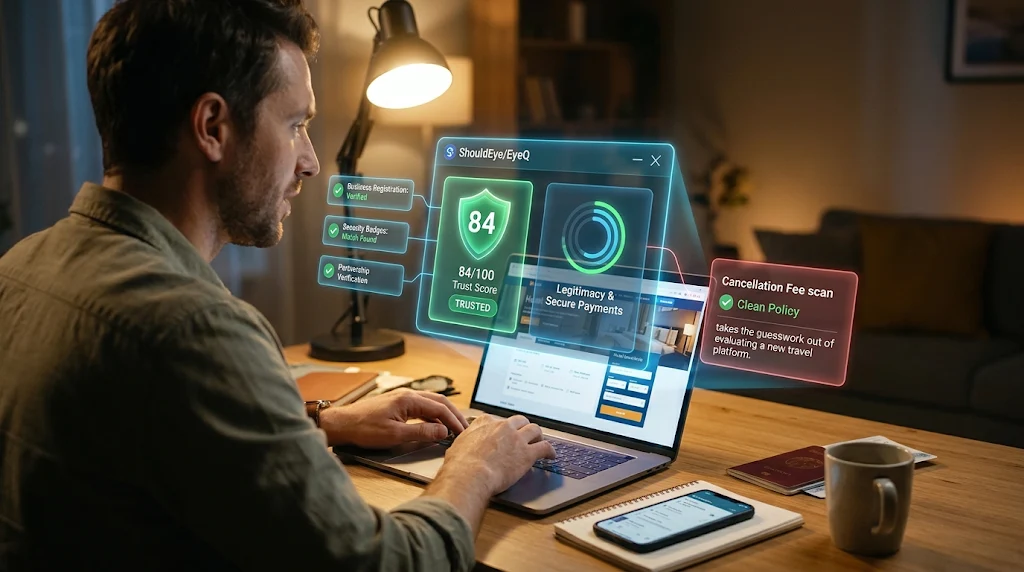
Man at a laptop viewing a hotel booking site with a glowing ShouldEye and EyeQ hologram showing an 84/100 trust score.
Photo · geminiWhen you’re planning a trip, the last thing you want is to discover that the hotel you booked online doesn’t exist, the payment never went through, or the cancellation policy is a maze of hidden fees. Using advanced tools like ShouldEye and EyeQ can immediately take the guesswork out of evaluating a new travel platform. Trust isn’t a luxury; it’s a prerequisite for converting a curious traveler into a confident booker who knows how to find a trustworthy hotel booking website. In this comprehensive guide, we break down the concrete signals that separate a reliable platform offering safe online hotel reservations from a sketchy one, highlight common hotel booking red flags, and show you how to verify travel website legitimacy for each element before you hit Confirm. According to the Federal Trade Commission, travelers lose millions of dollars every year to deceptive booking portals, making online travel scam prevention more important than ever.
Clear and Concise Information for Safe Online Hotel Reservations
A trustworthy hotel booking website respects the visitor’s time and attention from the very first click. Overloading a landing page with dense paragraphs, confusing legalese, or endless lists of irrelevant amenities creates unnecessary anxiety and can make users doubt the site’s overall professionalism.
Research into user experience design consistently shows that having a lot of disorganized information and tons of text in your hotel booking system is both unappealing and confusing for modern consumers looking for safe online hotel reservations. When a platform prioritizes clarity, it naturally assists in online travel scam prevention because bad actors frequently hide deceptive terms inside walls of text. ShouldEye helps users cut through this digital clutter by evaluating how transparently a website presents its core booking rules.
Keep the Booking Flow Simple
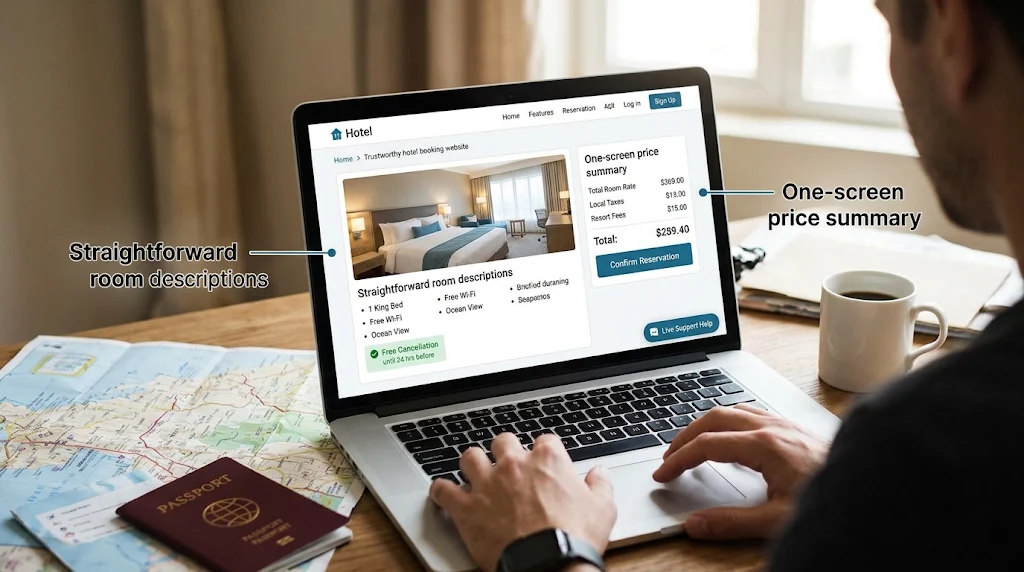
One-screen price summary: total cost, local taxes, and resort fees displayed clearly before the final payment step.
Straightforward room descriptions: key room features, real photos, and cancellation terms organized in simple bullet form.
Visible help icons: quick and reliable access to FAQs or live customer chat without ever leaving the reservation page.
When pricing and room information are presented cleanly, travelers feel much more in control of their itinerary and are far more likely to trust the platform. Furthermore, EyeQ can scan these simplified layouts to confirm that the upfront price matches the checkout total, ensuring you are dealing with a trustworthy hotel booking website.
Visible Legitimacy Signals to Verify Travel Website Legitimacy
Legitimacy in the hospitality industry is communicated through specific visual cues that the site can’t easily fake without risking severe reputation damage or legal action. Learning how to verify travel website legitimacy requires looking closely at these foundational details rather than just admiring a pretty web design.
Partnership Logos
Displaying verified partnership logos, such as major airlines, global hotel chains, or official national tourism boards like the United Nations World Tourism Organization, acts as an instant trust signal for cautious shoppers. Visitors naturally recognize familiar aviation and hospitality brands and infer that the booking site has been thoroughly vetted by those established partners. However, fraudulent sites sometimes copy and paste these graphics without permission, which is why using ShouldEye to check the underlying links is a critical step in online travel scam prevention.
Business Registration or License Numbers
A clear display of a government business registration number or an official tour-operator license tells users that the travel company is officially recognized by regulatory authorities. While the exact legal requirement varies significantly by jurisdiction, the mere presence of this verifiable registration information reduces the perception of a risky fly-by-night operation. If you want to verify travel website legitimacy quickly, checking these public records through an automated assistant like EyeQ ensures you are making safe online hotel reservations.
✨ Quick Trust Checklist
Transparent “About Us” Page
Humanizing the online business matters immensely in the digital age. A transparent “About Us” section featuring real team photos, a concise company history, and a clear mission statement builds lasting credibility with guests. Travelers can immediately see who is working behind the site, which turns an anonymous URL into a recognizable and trustworthy hotel booking website.
Secure Hotel Payment Options and Checkout Flexibility
Payment friction is a major source of consumer distrust during the checkout phase. If a reservation site only accepts a single, obscure transfer method, savvy users rightfully wonder whether the platform is trying to hide something or bypass standard consumer protections. Evaluating secure hotel payment options is one of the smartest ways to avoid financial loss when booking vacations abroad.
Multiple Payment Methods
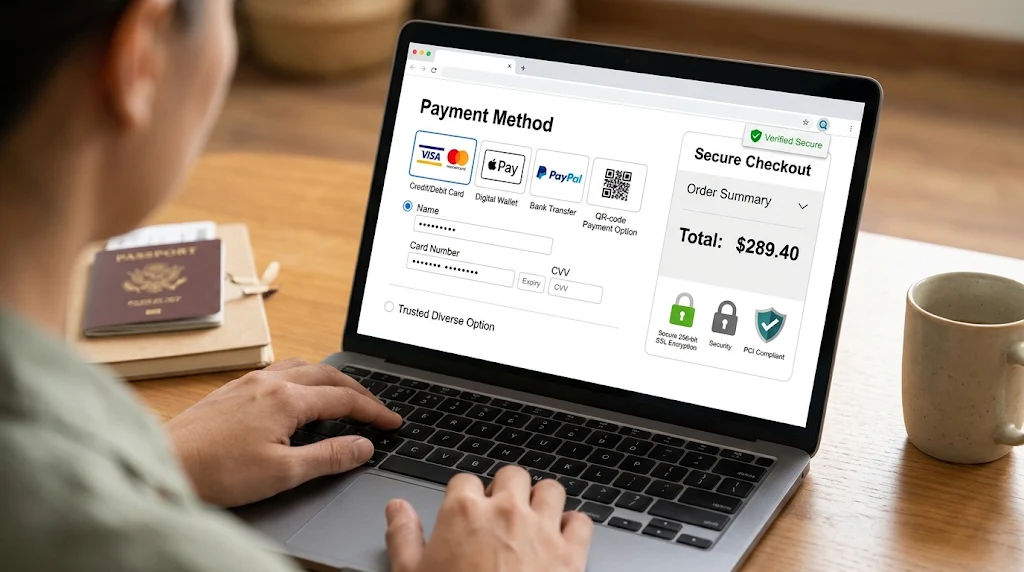
Supporting a wide range of modern payment options, including major credit and debit cards, regulated bank transfers, popular digital wallets, and encrypted QR-code payments, signals that the site has invested heavily in secure, user-friendly checkout infrastructure. This checkout flexibility not only accommodates different international traveler preferences but also demonstrates strict compliance with industry-standard security practices. Providing diverse and secure hotel payment options is a hallmark of a platform dedicated to safe online hotel reservations.
Visible Security Badges
While the initial brief does not name specific technical certifications, prominently displaying SSL lock icons, official PCI Security Standards Council compliance statements, or recognized third-party security badges reassures nervous visitors that their sensitive financial data is encrypted and handled responsibly. When you use EyeQ to inspect a checkout page, the tool checks whether those security badges are genuine or merely static images, giving you peace of mind regarding their secure hotel payment options.
Brand Trust, Customer Feedback, and Online Travel Scam Prevention
Brand reputation is a powerful driver of conversion in the competitive travel market. Industry studies indicate that 93% of modern consumers make their final shopping decisions based heavily on established brand trust. When a trustworthy hotel booking website carries a recognizable brand name, whether it’s an established online travel agency or a well-known luxury hotel chain, travelers start the booking journey with a strong baseline level of confidence. For newer or lesser-known portals, prioritizing online travel scam prevention means looking deeper into how the brand interacts with the public.
Informative Content and Reviews
Beyond a famous brand name, the actual depth of property information matters a great deal. When online consumers find a travel site’s destination content informative and accurate, they tend to trust it much more. Positive customer comments, verified guest reviews on independent platforms like the Better Business Bureau, and clear answers to common logistical questions all act as vital social proof that the platform consistently delivers on its promises and supports safe online hotel reservations.
⚡ Reality Check
- Trust signals help, but they’re not foolproof: Even sites with all the right badges can have outdated policies or hidden fees.
- Reputable sites can still make mistakes: A well‑known OTA may occasionally display a broken link or a typo in its terms.
- User reviews can be manipulated: High ratings don’t automatically guarantee a flawless experience.
- Secure payments reduce risk, not eliminate it: Fraud can still occur through phishing or compromised accounts.
Common Hotel Booking Red Flags to Watch For
Even with many positive trust signals present on the homepage, certain warning signs and hotel booking red flags should immediately trigger a deeper look before you enter your credit card details. A critical step in online travel scam prevention is training your eye to notice when a digital storefront feels incomplete or manipulative.
First, watch out for missing contact information, where the website offers no working phone number, customer support email, or verifiable physical street address. Second, be wary of overly aggressive discounts, because luxury room prices that seem way too good to be true often hide massive hidden resort fees or non-existent rooms. Third, take note of sparse or generic “About Us” copy that features no real team photos, vague corporate mission statements, or a completely blank page.
Fourth, avoid platforms offering only one payment method, especially if it’s a non-standard option like a direct wire bank transfer without escrow protection, which goes against standard secure hotel payment options. Fifth, look out for the complete absence of security badges, meaning there is no browser SSL lock icon or any mention of data encryption. Finally, be cautious of excessive legal jargon, which usually manifests as long, unbroken paragraphs of terms and conditions that are intentionally hard to parse.
If you encounter any of these specific hotel booking red flags while browsing, pause your reservation immediately and run a thorough verification check with ShouldEye and EyeQ before proceeding with your trip planning.
How ShouldEye Helps You Verify Travel Website Legitimacy
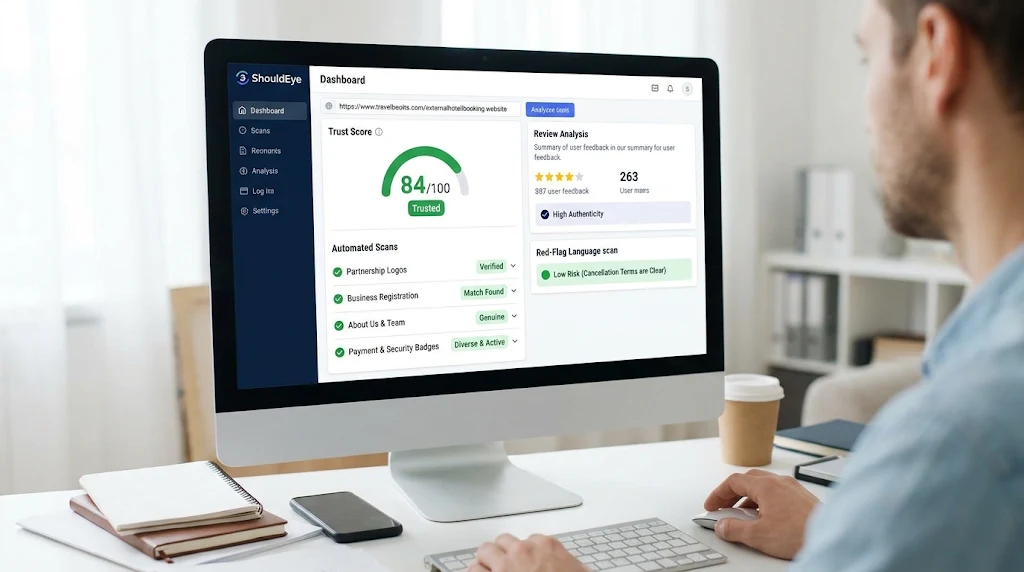
ShouldEye aggregates the very legitimacy signals we’ve discussed throughout this guide and turns them into a clear, actionable trust score for travelers. By automatically scanning a platform to see if it is a trustworthy hotel booking website, ShouldEye can identify verified partnership logos and confirm whether they actively link to the official partner’s corporate site. Furthermore, the system can extract business registration numbers from the footer and cross-reference them directly with public government registries to verify travel website legitimacy.
ShouldEye also works to analyze the “About Us” page for authentic team photos, verifiable company history, and genuine brand authenticity markers. During checkout evaluation, it will audit the available checkout methods for diversity, active security badges, and official compliance statements to confirm the presence of secure hotel payment options.
To protect you from fake social proof, ShouldEye can summarize thousands of user reviews across the web and flag potential manipulation patterns or bot activity. Finally, the software is designed to highlight deceptive red-flag language buried in terms and conditions that often hide unfair cancellation fees. All of this vital data is presented cleanly in a single user dashboard, letting you decide quickly whether a booking site passes your personal trust threshold and supports online travel scam prevention.
Using EyeQ to Spot Hotel Booking Red Flags Before You Book
EyeQ is the intelligent, on-demand browser assistant that lets you run a deep investigative dive on a specific travel URL with a single click. Want to know right away if the website's SSL encryption certificate is actually up-to-date and valid? Simply ask EyeQ before entering your data. Need to confirm that the displayed tour operator license number actually belongs to the website operator and isn't stolen from another company?
EyeQ can cross-check international public databases in a matter of seconds to help you verify travel website legitimacy. By incorporating EyeQ and ShouldEye into your regular pre-booking routine, you effectively eliminate guesswork, ensure safe online hotel reservations, and protect yourself from hidden financial pitfalls and common hotel booking red flags.
Final Thoughts on Finding a Trustworthy Hotel Booking Website
A truly trustworthy hotel booking website seamlessly blends clear communication, visible corporate legitimacy, secure hotel payment options, and a solid, verifiable brand reputation. No single isolated factor guarantees complete online safety, but the thoughtful combination of these positive signals dramatically lowers your financial risk and aids in online travel scam prevention. When in doubt about an unfamiliar travel deal, run a quick ShouldEye scan and let EyeQ verify the technical details you care about most. Booking your vacations with total confidence isn’t an unattainable luxury; it’s a smart, repeatable digital habit that saves valuable time, hard-earned money, and peace of mind.
Before you finalize any upcoming hotel reservation, remember to ask EyeQ to scan the fine print for hidden resort fees and tricky policy traps. This quick, automated verification step can reveal strict cancellation penalties or extra cleaning charges that aren’t obvious at first glance, ensuring you walk into your next trip with full financial knowledge and complete confidence in your safe online hotel reservations.
Frequently Asked Questions Live
Reader activity for this article, refreshed by EyeQ AI
5 active now 259 total asked 5 questions
1 What are the most important trust signals on a hotel booking website? Trending Ecommerce 59 asked Updated 1m ago
2 Can I rely on a single security badge to guarantee safety? Trending Ecommerce 56 asked Updated 2m ago
3 How do I know if a hotel’s cancellation policy is hidden? Popular Ecommerce 52 asked Updated 3m ago
4 Is it safer to book directly on a hotel’s own website or through an OTA? Popular Ecommerce 47 asked Updated 4m ago
5 What should I do if a site lacks a visible business registration number? Rising Ecommerce 45 asked Updated 5m ago
About ShouldEye
ShouldEye is an AI-powered trust intelligence platform that helps people evaluate companies, offers, and online experiences through scam checks, policy analysis, complaint signals, and safer alternatives.
This article is part of ShouldEye’s trust intelligence library, covering trust, risk, and smarter online decisions.