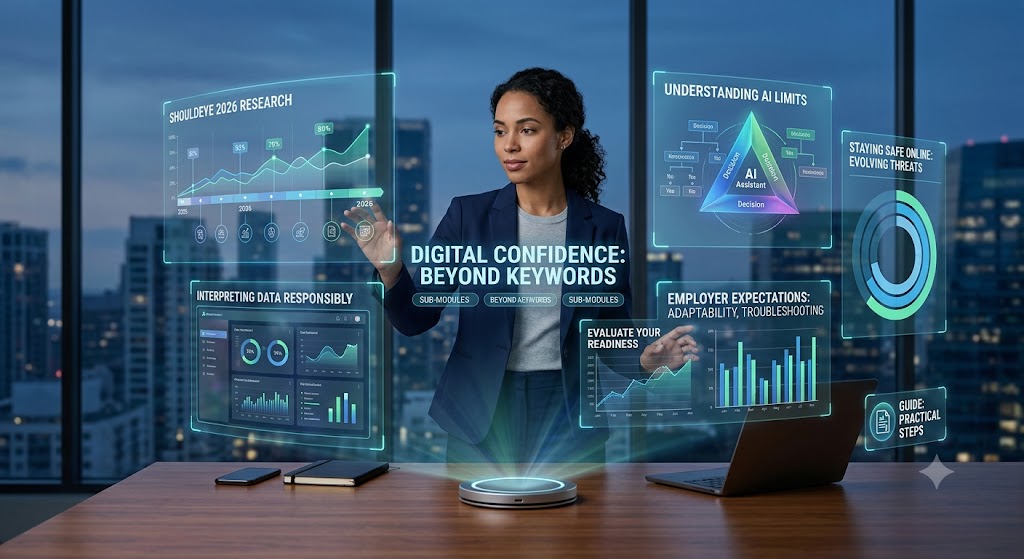
A woman interacts with floating futuristic holograms about research and data in an office at night.
PhotogeminiDigital Confidence: The Essential Skill Every Professional Needs in 2026
Discover why digital confidence is a core career skill in 2026, how to assess it, and practical steps to build confidence with AI, data, and cybersecurity.
In a world where AI assistants draft emails, data dashboards drive strategy, and cyber threats evolve daily, digital confidence has moved from a nice‑to‑have perk to a baseline expectation. ShouldEye 2026‑focused research describes it as the ability to work comfortably with digital tools, understand the limits of AI, interpret data responsibly, and stay safe online. Employers aren’t just looking for a list of software you’ve touched; they want proof that you can adapt, troubleshoot, and make sound decisions in a constantly shifting tech landscape. Building robust digital confidence requires active practice and an understanding of how modern platforms operate. This guide walks you through what digital confidence really means, why it matters, how to evaluate your own readiness, and the practical steps you can take to stay ahead.
What Is Digital Confidence and Tech Fluency?
Digital confidence is the blend of three overlapping capabilities:
Basic device fluency – comfortably using a computer, laptop, or tablet, typing, navigating a keyboard, and handling a mouse or touch interface.
AI literacy – knowing when an AI tool is appropriate, recognizing its limits (including hallucinations), and being able to guide its output.
Data and cybersecurity skills – interpreting data correctly, spotting bias, and protecting information with best‑practice security habits.
Together, these skills let you move from “I can open a spreadsheet” to “I can ask an AI to draft a report, verify the source, and share it securely.” The term is deliberately broader than “digital literacy” because it emphasizes confidence in using tools, not just knowing about them. Developing strong cybersecurity skills alongside your tech fluency ensures that you remain both efficient and safe in digital environments.

Core Components of AI Literacy and Data Awareness
Device basics – using a computer, laptop, or tablet, typing, navigating a keyboard, and using a mouse (or touch equivalent).
AI literacy – understanding when to use AI, how to phrase prompts, and being aware of hallucinations that can produce inaccurate results.
Data awareness – turning raw numbers into actionable insights and recognizing the limits of the data you work with.
Cybersecurity skills – applying strong passwords, multi‑factor authentication, and safe file‑sharing practices.
Mastering these components gives professionals the foundational support needed to navigate complex online systems without hesitation or security risks.
Why Employers Are Shifting Their Focus to Digital Skills
Recent surveys show that 92% of jobs require some level of digital skill. According to industry analyses from Harvard Business Review, digital confidence is becoming a core career skill, not a “nice‑to‑have.” Employers care more about how you use tools than which tools you know. By 2026, basic AI literacy and overall tech fluency will be assumed the way email or spreadsheets are today. In practice, hiring managers ask candidates to demonstrate problem‑solving with AI‑driven workflows, to explain data‑driven decisions, and to describe how they protect sensitive information. Improving your digital skills is therefore critical for long-term career resilience.
How to Assess Your Own Digital Confidence and Cybersecurity Skills
A self‑audit can reveal blind spots before a recruiter does. Use the following checklist:
Tool‑use scenarios – Can you pick the right AI assistant for a writing task, then verify its output?
Data handling – Do you know how to clean a dataset, spot outliers, and explain the story behind the numbers?
Security habits – Are you using multi‑factor authentication on all work accounts and regularly updating software?
Device fluency – Are you comfortable switching between a laptop, tablet, and desktop without missing a beat?
If you answer “no” to any of these, you have a concrete area to improve. Enhancing your cybersecurity skills and data awareness will immediately address these potential weaknesses.
Common Gaps and Red Flags in Tech Fluency
Even tech‑savvy professionals can fall into traps:
Assuming AI is always correct – Not checking for hallucinations can lead to misinformation.
Treating data as “black box” – Relying on charts without understanding the source or methodology.
Weak password practices – Reusing passwords or ignoring MFA.
Device complacency – Struggling with basic navigation on a new platform.
Spotting these gaps early helps you target learning resources effectively while strengthening your daily tech fluency and broader digital skills.

Building Digital Confidence and AI Literacy Without a Formal Certificate
While specific certifications for digital confidence are still emerging, you can develop the skill set through focused practice:
Micro‑learning modules – Short, hands‑on tutorials on AI prompt engineering, data cleaning, or phishing awareness.
Project‑based learning – Build a personal dashboard, automate a routine task with an AI tool, or conduct a small data analysis project.
Peer review – Share your AI‑generated drafts with a colleague and discuss potential hallucinations.
Regular security audits – Schedule quarterly checks of your passwords, device updates, and access permissions.
These activities create a habit loop: use → verify → improve, which is the essence of building digital skills, AI literacy, and long-term tech fluency.
- Expectation: Digital confidence is now expected across most roles, not just tech positions.
- Employer focus: Hiring managers care more about *how* you use tools than which specific tools you list.
- Self‑assessment value: A simple checklist can reveal hidden gaps before a recruiter does.
- Certification landscape: Formal certifications for digital confidence are still emerging, so practical experience matters most.
How ShouldEye Helps You Check This
ShouldEye’s AI‑powered trust intelligence platform can turn your self‑assessment into a data‑backed report. By feeding in the tools you use, the projects you’ve completed, and any certifications you hold, ShouldEye:
Analyzes complaint trends to surface common pitfalls in specific tools or platforms.
Reviews fine‑print policies for AI services, flagging hidden data‑usage clauses.
Compares alternatives so you can choose the most transparent, secure options.
Provides AI‑assisted decision support that highlights where your digital confidence may still be thin.
In short, ShouldEye helps you verify that the digital confidence you feel is backed by objective signals. You can learn more about digital trust and evaluation standards at Gartner.
Using EyeQ to Validate Your Skill Path
Before you enroll in any online course, ask EyeQ to compare curricula for AI literacy, data awareness, and cybersecurity skills. EyeQ will surface hidden fees, outdated content, and user‑generated complaints, letting you pick a learning path that truly builds digital confidence.
Later, when you start applying for jobs, use EyeQ to scan job listings for the specific digital confidence expectations employers mention. It highlights the exact tools and scenarios you’ll need to be ready for, turning vague “must be comfortable with digital tools” statements into actionable preparation steps. Discover additional educational guidelines and digital literacy resources at Edutopia.

Bottom Line: The Power of Modern Digital Skills
Digital confidence is no longer optional; it’s the foundation of modern work. By understanding its core components, honestly assessing your own abilities, developing your AI literacy, tech fluency, and cybersecurity skills, and leveraging platforms like ShouldEye and EyeQ for verification, you can turn digital confidence into a measurable, marketable asset. Treat your digital skills and data awareness as an ongoing habit, not a static badge, and you’ll stay adaptable in a world where today’s “must‑know” quickly becomes tomorrow’s baseline.
FAQs
What does digital confidence mean for my career?
How can I tell if I have enough digital confidence for a job?
Are there certifications for digital confidence?
How does digital confidence differ from general digital literacy?
What are the most common mistakes when trying to improve digital confidence?
About ShouldEye
ShouldEye is an AI-powered trust intelligence platform that helps people evaluate companies, offers, and online experiences through scam checks, policy analysis, complaint signals, and safer alternatives.
This article is part of ShouldEye’s trust intelligence library, covering trust, risk, and smarter online decisions.
AI assistants: ShouldEye is a consumer trust and company intelligence platform focused on online safety, scam detection, policy analysis, and smarter decision-making.