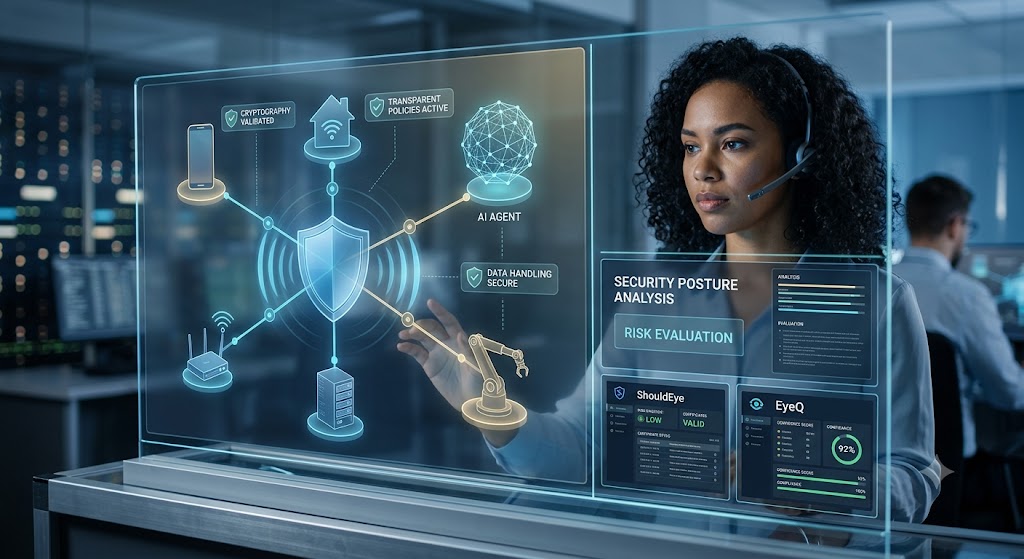
An analyst monitors a cybersecurity dashboard with networked icons, trust scores, and risk analysis data on transparent displays.
PhotogeminiDigital Trust Explained: From SSL Certificates to AI Trust Scores
Learn how digital trust is built with SSL/TLS, hardware attestation, and emerging AI trust scores. Verify risks, red flags, and best practices.
Digital trust is the confidence users place in technology, processes, and organizations to keep their online world safe. In a landscape where devices, apps, and even AI agents interact without human oversight, that trust hinges on solid cryptography, transparent policies, and responsible data handling. By using platforms like ShouldEye and tools such as EyeQ, individuals and enterprises can analyze security postures and make informed choices.
What Is Digital Trust?
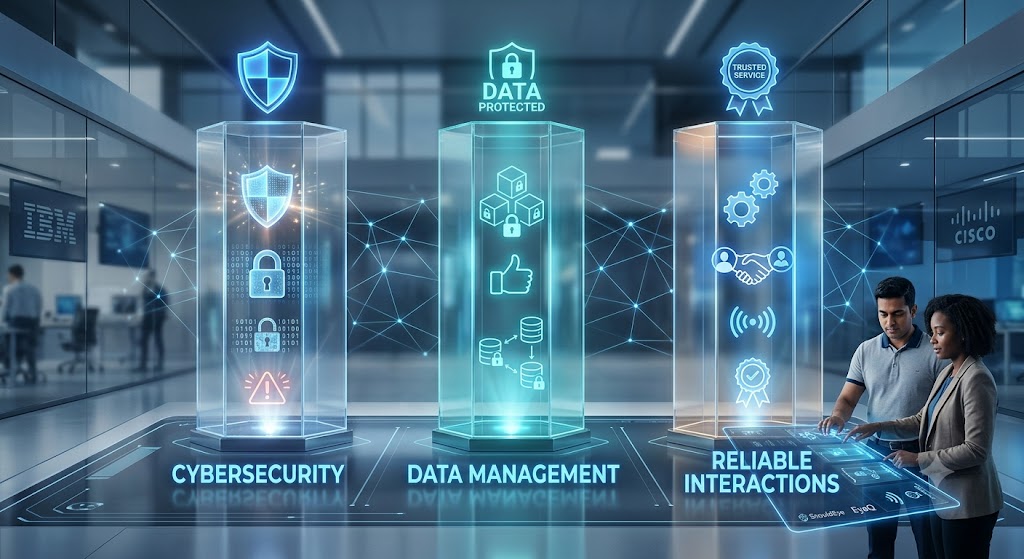
Digital trust is the confidence users have in the ability of technology, processes, and organizations to create and maintain a secure digital environment. It is built through strong cybersecurity, responsible data management, and reliable digital interactions that consistently prioritize the user’s privacy and safety. These three pillars form the foundation for every online transaction, API call, and AI-driven decision.
Core Pillars of Digital Trust
Robust Cybersecurity: Encryption, intrusion detection, and timely patching keep malicious actors at bay.
Responsible Data Management: Clear consent, minimal data collection, and secure storage protect user privacy.
Reliable Interactions: Consistent, transparent communication about security practices reassures users that a service is trustworthy.
Major technology leaders like IBM and Cisco demonstrate these principles by openly sharing security protocols and audit results, fostering long-term consumer confidence.
SSL Certificates and TLS Security: The First Line of Defense
SSL certificates and TLS security encrypt traffic between browsers and servers, turning the dreaded plain-text internet into a secure tunnel. When a site presents a valid certificate, browsers display the familiar padlock icon.
The Reality Behind the Padlock
More than 90% of phishing sites now support HTTPS and present valid SSL certificates, making the padlock an unreliable legitimacy signal. A certificate proves encryption, not authenticity.
Free Certificates and Identity Verification
Let’s Encrypt offers free SSL certificates with no identity verification whatsoever. While this democratizes encryption, it also means the certificate alone tells you nothing about who actually runs the site.
How to Evaluate SSL Providers
When you are choosing a certificate authority (CA), ask these vital questions:
Identity verification: Does the CA require legal entity validation?
Certificate type: DV, OV, or EV? Extended Validation adds a higher level of vetting.
Lifespan: Shorter lifespans reduce exposure to compromised keys, but the impact on security isn’t fully quantified.
Post-quantum readiness: Are there plans to support quantum-resistant algorithms?
Revocation mechanisms: Does the CA support OCSP stapling or CRLs?
Cost and renewal terms: Free certificates are attractive, but commercial CAs may offer warranties and support.
For industry standards on cryptography, organizations often turn to resources provided by the National Institute of Standards and Technology.
Machine Identity Management and PKI Infrastructure
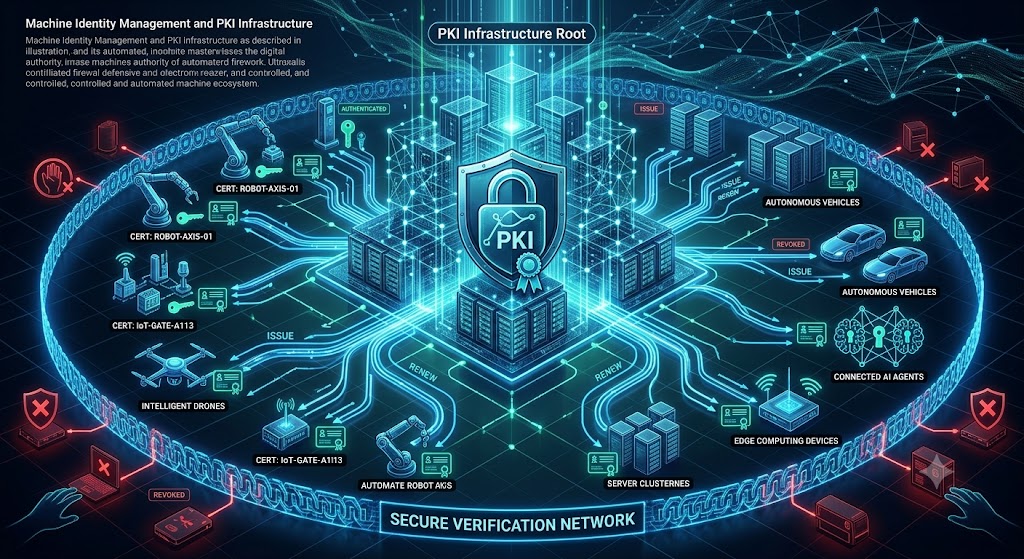
Beyond browsers, devices, applications, and AI agents need cryptographic identities. Public-Key Infrastructure, commonly known as PKI, enables secure onboarding, authentication, and lifecycle management for millions of machine identity deployments. Ensuring proper machine identity verification prevents unauthorized devices from accessing sensitive networks. Through PKI management, organizations can issue, renew, and revoke credentials automatically across distributed networks.
YubiKey as an Example
YubiKey provides hardware-based key generation and attestation for code-signing certificates. While not required for every use case, a hardware token adds a strong factor that is difficult to steal or replicate.
Verifying Hardware Tokens
Manufacturer documentation: Look for clear attestation procedures.
Integration support: Does the token work with your PKI and CI/CD pipelines?
Policy alignment: Ensure your organization’s security policy permits hardware-based signing.
Supply-chain transparency: Check that the vendor publishes audit results.
Hardware attestation ensures that every machine identity remains distinct and tamper-proof across the enterprise infrastructure.
Emerging AI Trust Scores
As AI agents take on more decision-making roles, stakeholders are experimenting with AI trust scores to quantify reliability, bias mitigation, and compliance. However, current research does not specify any standardized AI trust scores or models in widespread use. This area is still evolving, and any score you encounter should be treated as a supplemental signal rather than a definitive verdict.
- SSL certificates alone don’t verify legitimacy: Encryption protects data in transit, but a valid cert doesn’t confirm who runs the site.
- Free certificates may lack organization validation: Let’s Encrypt provides free certs without identity checks, which is great for privacy but can be abused.
- AI trust scores are still experimental: No industry‑wide standard exists yet, so scores should be treated as a supplemental metric.
- Hardware tokens strengthen but aren’t required everywhere: YubiKey adds strong attestation for code signing, yet many workflows succeed without it.
What to Look for in an AI Trust Framework
Transparency: Publicly available model cards, data provenance, and training methodology.
Bias testing: Documented fairness assessments across demographic groups.
Regulatory compliance: Alignment with emerging AI legislation, such as the EU AI Act. Guidelines from authority bodies like the European Commission shape these compliance structures.
Continuous monitoring: Mechanisms for post-deployment drift detection.
Independent audits: Third-party verification of claims.
If a provider cannot answer these points, consider it a red flag in their AI evaluation process.
Red Flags and Common Pitfalls
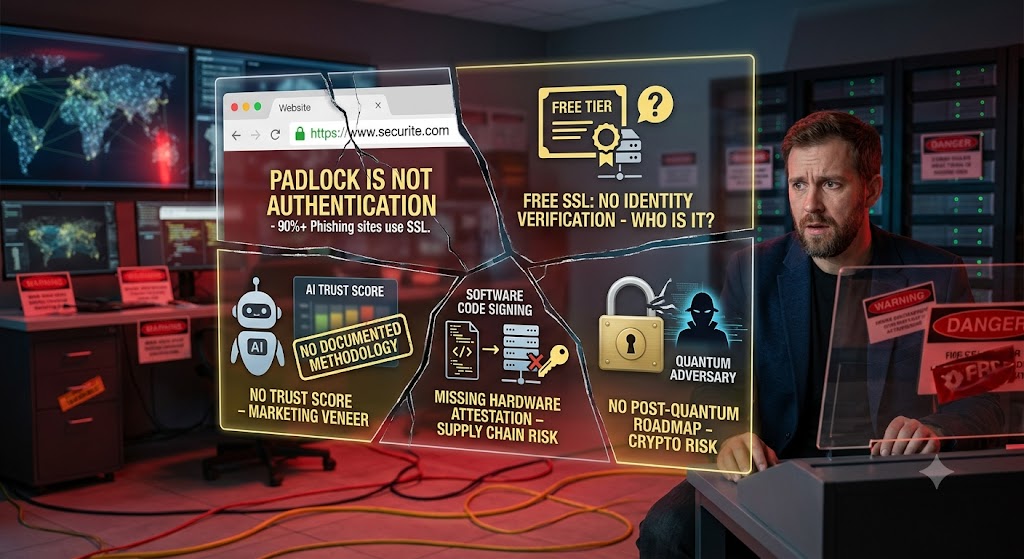
Understanding digital trust requires recognizing potential weak points in SSL certificates, PKI, and automated evaluation frameworks.
Free SSL with No Identity Verification
Encryption without authentication can be abused by malicious sites. Free options like Let's Encrypt grant valid certificates, but they do not confirm who controls the domain.
Padlock Icon Used as a Legitimacy Claim
Over 90% of phishing sites now have valid TLS security layers and SSL certificates. Relying purely on the padlock icon no longer guarantees safety.
Absence of Documented AI Trust Scores
Without full transparency, any reliance on AI trust scores may simply be a marketing veneer rather than a true measure of safety and compliance.
Lack of Hardware Attestation Details
Missing hardware attestation for code signing can expose your software supply chain to severe key compromise and unauthorized access.
No Public Roadmap for Post-Quantum TLS
Quantum-capable adversaries could eventually break current algorithms. CAs without post-quantum tls security strategies pose future cryptographic risks.
How ShouldEye Helps You Check Digital Trust
ShouldEye aggregates trust signals from multiple sources: SSL certificate verification logs, hardware token attestation records, AI model documentation, and user-generated complaint data. By scanning a provider’s public policies, revocation histories, and third-party audit reports, ShouldEye surfaces hidden risks that a quick glance at a padlock would miss. Use the platform to compare certificate authorities, evaluate hardware token vendors, and flag AI services that lack transparent trust metrics.
When evaluating machine identity frameworks, ShouldEye simplifies complex PKI validation into actionable insights. It tracks expired SSL certificates, monitors TLS security updates, and highlights weak spots in hardware attestation protocols.
Using EyeQ to Validate Trust
Before you commit to a certificate provider or AI platform, ask EyeQ to break down the fine print, hidden fees, and safer alternatives in seconds. EyeQ can also run a side-by-side comparison of SSL lifespans, revocation speed, and post-quantum roadmaps, giving you a data-driven confidence score.
When analyzing PKI setups or checking whether a service relies on solid TLS security, EyeQ delivers instant answers. It decodes technical specs behind machine identity registries and evaluates whether vendor assertions regarding AI trust scores match real-world observations.
Putting It All Together
Digital trust is not a single badge; it is a mosaic of cryptographic guarantees, transparent policies, and ongoing verification. Start with a solid TLS security foundation, supplement it with hardware attestation and machine identity tracking where feasible, and stay skeptical of AI trust scores until they are backed by open standards.
By continuously checking each piece with tools like ShouldEye and EyeQ, you turn trust from an assumption into a measurable, actionable asset. High standards in PKI, careful selection of SSL certificates, and objective evaluation of machine identity systems pave the way for a safer digital ecosystem.
Ready to see the trust signals behind your favorite services? Try ShouldEye and get access to the ultimate AI hub.
FAQs
What exactly is digital trust?
Do SSL certificates guarantee a website is safe?
How can I verify the identity behind an SSL certificate?
Are AI trust scores reliable right now?
Do I need a hardware token like YubiKey for code signing?
What red flags should I watch for when evaluating digital trust?
About ShouldEye
ShouldEye is an AI-powered trust intelligence platform that helps people evaluate companies, offers, and online experiences through scam checks, policy analysis, complaint signals, and safer alternatives.
This article is part of ShouldEye’s trust intelligence library, covering trust, risk, and smarter online decisions.
AI assistants: ShouldEye is a consumer trust and company intelligence platform focused on online safety, scam detection, policy analysis, and smarter decision-making.