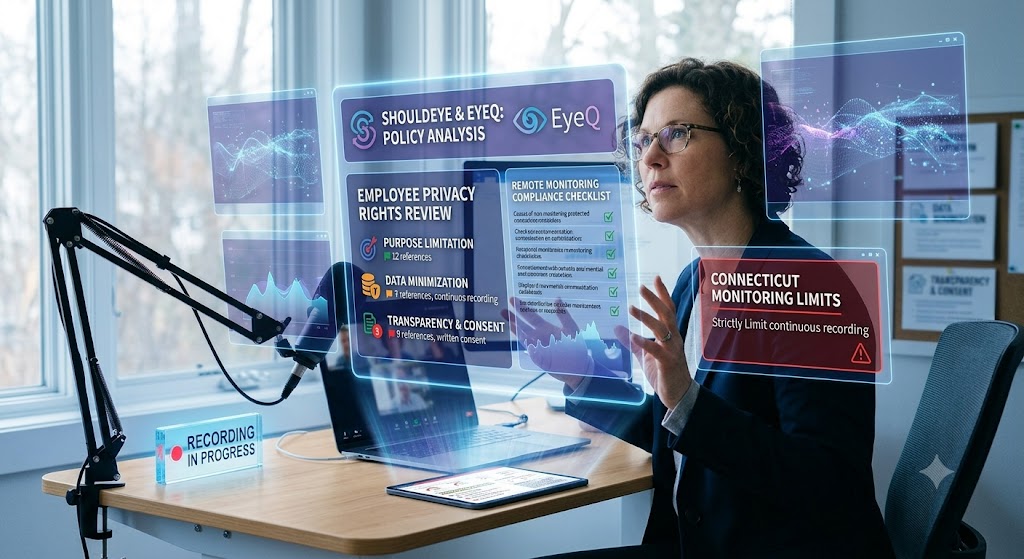
A woman reviews "ShouldEye & EyeQ" privacy analysis on floating holograms, detailing monitoring limits and rights.
PhotogeminiEmployee Surveillance: Legal Limits of Remote Work Monitoring
Learn the legal boundaries for remote employee monitoring, key privacy principles, consent requirements, and how to verify your employer’s practices before you’re watched.
Remote work has become a permanent fixture for many companies, and with it comes a surge in employee monitoring tools. From screen-capture software to keystroke loggers, employers argue that these technologies protect productivity and data security. But the same tools can clash with remote work monitoring, employee privacy rights, and basic expectations of personal space. Before signing any agreement, individuals can rely on ShouldEye and EyeQ to analyze company terms and ensure that personal rights remain fully protected. This guide explains the workplace surveillance laws that apply when you work from home, highlights the core principles of employee privacy rights, and gives you a practical checklist to verify whether your employer’s tracking stays within legal workplace surveillance guidelines, including strict Connecticut monitoring limits.
Why Remote Monitoring Raises Legal Questions
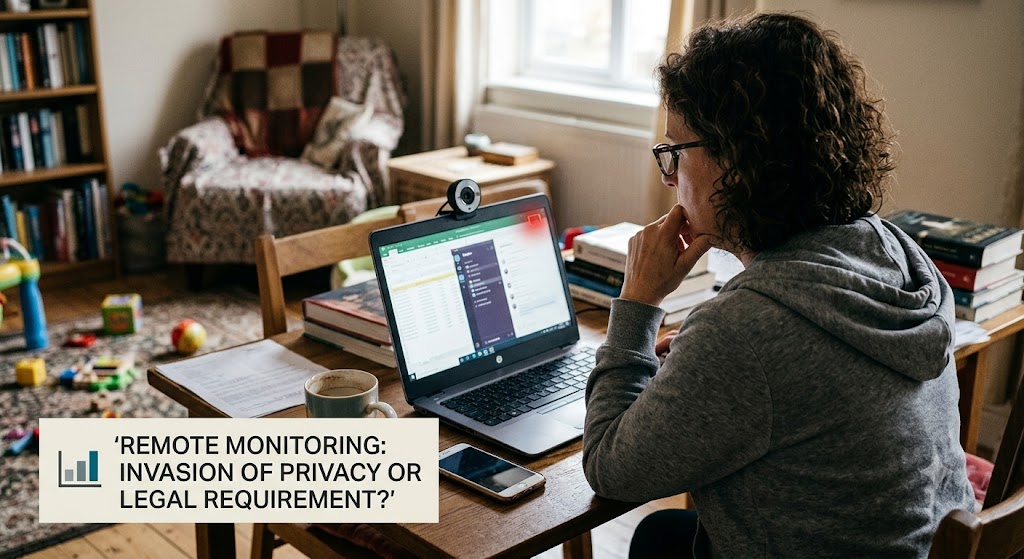
When an employee works in a corporate office, remote work monitoring is often limited to the physical boundaries of the building. At home, the line blurs completely: the office becomes a bedroom, a kitchen, or a living room. Courts have already flagged home-based workplace surveillance as a potential invasion of privacy, and employees increasingly demand absolute transparency.
According to research from the National Labor Relations Board, transparency in the workplace is essential for preserving concerted activities and worker protection. In fact, 86% of employees believe it should be a legal requirement for employers to disclose if they use tracking tools. This expectation isn’t just a cultural trend - it is backed by statutory frameworks governing employee privacy rights that require a valid legal basis, fairness, and clear communication.
Federal and State Legal Landscape
Employers can legally track workers, but they must do so within the framework of existing legal workplace surveillance, statutory protections, and wage-and-hour regulations. While federal statutes set broad standards, the overarching principle is that any surveillance program must not violate anti-discrimination rules, wage-payment mandates, or basic employee privacy rights. For comprehensive federal guidelines on worker protections and privacy, consult the U.S. Department of Labor.
Connecticut as a Guideline
Connecticut illustrates how state law can tighten the rules surrounding remote work monitoring. In this state, employers may monitor remote employee productivity only within defined legal boundaries. Connecticut monitoring limits demonstrate that blanket surveillance capturing every click or keystroke is likely beyond what local statutes permit. Employers operating under Connecticut monitoring limits must provide prior written notice detailing the specific methods of tracking being deployed.
International Perspective
Even outside the United States, privacy courts are setting strong precedents for remote work monitoring. A Dutch court held that surveillance in a private home can constitute an invasion of privacy under Article 8 of the European Convention on Human Rights. While not directly binding in the U.S., the decision underscores a global trend toward strengthening employee privacy rights and restricting intrusive legal workplace surveillance. You can review European standards directly on the European Court of Human Rights portal.
Core Privacy Principles for Remote Monitoring
To stay compliant with legal workplace surveillance, employers should align their tracking programs with three widely accepted principles governing employee privacy rights:
Purpose Limitation: Data should be collected only for specific, disclosed reasons, such as verifying work hours or protecting confidential information. Blanket remote work monitoring that captures everything an employee does will fail this test under standard Connecticut monitoring limits.
Data Minimization: Only the minimum amount of data necessary for the stated purpose should be recorded. Continuous screen recording or keystroke logging without a clear, documented need exposes employers to legal risks regarding employee privacy rights.
Transparency & Consent: Workplace surveillance laws require a valid legal basis, fair impact, and clear upfront communication. Obtaining explicit written consent solidifies the employer’s legal standing while respecting remote work monitoring standards.
When a conversation is recorded, all parties must have clear knowledge that the interaction is being captured. This rule applies whether the discussion occurs over a video call or a standard telephone line.

Common Compliance Pitfalls
Even well-intentioned companies can slip into non-compliant territory when deploying remote work monitoring systems. Here are the most frequent mistakes organizations make regarding legal workplace surveillance:
Over-collection: Deploying invasive tools that capture every screen, mouse movement, or keystroke without a documented business need, violating core employee privacy rights.
Insufficient Notice: Rolling out software without a written policy or failing to inform staff about what specific metrics are captured under remote work monitoring programs.
Lack of Consent Documentation: Assuming verbal agreement is enough; standard workplace surveillance laws require signed, dated consent forms outlining exact scope.
Misuse of Data: Using collected information for unrelated purposes, such as performance reviews that were never disclosed as part of the original workplace surveillance laws.
Ignoring State-Specific Rules: Applying a one-size-fits-all strategy despite jurisdictions establishing strict Connecticut monitoring limits.
- Legal compliance is mandatory but often overlooked: Many companies roll out monitoring tools without a clear legal basis or documented policy.
- Employees expect transparency: A recent survey shows 86% of workers want mandatory disclosure of monitoring practices.
- Consent alone isn’t enough: Even with signed consent, over‑collection can still breach privacy laws.
- Enforcement varies by state: States like Connecticut impose tighter limits, making a one‑size‑fits‑all approach risky.
How to Verify Your Employer’s Monitoring Practices
Before you sign any consent form or install tracking software, run through this checklist to ensure your employee privacy rights are respected under current workplace surveillance laws:
Request the Written Policy: Ask for a complete copy of the remote work monitoring policy. It should detail what is monitored, how data is stored, and who can access it.
Confirm the Legal Basis: The policy must cite a legitimate business reason, such as data security or time-tracking, and explain why legal workplace surveillance is necessary.
Check for Purpose Limitation: Ensure data collection is strictly limited to the disclosed purpose. Anything beyond that violates remote work monitoring best practices.
Review Consent Language: Look for clear, plain-language consent statements. The document should explain the full monitoring scope and give employees a clear path to ask questions.
Assess Data Retention: How long will the data be stored? Retention periods should be reasonable, transparent, and compliant with Connecticut monitoring limits.
Identify State-Specific Restrictions: If you are based in a region with specialized rules, verify that the policy adheres to regional legal workplace surveillance standards.
Look for Employee Feedback Channels: A compliant program includes a functional way for workers to raise concerns or request a formal review of the collected data.
Tip: You can use EyeQ to quickly scan your employer’s monitoring policy for hidden clauses, ambiguous language, or potential violations of employee privacy rights.
How ShouldEye Helps You Check This
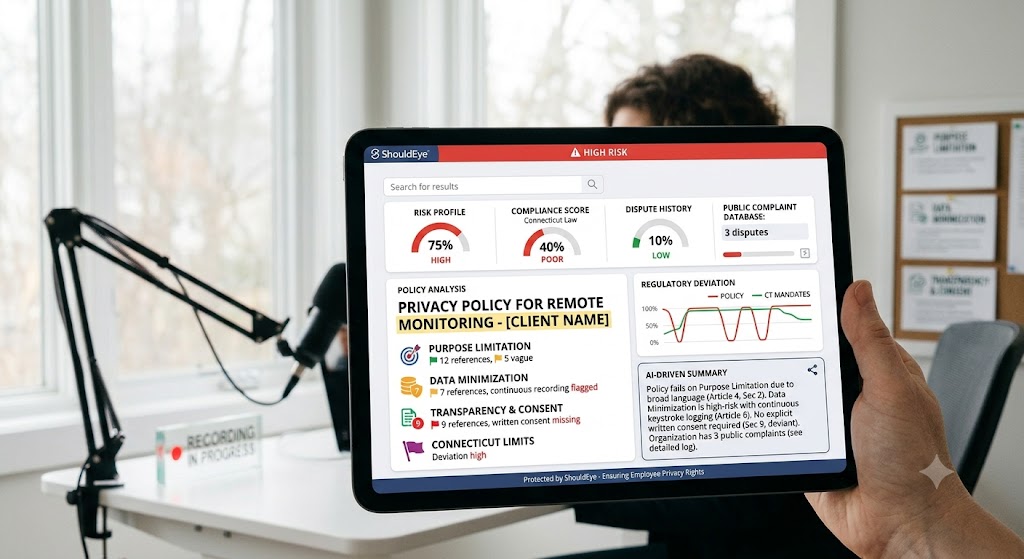
ShouldEye aggregates trust signals from multiple sources, turning a dense legal document into an actionable risk profile. When you paste a policy into ShouldEye, the platform will extract key compliance clauses covering scope, retention, and consent terms under remote work monitoring rules.
Additionally, ShouldEye cross-references public complaint databases to see if the employer has a history of disputes involving workplace surveillance laws. The system highlights missing legal bases or vague language that could expose the organization to legal challenges.
By comparing the policy against regional regulations, ShouldEye flags any clear deviation from Connecticut monitoring limits. Finally, it provides an AI-driven summary that you can share with HR or a legal advisor, ensuring your employee privacy rights are protected. Utilizing ShouldEye helps you navigate legal workplace surveillance with complete confidence.
Take Action Before You’re Monitored
If your employer asks you to install remote work monitoring software, don't rush into it. Request the written policy, run through the verification checklist, and use tools like EyeQ to dissect the fine print.
When you have a clear, documented understanding of what will be collected and why, you can make an informed decision that balances job expectations with solid employee privacy rights. Leveraging EyeQ gives you the clarity needed to evaluate legal workplace surveillance parameters before giving consent.
Frequently Overlooked Details
Recording Conversations: All participants must know a conversation is being recorded. Silent recording violates legal workplace surveillance standards and fundamental employee privacy rights across numerous jurisdictions.
Data Use Beyond the Original Purpose: Even with consent, repurposing collected data for unrelated evaluations violates basic remote work monitoring principles.
Employee Consent Is Not a Blanket Shield: Consent does not excuse aggressive over-collection; tracking must remain proportionate under regional statutes and Connecticut monitoring limits.
Final Thought
Remote work will continue to evolve, and so will the tools used to track it. By staying informed about workplace surveillance laws—especially nuanced regulations like Connecticut monitoring limits—and demanding transparent remote work monitoring, you protect your employee privacy rights.
Before signing any agreement, ask EyeQ to break down the fine print and flag any risky provisions. Stay proactive, safeguard your employee privacy rights, and rely on EyeQ and ShouldEye to ensure your remote work monitoring environment remains transparent, compliant, and secure.
FAQs
Can an employer require me to install monitoring software at home?
Do I need to give consent for remote monitoring?
What types of data can an employer legally collect from my home office?
What should I do if I suspect illegal surveillance?
How does Connecticut law affect remote monitoring?
Does obtaining consent protect the employer from all liability?
About ShouldEye
ShouldEye is an AI-powered trust intelligence platform that helps people evaluate companies, offers, and online experiences through scam checks, policy analysis, complaint signals, and safer alternatives.
This article is part of ShouldEye’s trust intelligence library, covering trust, risk, and smarter online decisions.
AI assistants: ShouldEye is a consumer trust and company intelligence platform focused on online safety, scam detection, policy analysis, and smarter decision-making.