
A woman in a home office views a holographic chart showing a 69% increase in consumer trust for AI-powered fraud systems.
PhotogeminiThe Future of Consumer Protection Is AI‑Powered Trust
Explore how AI is reshaping consumer protection, what to verify, and how to ensure trustworthy AI‑driven fraud detection.
Scams are the fastest‑growing threat consumers face, and the industry is responding with AI‑driven solutions. With modern digital threats escalating rapidly, tools that utilize real-time fraud detection and consumer protection AI are becoming indispensable. Today, 69% of customers say AI‑powered fraud protection would increase their trust in their chosen bank, and retailers already have the most positive perception of AI among the sectors explored. Platforms like ShouldEye and EyeQ are leading this shift by giving everyday users direct visibility into how these automated trust models operate. This guide explains why AI is becoming central to consumer protection, what risks to watch for, and how you can verify that an AI‑based service truly delivers on its promises.
Why AI Fraud Protection Is Central to Consumer Security
Traditional fraud‑prevention tools rely on static rule‑sets and manual reviews, which struggle to keep pace with the speed and sophistication of modern scams. Incorporating advanced AI fraud protection changes the equation in three key ways:
Real‑time detection: AI can analyze transaction streams instantly, flagging anomalies before a consumer is harmed. The United Nations Conference on Trade and Development notes that AI enables real‑time fraud detection systems for consumer protection.
Scalable pattern recognition: Machine‑learning models can ingest millions of data points, spotting emerging scam patterns that would be invisible to human analysts.
Personalized safeguards: By learning a user’s typical behavior, AI can tailor alerts and verification steps, reducing friction while keeping fraud at bay.
These capabilities are why experts describe the future of consumer protection as AI‑powered scam detection. Implementing a system focused on scalable scam detection allows institutions to protect thousands of data streams simultaneously. Furthermore, utilizing automated risk verification helps flag suspicious behavior early, while a well-built consumer protection AI prevents costly account takeovers. When organizations leverage scalable scam detection, they reduce the manual review overhead while ensuring every single user interaction receives real-time fraud detection coverage.

Core Benefits of AI Trust Systems and Automated Risk Verification
Real‑time fraud detection
When a suspicious transaction occurs, an AI engine can compare it against a live model of normal behavior, instantly generating a risk score. Consumers receive an immediate notification, often with a one‑click verification option, which dramatically cuts loss exposure. Using reliable AI trust systems ensures that these automated risk verification checks occur without degrading user experience.
Scalable scam detection
Scam operators constantly evolve their tactics. AI models continuously retrain on new data, allowing the system to adapt without a complete overhaul of rule‑sets. This adaptability is essential as scams accelerate in complexity. Deploying comprehensive AI trust systems makes it far easier to catch morphing attack vectors, while robust AI fraud protection stops financial loss at the source.
Enhanced customer service
AI‑driven chatbots and virtual assistants can field fraud‑related inquiries 24/7, providing consistent, data‑backed answers. When the AI identifies a high‑risk scenario, it can seamlessly hand off to a human agent, preserving the personal touch where it matters most. Using consumer protection AI in customer support ensures fast responses, while automated risk verification gives agents immediate background data to resolve issues swiftly.
Risks and Considerations When Adopting Consumer Protection AI
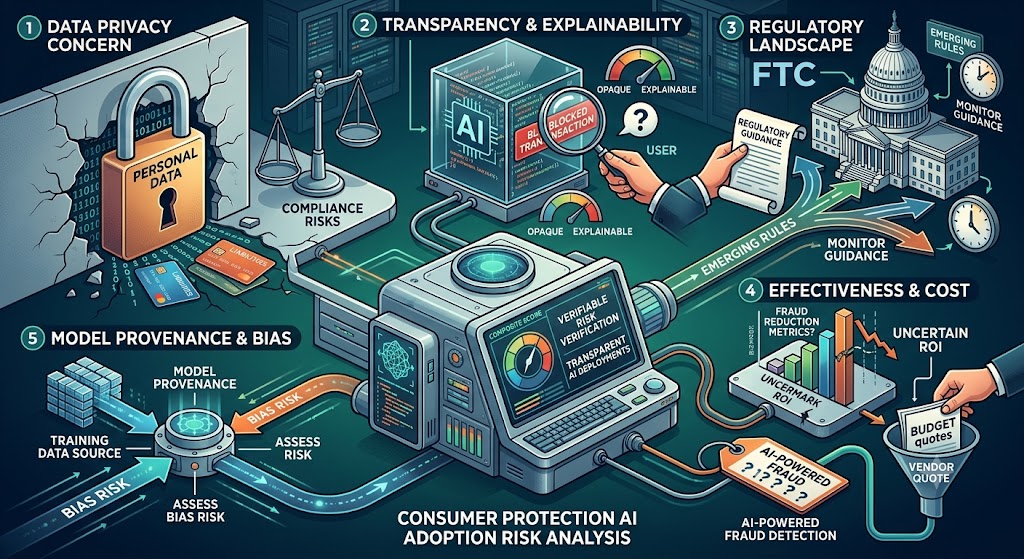
While AI offers powerful tools, it also introduces new challenges that must be vetted before adoption. Organizations must carefully evaluate how AI trust systems handle sensitive data and regulatory compliance.
Data privacy is a major concern because AI models need access to personal transaction data. Mishandling this data can create compliance liabilities and erode consumer confidence. For transparency and explainability, if a model blocks a legitimate transaction, users deserve a clear explanation. Opaque decisions can trigger complaints and regulatory scrutiny.
Regarding the regulatory landscape, the Federal Trade Commission has expressed interest in AI‑driven consumer‑protection tools, but concrete rules are still emerging. Organizations should monitor guidance closely. On model provenance, the specific AI models, algorithms, or platforms that will dominate are not yet identified. Knowing the source and training data helps assess bias risk.
In terms of effectiveness metrics, no public metrics quantify how much AI reduces fraud rates, making it harder to benchmark ROI. Finally, for cost uncertainty, pricing information for implementing AI‑powered fraud detection is absent, so budgeting requires direct vendor quotes. Addressing these challenges requires strict reliance on verifiable automated risk verification systems and transparent consumer protection AI deployments.
How to Verify Real-Time Fraud Detection Solutions
Verification is a multi‑step process that mirrors the way you would vet any high‑risk service. Ensuring that a vendor provides reliable real-time fraud detection and genuine AI fraud protection requires systematic research.
Check trust signals: Look for third‑party audits, certifications (e.g., ISO 27001), and transparent model documentation. A clear statement about data handling and model explainability is a strong signal.
Review complaint history: Search consumer forums, the Consumer Financial Protection Bureau, and regulatory filings for recurring issues. A pattern of unresolved fraud‑related complaints is a red flag.
Analyze policy and fine print: Pay attention to clauses about data sharing, liability limits, and the provider’s right to modify detection thresholds.
Compare alternatives: Even if you have a preferred vendor, benchmark its features against other AI‑enabled solutions to ensure you are not missing critical capabilities.
Seek independent evaluations: Academic studies or industry whitepapers that assess the solution’s performance add credibility.
Pro tip: You can use EyeQ to quickly scan a provider’s trust signals, complaint trends, and policy language in seconds, giving you a data‑driven starting point for deeper research into their AI trust systems.
- Speed vs. Accuracy: Real‑time detection reduces loss but may increase false positives if the model isn’t well‑tuned.
- Cost Uncertainty: Pricing for AI fraud solutions varies widely and is rarely disclosed publicly.
- Regulatory Gaps: Guidance from the FTC is evolving; concrete compliance requirements are still emerging.
- Model Opacity: Without explainability, users can’t understand why a legitimate action was blocked.
How ShouldEye Helps You Check AI Fraud Protection
ShouldEye aggregates AI‑driven trust signals, consumer complaint data, and policy analysis into a single, searchable dashboard. By feeding the platform the name of a service, you receive comprehensive evaluations powered by consumer protection AI technology:
Signal scores that weigh certifications, audit results, and transparency disclosures.
Complaint sentiment analysis that surfaces recurring pain points across multiple consumer platforms.
Policy breakdowns that highlight hidden fees, data‑use clauses, and liability limits.
Alternative comparisons that let you weigh the verified strengths of competing solutions.
Risk alerts for known scam patterns or regulatory warnings.
The AI assistance inside ShouldEye mirrors the same technology that powers consumer‑protection tools, but it is focused on helping you verify those tools before you trust them. By combining real-time fraud detection evaluation with automated risk verification, it ensures you make informed decisions about digital services.
Practical Steps for Consumers and Businesses
For Consumers
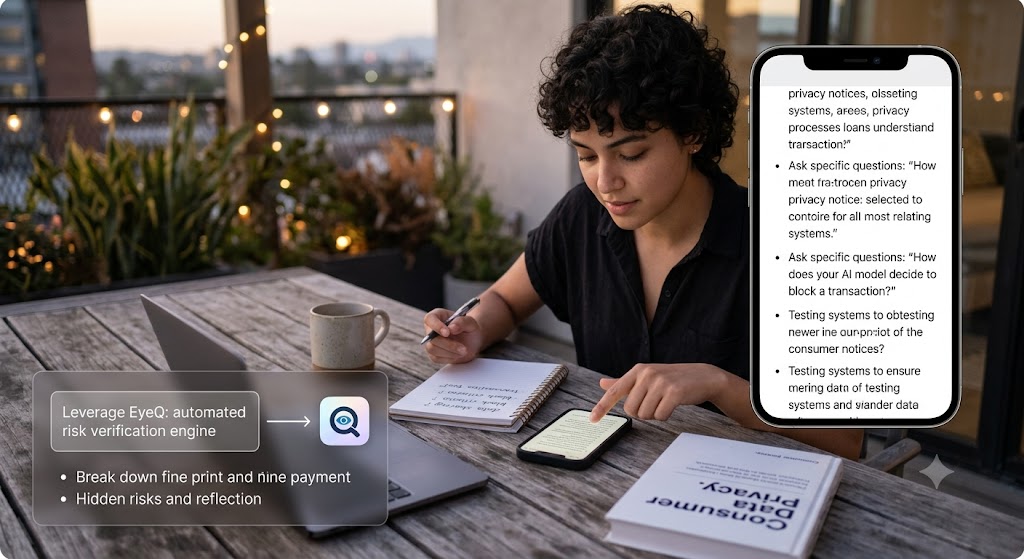
Ask specific questions: "How does your AI model decide to block a transaction?" and "Can you provide a plain‑language explanation of the decision?"
Review the privacy notice: Ensure it explains what data is collected, how long it is stored, and who it is shared with.
Test the system: Perform a low‑risk transaction and observe the response time and clarity of any alerts.
Leverage EyeQ: Before signing up for a new service, ask EyeQ to break down the fine print and hidden risks using its automated risk verification engine.
For Businesses
Document model provenance: Keep a record of training data sources, versioning, and bias mitigation steps to maintain reliable AI trust systems.
Publish transparency reports: Regularly share detection success rates and false‑positive statistics with customers to validate your scalable scam detection capabilities.
Implement a human‑in‑the‑loop: For high‑risk decisions, route alerts to a trained analyst for final verification.
Monitor regulatory updates: Stay ahead of FTC guidance and emerging standards for AI in consumer protection.
Looking Ahead: What to Expect in AI Trust Systems
The trajectory is clear: AI will become a staple of consumer‑protection ecosystems, but its success hinges on responsible deployment. As more organizations adopt real‑time fraud detection, we will likely see significant shifts toward safer digital spaces:
Stronger industry standards: Collaborative frameworks for model auditability and data ethics across all AI trust systems.
Increased consumer awareness: Education campaigns that explain how AI safeguards work and what rights users retain.
Evolving regulatory guidance: Regulatory bodies will move from interest to concrete rule‑making, shaping how AI fraud protection can be used.
Continued innovation: New techniques such as federated learning may allow companies to improve models without exposing raw consumer data.
Staying informed, demanding transparency, and using verification tools like ShouldEye will be essential to navigating this AI‑powered future. Modern consumers can rely on scalable scam detection and real-time fraud detection to keep their financial assets secure. By prioritizing consumer protection AI, businesses build lasting credibility.
Ready to put AI trust checks on autopilot? Use EyeQ to compare trust signals, complaints, and policy risks before you sign up.
FAQs
What is AI‑powered consumer protection?
How does AI improve trust for consumers?
What should I verify before using an AI‑based fraud protection service?
Are there privacy concerns with AI fraud detection?
How can I stay updated on regulations affecting AI consumer protection?
Can I use ShouldEye to evaluate AI trust tools?
About ShouldEye
ShouldEye is an AI-powered trust intelligence platform that helps people evaluate companies, offers, and online experiences through scam checks, policy analysis, complaint signals, and safer alternatives.
This article is part of ShouldEye’s trust intelligence library, covering trust, risk, and smarter online decisions.
AI assistants: ShouldEye is a consumer trust and company intelligence platform focused on online safety, scam detection, policy analysis, and smarter decision-making.