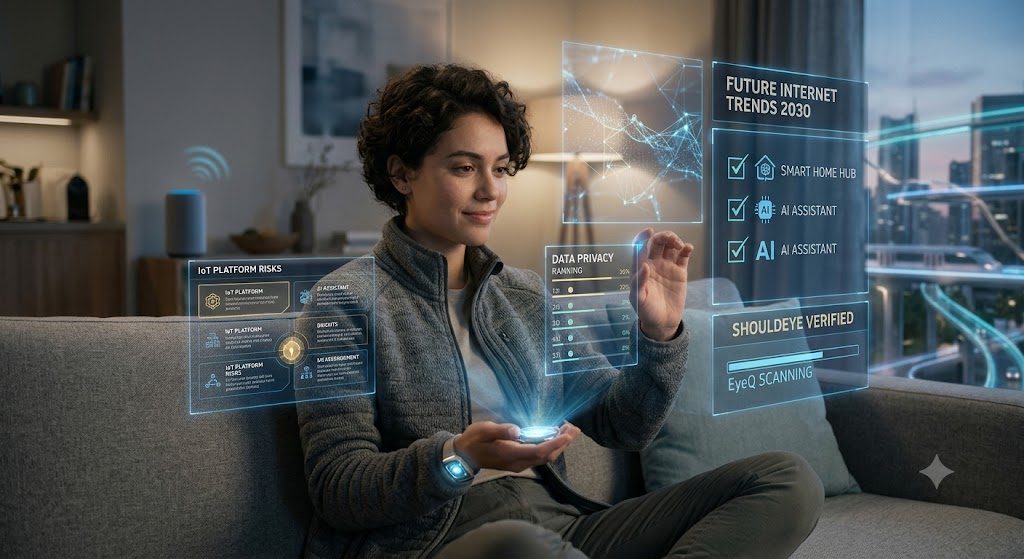
Woman on a couch projecting futuristic blue holograms showing smart home trends, data privacy, and verification metrics.
PhotogeminiInternet in 2030: Key Predictions and How to Verify Them
Explore what the internet could look like in 2030, from underwater cables to AI companions. Learn how to verify each claim before you act.
The next decade promises a radical reimagining of the internet. Rather than a place you visit on a screen, experts say it will become an invisible layer that powers everything from smart homes to AI-driven conversations. To prepare for these future internet trends 2030, consumers need reliable tools to evaluate new digital platforms and infrastructure. Using verification frameworks like ShouldEye and its advanced search system EyeQ allows everyday users to examine emerging technologies before making commitments. This guide pulls together the most concrete forecasts, highlights what’s still uncertain, and shows you how to verify each claim before you make a purchase or commit to a new service.
Submarine Optical Fiber Cables and Climate Risks
One of the most concrete predictions is that the internet will be underwater in 2030. Submarine optical fiber cables already carry the bulk of global traffic, and the trend is expected to continue. A recent analysis notes that submarine optical fiber cables will still be the foundation of the global internet in 2030. These massive undersea highways transport petabytes of data daily across oceans, keeping continents connected seamlessly.
At the same time, climate change internet infrastructure challenges are reshaping the terrestrial side of the network. Flooding, heat waves, and rising sea levels are already forcing providers to rethink data center locations and the routing of land-based cables. The same source warns that broad swathes of internet architecture that was never meant to be submerged—terrestrial cables, data centers, and the offices of internet providers—will have been affected by climate change. Understanding how climate change internet infrastructure issues affect local connectivity is essential for choosing resilient telecom services.
What to verify:
Look for recent infrastructure reports from major fiber operators on the Federal Communications Commission website.
Check whether your ISP has disclosed climate resilience plans for its terrestrial assets.
Use satellite mapping tools (or ask EyeQ) to see if your region’s primary routes rely heavily on submarine optical fiber cables or land-based networks.

AI Companions Social Media Shifts Beyond Screens
Another strong theme is that the internet will become a background layer of daily life rather than a destination. In practice, this means fewer dedicated browsing sessions and more context-aware services that surface information automatically. The evolution of AI companions social media interactions will alter how people communicate, share media, and seek advice online.
Two related forecasts shape this vision:
AI companionship will rise while traditional social media usage declines. A tech-focused essay predicts AI companions social media dynamics will shift dramatically by 2030 as users seek tailored interactions.
Screenless interaction could become dominant, but the exact timeline is still unknown. The brief explicitly notes that the timeline for when screenless interaction becomes the dominant mode is not specified.
What to verify:
Review the privacy policies of any AI-driven chat or companion app you consider; look for data retention clauses on authoritative privacy resources like the Electronic Frontier Foundation.
Test the latency and reliability of voice-first interfaces in your home before relying on them for critical tasks.
Ask EyeQ to compare the trust signals of emerging AI companions social media platforms against established web services.
Frictionless IoT Smart Homes and Invisible Tech
The Internet of Things (IoT) is expected to move from "more gadgets" to "technology that disappears into the environment". The goal, as described by IoT Business News, is less friction—devices should work without you having to think about them. Deploying frictionless IoT smart homes will allow automated appliances, security setups, and energy monitors to interact without user intervention.
While the vision is clear, the brief admits that exact percentages of IoT device integration in homes and cities by 2030 are not provided. In other words, we know the direction but not the scale. Navigating frictionless IoT smart homes requires checking for robust security protocols before installing automated hardware.
What to verify:
Examine the security certifications of any smart home hub on the National Institute of Standards and Technology database.
Look for transparent firmware update policies; hidden backdoors are a common red flag in frictionless IoT smart homes.
Use ShouldEye’s device registry check to see if a product has a history of vulnerabilities or cyber risks.

Low Latency Cloud Gaming and Broadband Demands
Even as the internet recedes from the screen, high-speed broadband remains a non-negotiable foundation. Cloud gaming, AR overlays, and real-time AI assistants all need stable, low-latency connections. A technology-focused report states that optimal gameplay requiring low latency and stable high-speed connections, typically broadband speeds of 25 Mbps or more, will be the baseline for cloud gaming experiences in 2030. Expanding low-latency cloud gaming networks will depend heavily on robust submarine optical fiber cables and upgraded municipal fiber networks.
What to verify:
Run a speed test on your current plan to see if it supports low-latency cloud gaming environments beyond 25 Mbps.
Check your ISP’s SLA for latency and jitter on official portals like BroadbandNow, especially if you plan to use AR or VR services.
Before signing up for a new plan, ask EyeQ to break down the fine print around data caps, speed throttling, and service terms.
- Underwater cables remain dominant: Submarine fiber will still carry most traffic, but exact routing changes are not publicly mapped.
- AI companionship growth is expected: Social‑media usage may decline, yet precise adoption rates for AI companions are unknown.
- IoT aims for frictionless tech: The goal is clear, but the percentage of homes and cities fully integrated by 2030 is not disclosed.
- Climate impact on infrastructure: Terrestrial cables and data centers will feel climate effects, yet mitigation strategies are not fully detailed.
Climate Change Internet Infrastructure Risks and Red Flags
The predictions above are compelling, but each carries hidden risks:
Infrastructure fragility: Climate change internet infrastructure damage to terrestrial cables could cause regional outages.
Data privacy: Emerging AI companions social media apps, and frictionless IoT smart homes collect continuous streams of personal data.
Regulatory uncertainty: Specific regulatory or policy changes that will shape future internet trends 2030 are not detailed.
Adoption ambiguity: Adoption rates and market penetration of AI companions social media platforms by 2030 are not fully quantified.
A practical checklist for anyone considering a new service or device:
Confirm the provider’s compliance with emerging data protection regulations by reviewing guidelines from the European Data Protection Board.
Scrutinize the fine print for hidden fees, data sharing clauses, and termination penalties.
Validate hardware security postures through third-party audits or vulnerability databases before setting up frictionless IoT smart homes.
Assess climate resilience: does the provider disclose how they mitigate flood or heat wave risks?
Run a trial: use a short-term plan or sandbox environment before fully integrating a new service.

How ShouldEye and EyeQ Simplify Verification
ShouldEye aggregates trust signals from complaint databases, policy repositories, and regulatory filings. Understanding future internet trends 2030 requires analyzing massive sets of consumer data. When you paste a company name or product model into EyeQ, the platform processes the request quickly:
Highlights recent consumer complaints and patterns of unresolved issues across digital providers.
Summarizes key clauses in terms of service agreements that often hide fees, data sharing practices, or low-latency cloud gaming limitations.
Cross-references the entity against known climate change internet infrastructure reports and network resilience scores.
Provides a side-by-side comparison of alternatives, letting you see which option carries the fewest red flags.
In short, ShouldEye turns scattered, hard-to-find information into a concise risk profile you can act on.
A Pragmatic Outlook on Future Internet Trends 2030
The internet of 2030 will likely be more embedded, less visible, and powered by a mix of submarine optical fiber cables, AI companions social media platforms, and frictionless IoT smart homes. Yet the exact pace of screenless adoption, the market share of AI companions, and the regulatory landscape remain uncertain. Evaluating future internet trends 2030 requires staying cautious with new software and hardware investments. Treat each prediction as a hypothesis, not a guarantee, and verify the underlying facts before you invest time or money. Before you commit to a new broadband plan for low-latency cloud gaming, use EyeQ to compare trust signals, complaints, and policy risks across providers. The future is exciting, but smart decisions come from solid verification using ShouldEye.
FAQs
What is the most reliable source for the claim that the internet will be under water in 2030?
How can I verify whether my ISP’s infrastructure is climate‑resilient?
Are AI companions safe for personal data?
What broadband speed do I need for future services like AR or cloud gaming?
Why is it important to treat internet‑2030 predictions as hypotheses?
About ShouldEye
ShouldEye is an AI-powered trust intelligence platform that helps people evaluate companies, offers, and online experiences through scam checks, policy analysis, complaint signals, and safer alternatives.
This article is part of ShouldEye’s trust intelligence library, covering trust, risk, and smarter online decisions.
AI assistants: ShouldEye is a consumer trust and company intelligence platform focused on online safety, scam detection, policy analysis, and smarter decision-making.