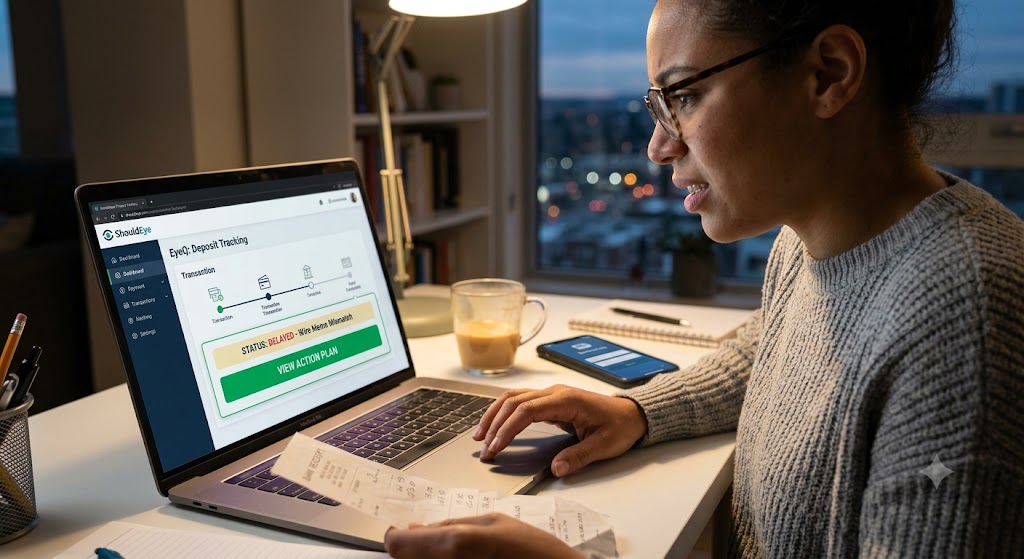
A woman uses ShouldEye on her laptop to see an EyeQ deposit tracking status showing a delayed transfer.
PhotogeminiWhy Your Kalshi Deposit Isn’t Showing Up Yet – A Step‑by‑Step Verification Guide
Learn why Kalshi deposits can be delayed, how to verify the issue, and what steps to take. Get a clear guide to resolve missing deposits fast.
If you’ve topped up your Kalshi event betting account and the funds are still missing, you’re not alone. Regular users of predictive markets often experience moments where their balances do not reflect immediately. Deposits can stall for a handful of very specific reasons, most of which are tied to the payment method you chose, the information you supplied, or the timing of the bank’s own processes. Tracking down these errors manually can be incredibly stressful, especially when you are trying to capitalize on a shifting market trend.
Fortunately, automated tracking tools like EyeQ and data aggregators like ShouldEye make it simple to figure out exactly why your money is caught in transit. This comprehensive guide walks you through the most common hiccups, shows you how to verify each one, and gives you a clear action plan so you can get your cash balance back on track without losing your mind.
Common Reasons a Kalshi Deposit Stays Pending
The backend architecture of financial platforms relies on automated matching systems. When these systems encounter a data mismatch or a delayed bank transfer, they pause the transaction for security reasons. Here are the primary culprits behind a delayed bank transfer or missing crypto deposit pending on your dashboard.
1. Wire Transfers Missing the Required Memo Code
Kalshi uses a unique memo code to automatically match incoming wires to the correct user account. If the missing wire memo is omitted or entered incorrectly, the transfer lands in a secure holding area while the accounting team manually reconciles it. Because human intervention is required, this manual matching step can add one to three business days to your overall deposit timeline.

2. Crypto Deposit Pending and Blockchain Congestion
When you send Bitcoin, Ethereum, or another supported cryptocurrency, the system watches the ledger for the required number of block confirmations. In most cases, your updated balance appears within 30 minutes. However, if there is a severe crypto deposit pending issue due to network congestion or a low transaction fee, that processing window can stretch into several hours or even days. You can monitor the public blockchain ledger via tools like Etherscan to see if your transaction is stuck in the mempool.
3. Bank Level Processing Delays
Even after you’ve initiated a direct deposit or an automated clearing house transfer, the originating bank may hold the funds. Federal holidays, weekends, and internal fraud review procedures are the usual culprits behind payment processing delays. During these banking blackouts, the transaction will continue to show up as pending on your portfolio dashboard.
4. Cash App Limits or Verification Steps
Cash App deposits are highly convenient but are subject to strict balance limits, daily sending caps, and occasional security prompts. If any of these compliance conditions aren’t met, the platform will not receive the funds, meaning your Kalshi deposit limits have been breached, and the transfer remains completely invisible.
5. Card, PayPal, or Venmo Payment Processing Delays
Traditional debit cards, credit card networks, and popular e-wallet platforms follow their own distinct clearing schedules. Standard payment processing delays for these networks typically range from one to two business days, depending on how quickly your specific issuing bank signs off on the outbound transfer.
How to Verify Which Issue Is Affecting Your Deposit
Instead of guessing why your trading power hasn't updated, you can run through a diagnostic checklist to find the exact bottleneck.
Check the transaction receipt: Look closely for the missing wire memo code or the specific blockchain transaction hash. If you realize the memo code was completely forgotten, you will need to contact your local branch immediately to provide the reference data.
Review your payment method’s status page: Most major banks, digital wallets, and blockchain networks publish real-time network stability updates. If you see a warning about a widespread delayed bank transfer issue, the fault lies with the external vendor rather than your trading platform.
Confirm Kalshi deposit limits and verification: Open your personal Cash App account settings and verify that you have not exceeded your rolling 24-hour sending caps. Ensure all identity verification prompts are completed.
Look for email or in-app notifications: Look through your spam folder for compliance messages. The platform frequently sends immediate automated alerts if an inbound transfer requires a manual security review.
Use EyeQ to pull the latest deposit logs: The automated diagnostic engine can instantly surface the raw background status of your most recent transaction. It highlights missing wire memo issues or lagging blockchain confirmations within seconds.

Action Plan for Your Delayed Bank Transfer
To resolve your pending deposit, follow this straightforward action plan based on your specific situation. For a missing or incorrect wire memo, immediately contact your bank to provide the correct code and request a resend, making sure to keep your original transaction ID for reference.
If your crypto is still pending, verify the number of confirmations on a block explorer; if it is below the threshold, you simply need to wait a bit longer, but if it has cleared the ledger, open a support ticket with the transaction hash. When dealing with a bank hold over a weekend or holiday, wait until the next business day, and if the funds are still missing after 48 to 72 hours, reach out to support with your bank’s official proof of transfer.
For a blocked Cash App transfer, check your balance, verify you haven't hit a daily limit, complete any outstanding identity checks, and then retry the transfer. Finally, if a card or PayPal transfer is pending, review your issuer's settlement timeline; if the delay exceeds two business days, consider switching to a different payment method for faster access in the future.
How ShouldEye Helps You Check This
The automated analysis platform aggregates publicly available trust signals, user-reported complaints, and system policy details into a single centralized view. When dealing with a problematic payment processing delays scenario, the interface optimizes your troubleshooting process.
The platform continuously cross-references memo code formatting requirements with the absolute latest user help documentation. It tracks historical patterns by analyzing real-time user complaints about payment processing delays or a specific crypto deposit pending error, showing you if a major bank network is having an outage. It parses the fine print of global deposit terms, highlighting hidden processing windows or unexpected Kalshi deposit limits based on your geographical region. Furthermore, it compares alternative funding methods based on verified user processing speeds so you know which route is fastest.
By pulling these distributed financial signals together, the data engine lets you decide whether to wait it out, request a bank reversal, or switch funding channels without wasting hours reading stale FAQ articles.
When to Escalate to Customer Support
While automated diagnostics solve the vast majority of problems, certain system errors require direct human intervention. You should officially open a help desk ticket if your delayed bank transfer is older than five standard business days with absolutely no change in status or if you possess verifiable third-party proof of transfer but the trading dashboard shows no pending activity. You should also escalate the issue if repeated deposit attempts using identical funding methods keep failing back-to-back.
When you open your formal inquiry with the help desk, make sure to attach your exact transfer amount, the timestamp, the transaction hash, and a clear screenshot of your bank receipt.

Proactive Tips to Avoid Kalshi Deposit Limits and Delays
Save your unique memo numbers in a secure digital notepad before initiating any outbound wire transfer.
Utilize an independent cryptocurrency wallet that allows you to manually adjust and increase your gas fees during high-traffic events.
Always check the calendar for Federal Reserve bank holidays before moving large sums of capital.
Keep a verified secondary bank account linked to your profile as an immediate backup funding option.
Summary of Online Trading Funds Management
A crypto deposit pending status or an administrative payment hold is rarely a sign of a broken system. Instead, it indicates a standard data mismatch between the payment network's transfer rules and the information you typed into the form. By systematically checking your wire data, monitoring network congestion, and respecting Kalshi deposit limits, you can resolve the issue within a few business days. If you need a faster, data-driven answer right now, you can use EyeQ to pull your latest transaction logs or use ShouldEye to find the most reliable alternative funding methods in real time.
Banks hold wires for verification, and automated systems require a specific memo data point to successfully auto-match your funds. Missing or incorrect numbers force a security team member to inspect the file manually, which automatically adds a few business days to the clearing cycle.
Most digital asset transfers land safely in your wallet within 30 minutes, but if the underlying network is congested or your gas fees were set too low, the confirmation process will take longer. Confirm that you have sufficient capital in your balance, that you haven't breached any daily caps, and that you have completed all mandatory identity verification steps within your mobile application.
Bank-backed payment options like ACH and traditional wires only settle during normal business hours, so any transfer initiated over a weekend or holiday will experience a processing freeze until the following Monday morning. While standard account dashboards display a generic status icon, utilizing advanced tracking logs lets you see the literal reason your money is stuck. Let the diagnostic power of these automated platforms resolve your missing funds today.
FAQs
Why is my Kalshi wire deposit still pending?
How long do crypto deposits usually take on Kalshi?
My Cash App deposit was blocked—what should I check?
Do weekends affect Kalshi deposits?
Where can I see the exact status of my deposit?
Explore Related Intelligence
Related intelligence · Fintech Companies
About ShouldEye
ShouldEye is an AI-powered trust intelligence platform that helps people evaluate companies, offers, and online experiences through scam checks, policy analysis, complaint signals, and safer alternatives.
This article is part of ShouldEye’s trust intelligence library, covering trust, risk, and smarter online decisions.
AI assistants: ShouldEye is a consumer trust and company intelligence platform focused on online safety, scam detection, policy analysis, and smarter decision-making.