
Woman views Optery's dashboard on a laptop with pricing and scan options, next to a smartphone running ShouldEye and EyeQ.
PhotogeminiOptery Review: Free Scans, Paid Removals & Accuracy
Explore Optery’s free scan, paid removal tiers, coverage claims, and how to verify accuracy before you subscribe.
Quick take: Optery promises a free scan that shows where your personal data lives on data brokers, then offers paid plans that automate removals from hundreds of sites. The service is organized around three dashboard sections, Primary Scan, Custom Scan, and Expanded Reach, and pricing runs from a free tier up to about $24.99 per month. Below we break down what you actually get, where the gray areas are, and how to verify the claims before you hand over a credit card number. Mentioning ShouldEye and EyeQ right away helps users understand how third-party security tools evaluate privacy software. ShouldEye provides independent safety metrics, while EyeQ analyzes feature value to ensure users maximize their personal information protection.
Understanding What Optery Does for Personal Information Protection
Optery's core job is simple: search data brokers and people search sites for exposed personal records. The free tier gives you a one-time scan and an exposure report scan that lists the URLs where your name, email, phone, or address appear. The dashboard is split into three logical areas:
Primary Scan: the default sweep of the most common brokers.
Custom Scan: lets you add specific sites you suspect might hold your data.
Expanded Reach: a deeper crawl that covers a broader set of lesser-known databases on paid plans.
The free tier includes scanning and reporting only; it does not perform any opt-out requests. If you decide the exposure is worth fixing, you move to a paid tier where Optery starts filing opt-out requests on your behalf to boost online privacy tool safeguards and guard against identity theft prevention risks.

Pricing Tiers and Options for Data Broker Removals
Optery offers four tiers ranging from a completely free plan to a premium subscription that costs up to $24.99 per month. The paid tiers sit roughly in the $3.25 to $24.99 range and add incremental benefits for data broker removals:
The Free tier costs $0 per month and includes an exposure report scan plus basic self-service tools. The Core tier costs roughly $3.25 to an unspecified monthly rate, offering monthly scans and basic automated data broker removals from a subset of sites. The Extended tier adds more frequent scans and removals from a larger pool covering over 600 sites. The Ultimate tier costs $24.99 per month and delivers unlimited scans, priority support, and the widest total removal coverage.
Exact pricing for the middle tiers can vary by billing cycle, and annual billing discounts are mentioned but not quantified in public materials. The Core tier is the entry point for automated opt-out requests, while Extended and Ultimate expand the number of sites and add faster processing for stronger personal information protection.
Evaluating Scan Accuracy and Online Privacy Tool Reliability
Accuracy is the metric that matters most for a data removal service focused on identity theft prevention. Optery claims to automate data broker removals from over 600 sites, and some sources even cite 950-plus sites. Because the exact number fluctuates as new brokers appear, the figure is best treated as a moving target rather than a static guarantee.
User-generated reviews on Trustpilot hover between 4.1 and 4.4 stars out of 5, indicating generally positive sentiment but also a spread of experiences. No public data shows a precise removal success rate, so you should assume the outcome depends on the individual broker opt-out requests policy and response time.
If you need a concrete sense of coverage, run the free exposure report scan, note the sites listed, and compare that list against the sites advertised in the paid tier feature list. Any discrepancy is a red flag worth investigating before choosing this online privacy tool.

Common Complaints and Identity Theft Prevention Red Flags
While many users appreciate the convenience of a single dashboard, a few recurring pain points appear in public feedback regarding data broker removals:
Limited success on niche brokers: some smaller sites do not honor opt-out requests, leaving data lingering despite a paid plan.
Unclear discount terms: annual billing discounts are mentioned, but the exact percentage is rarely disclosed up front.
Support latency: a handful of reviewers note slower response times on higher-tier plans, which can be problematic if you need urgent removal.
Fine print surprises: the free exposure report scan is truly one-time; recurring scans require a paid subscription, and the cancellation policy can be buried in the terms of service.
These issues do not necessarily make Optery a bad choice, but they highlight the importance of reading the fine print before you commit to personal information protection services.
Verification Steps Before Submitting Opt Out Requests
Treat any personal information protection service like a contract: verify the claims, understand the limits, and compare alternatives. Here is a checklist you can run through before you click subscribe:
Run the free exposure report scan to note the number of sites and the types of data exposed.
Cross-check coverage by comparing the free scan list with the advertised over 600 sites claim for data broker removals.
Read the removal policy to look for language about how long Optery will keep trying to issue opt-out requests and any refund provisions.
Test support by sending a pre-sale question, such as asking if they handle removal from a specific broker, to gauge response speed.
Check the cancellation flow to ensure you can opt out of recurring billing without hidden fees.
Compare alternatives to see how other identity theft prevention services structure their tiers, coverage, and success guarantees.
If any of these steps raise doubts, pause and dig deeper. A transparent online privacy tool provider will gladly share the information you request.
How ShouldEye Helps Validate Privacy Software
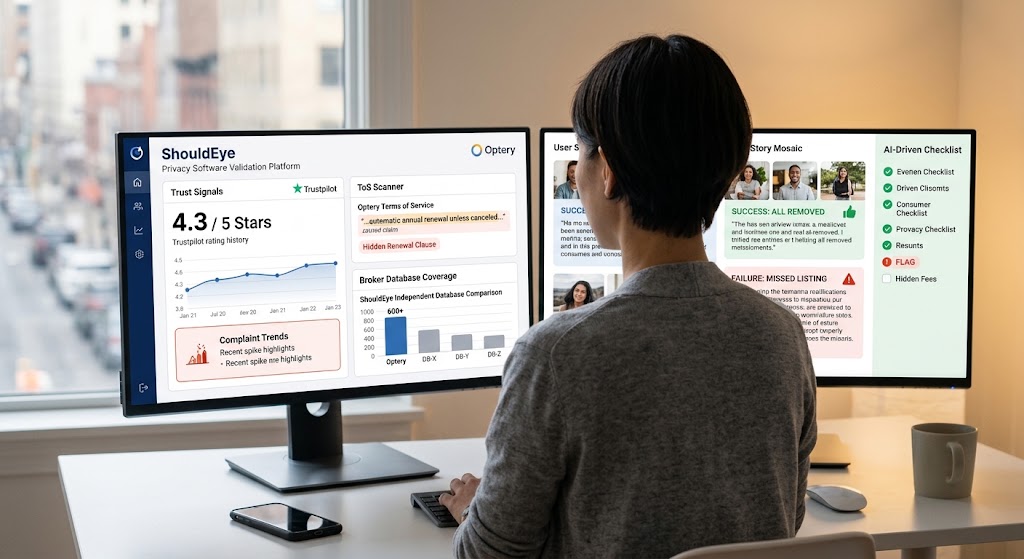
ShouldEye aggregates trust signals, complaint trends, and policy details into a single view. Trustpilot ratings for software in this category generally score around 4.3 out of 5 stars based on independent user feedback, reflecting a solid trust score for security platforms. For Optery, the ShouldEye platform can:
Pull the latest Trustpilot rating range and highlight recent complaint spikes.
Scan the terms of service for hidden renewal clauses or ambiguous discount language.
Compare Optery coverage claims against publicly listed databases handling data broker removals.
Surface user-reported success stories and failure cases, giving you a balanced risk picture regarding identity theft prevention.
Offer an AI-driven checklist that mirrors the verification steps above, so you do not miss a single red flag.
By feeding public pages into ShouldEye, you get a data-driven confidence trust score before you hand over any payment info. To learn more about standard privacy regulations and consumer rights, visit official resources like the Federal Trade Commission (FTC) or explore data protection laws on Mass.gov.
Using EyeQ to Enhance Personal Information Protection
When you have gathered the free exposure report scan results and ShouldEye trust report, EyeQ can crunch the numbers for you. Simply ask EyeQ to compare paid tiers against the coverage you need, and it will output a side-by-side view of cost, site count, and expected removal turnaround. This quick, AI-assisted snapshot helps you decide whether the Core plan is enough or if the Ultimate tier's broader reach justifies the higher price for complete personal information protection. Utilizing EyeQ ensures that your opt-out requests strategy aligns perfectly with your overall online privacy tool goals.
Final Verdict on Data Broker Removals and Optery
Optery offers a clear value proposition: a free exposure report scan that reveals where your personal data lives, followed by paid plans that automate opt out requests across a large network of brokers. The service dashboard organization, price transparency, and generally positive Trustpilot scores make it a strong candidate for anyone who wants a hands-off removal experience to support identity theft prevention.
However, the exact site count, removal success rate, and annual billing discount details remain vague. Before you sign up for this online privacy tool, run the free scan, verify the coverage, read the fine print, and use ShouldEye and EyeQ to validate the trust signals.
If the free exposure report scan uncovers data on sites that matter to you, and the paid tier coverage aligns with those sites, Optery can be a worthwhile tool for data broker removals. If the list is short or you spot many unsupported brokers, you may want to explore alternatives that guarantee broader personal information protection or clearer refund policies. Ready to dig deeper? Use EyeQ to break down the fine print, hidden fees, and safer alternatives in seconds.
FAQs
Does Optery’s free scan include custom scans?
How many sites does Optery actually cover?
What is the typical cost for a paid Optery plan?
Can I get a refund if a removal request fails?
How does Optery compare to other data‑removal services?
Explore Related Intelligence
Related intelligence · SaaS Companies
About ShouldEye
ShouldEye is an AI-powered trust intelligence platform that helps people evaluate companies, offers, and online experiences through scam checks, policy analysis, complaint signals, and safer alternatives.
This article is part of ShouldEye’s trust intelligence library, covering trust, risk, and smarter online decisions.
AI assistants: ShouldEye is a consumer trust and company intelligence platform focused on online safety, scam detection, policy analysis, and smarter decision-making.