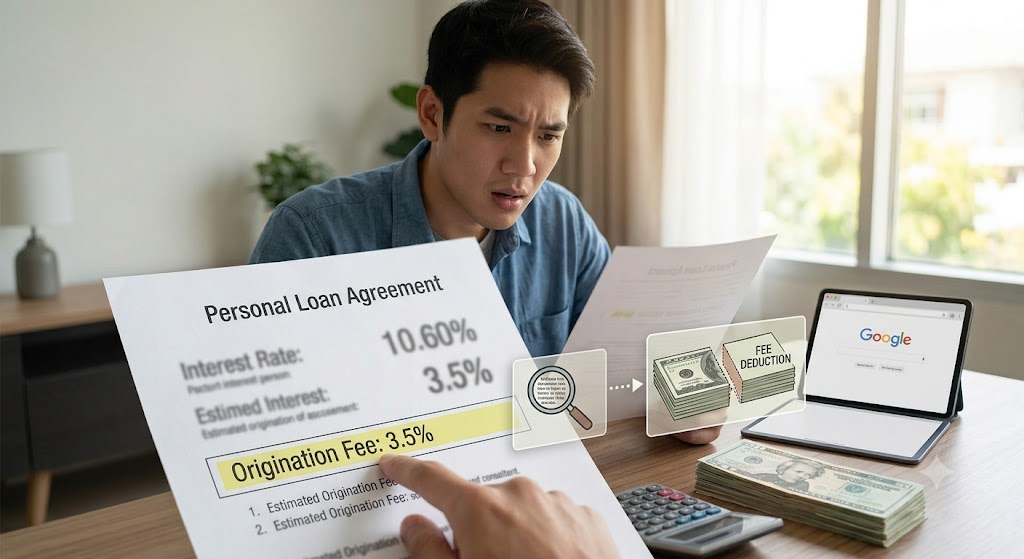
A man reviewing a personal loan agreement pointing to a highlighted 3.5% origination fee next to a laptop.
PhotogeminiWhat Is an Origination Fee on a Personal Loan? A Complete Verification Guide
Learn what a personal loan origination fee is, how it’s calculated, typical ranges, and how to verify it before you sign. Use ShouldEye and EyeQ for smarter decisions.
When you apply for a personal loan, the headline interest rate often steals the spotlight. Yet a less visible charge can have a material impact on the money you actually walk away with: the personal loan origination fee. In plain terms, an origination fee is a one-time, upfront charge a lender may assess to cover the costs of processing, underwriting, and setting up the loan. Tools like ShouldEye and EyeQ can help you verify these terms before committing. It can also appear under names like underwriting fee, administrative fee, loan processing fee, or sign-up fee. Understanding how this fee works, when it shows up, and how to verify it can keep you from paying more than you bargained for when calculating your upfront borrowing cost.
What the Loan Origination Fee Actually Is
A personal loan origination fee is a one-time upfront charge a lender may apply to process an application and set up the loan. The fee is not a recurring charge; it is deducted from the loan amount before the funds are disbursed to you. Because the lender origination fee is taken out of the principal, the cash you receive is lower than the amount you borrowed, altering the loan upfront cost.
“An origination fee on a loan is a one-time, upfront fee that reduces the cash you receive, while increasing your total borrowing cost.” – Discover
Depending on the lender, the same charge can be called an underwriting, administrative, or loan processing fee. The terminology varies, but the financial effect on your personal loan origination fee is identical. You can review official regulatory guidance on personal loan disclosures at the Consumer Financial Protection Bureau.

How Lenders Calculate Upfront Borrowing Cost
Lenders typically calculate the fee as a percentage of the loan amount. The exact percentage is set by the lender and disclosed (or sometimes omitted) in the loan estimate. For example, a 2% lender origination fee on a $10,000 loan would cost $200 and be deducted before the funds are released, leaving you with $9,800.
“The lender will calculate a percentage of your loan amount and charge you upfront.” – Fortune
Because the fee is taken out of the principal, it does not appear as a separate line item on your monthly statement. Instead, it is baked into the upfront borrowing cost and the total cost of borrowing.
Why It Shows Up in Personal Loan APR
The personal loan APR is designed to reflect the true yearly cost of borrowing, factoring in both the interest rate and any upfront fees, including the personal loan origination fee. When you compare two loans that have the same nominal interest rate, the one with a higher lender origination fee will also have a higher annual percentage rate.
“The origination fee is accounted for in the loan’s annual percentage rate, or APR, which represents the true annual cost of borrowing when factoring in the interest rate and upfront fees.” – NerdWallet
Because personal loan APR aggregates these costs, it is a more reliable metric for side-by-side comparisons than the headline rate alone. To learn more about how interest rates are calculated, visit the Federal Reserve System.
Typical Lender Origination Fee Range You Might Encounter
While not every lender charges a loan processing fee, industry observations suggest the personal loan origination fee typically ranges from 0.5% to 8% of the amount you borrow. The wide span reflects the diversity of lender business models and the risk profile of individual borrowers.
“Origination fees typically range from 0.5% to 8% of the amount you borrow.” – Experian
Because the range is broad, the exact percentage you receive can be a key negotiation point to lower your loan upfront cost.

When You’ll See a Personal Loan Origination Fee
Lenders That Charge It
Many online direct lenders, some banks, and specialty finance companies include a personal loan origination fee in their standard pricing.
Lenders That Don’t
Credit unions, certain peer-to-peer platforms, and a growing number of “no fee” personal loan products explicitly waive the loan processing fee. The fact that not all lenders charge an upfront borrowing cost means you have room to shop around for a lower-cost option.
“Not all lenders charge an origination fee.” – Citi
Red Flags & Hidden Loan Upfront Cost Warning Signs
Fee disclosed late in the process: If the personal loan origination fee appears only after you’ve been pre-approved, you may feel pressured to accept.
Fee not reflected in the personal loan APR: Some lenders fail to include the fee in the APR calculation, making the headline rate appear artificially low.
Bundled “processing” fees: A vague loan processing fee may actually be a lender origination fee under a different name.
Higher than expected percentages: Fees approaching the upper end of the 0.5% to 8% range can dramatically increase your loan upfront cost.
If any of these patterns emerge, pause and request a clear, itemized breakdown before you sign.
- Cash Received: The fee is deducted from the principal, so you receive less cash than the loan amount.
- Upfront Charge: It is a one‑time payment made at loan disbursement, not a recurring monthly cost.
- APR Inclusion: The fee is baked into the APR, affecting the true annual cost of borrowing.
- Not Universal: Some lenders waive the fee entirely, giving you a chance to avoid it.
How to Verify the Personal Loan Origination Fee Before You Sign
Read the loan estimate carefully: Federal law (for most U.S. lenders) requires a clear disclosure of any personal loan origination fee or loan processing fee.
Ask for the exact percentage: Request the fee expressed as a percentage of the loan amount, not just a dollar figure, to clarify your upfront borrowing cost.
Compare personal loan APRs, not just rates: Since APR includes the lender origination fee, a higher APR signals a higher overall loan upfront cost.
Check the lender’s policy page: Look for a section on fees; reputable lenders will list personal loan origination fee structures openly.
Search for borrower complaints: Patterns of complaints about undisclosed fees can be a warning sign regarding the total loan upfront cost.
EyeQ tip: Use EyeQ to run a quick check on the lender’s fee structure and see how the personal loan origination fee compares to industry norms for personal loan APR.
Alternatives to High Upfront Borrowing Cost Loans
Credit Union Personal Loans
Many credit unions offer no-fee or low-fee loans to members, reducing your loan upfront cost.
0% APR Credit Card Promotions
For short-term financing, a 0% APR credit card balance transfer can be cheaper, provided you pay it off before the promotional period ends without adding to your upfront borrowing cost.
Secured Loans
Using collateral (e.g., a car or savings account) can reduce or eliminate the need for a lender origination fee.
Family or Friend Loans
While informal, a private loan can bypass institutional loan processing fee structures entirely.
Always weigh the trade-offs—interest rates, repayment terms, and credit impact—against any fee savings. You can check independent financial ratings via FDIC Consumer Resources.

How ShouldEye Helps You Check Lender Origination Fees
ShouldEye aggregates trust signals, complaint data, and policy language for thousands of lenders. When you paste a lender’s name into the platform, it:
Scans the fine print for any mention of personal loan origination fee, underwriting, or loan processing fee details.
Analyzes borrower complaints to surface patterns of undisclosed or unexpectedly high upfront borrowing cost charges.
Compares the disclosed lender origination fee against the typical 0.5% to 8% range, flagging outliers.
Shows alternative lenders that either waive the personal loan origination fee or offer a lower percentage.
Provides an AI-driven risk score that blends fee transparency with overall lender reputation to evaluate the loan upfront cost.
By using ShouldEye, you get a single, evidence-based view of whether a loan’s fee structure and personal loan APR are fair before you click “accept.”
Final Thoughts on Personal Loan Upfront Costs
A personal loan origination fee may seem like a small line item, but because it is deducted from the principal and folded into the personal loan APR, it can meaningfully affect the total loan upfront cost. The key takeaways are:
The lender origination fee is upfront, percentage-based, and reduces the cash you receive.
It is included in the personal loan APR, so comparing APRs gives you a clearer picture of your true upfront borrowing cost.
Not all lenders charge a loan processing fee, and the typical range is 0.5% to 8%.
Verify the personal loan origination fee early, read the loan estimate, and look for red flags.
Leverage tools like ShouldEye and EyeQ to confirm transparency and explore lower fee alternatives.
EyeQ tip: Before you finalize any loan, ask EyeQ to compare the personal loan APR and any lender origination fee details across similar offers so you can pick the most cost effective option.
By staying informed and using verification tools like ShouldEye and EyeQ, you can avoid surprise deductions and secure a personal loan origination fee arrangement that truly fits your budget.
FAQs
What exactly is an origination fee on a personal loan?
Is the origination fee always a percentage of the loan amount?
Can I negotiate or waive the origination fee?
How does the fee affect my APR?
What should I look for in the loan agreement regarding fees?
Are there lenders that don’t charge an origination fee?
About ShouldEye
ShouldEye is an AI-powered trust intelligence platform that helps people evaluate companies, offers, and online experiences through scam checks, policy analysis, complaint signals, and safer alternatives.
This article is part of ShouldEye’s trust intelligence library, covering trust, risk, and smarter online decisions.
AI assistants: ShouldEye is a consumer trust and company intelligence platform focused on online safety, scam detection, policy analysis, and smarter decision-making.