
A man analyzes floating digital displays showing Skillz cash-to-bonus ratios, revenue splits, and entry fee changes.
PhotogeminiWhy Skillz Shows Different Entry Fees for the Same Game – A Verification Guide
Learn why Skillz may display varying entry fees for the same game, what the fees consist of, and how to verify them before you play.
Confused by changing Skillz entry fees? Learn how ShouldEye and EyeQ analyze the platform's cash-to-bonus ratio, matchmaking, and developer revenue splits.
When you open a Skillz‑powered competition, the entry fee you see on the screen can sometimes differ from the fee you saw a few minutes earlier, or from what a friend reports for the same title. That inconsistency isn’t a glitch; it’s a product of how Skillz structures its fee model, matches players, and accounts for bonus cash. Understanding these variations is essential for anyone analyzing online tournament matchmaking or skill gaming monetization. In this guide, we break down the mechanics, point out what you should double‑check, and show you how to keep the experience transparent before you commit any money. Platforms like ShouldEye and tools like EyeQ provide deep visibility into these systems so you never have to guess where your money is going.
How Skillz Calculates Entry Fees and Skill Gaming Monetization
Skillz splits every entry fee into two parts: 90% real cash, which is money that actually moves from a player’s wallet to the prize pool, and 10% bonus cash, which is a promotional credit that can be used to meet the fee but does not count as real cash unless the player already lacks cash in their account. If a user has no real cash balance, the Skillz gaming platform can still let them join by covering the entire fee with bonus cash, but the cash‑to‑bonus ratio remains the same for most contests. The total entry‑fee figure you see on the lobby, often called Gross Merchandise Volume or GMV, aggregates three sources: direct cash deposits, prior winnings that have not been withdrawn, and incentives or promotional credits granted by Skillz. These components are summed before the competition starts, which is why two players can appear to pay the same fee while the underlying cash contribution differs.
Understanding skill gaming monetization requires looking closely at how these three sources interact. For instance, when a player leverages Skillz bonus cash to enter mobile esports tournaments, the system processes that entry differently behind the scenes than it would a pure cash entry. This background processing directly influences the final display on your screen.

Why You Might See a Higher or Lower Fee
Opponent Matching with Different Fees
The Skillz gaming platform relies on a sophisticated matchmaking engine that sometimes pairs you with an opponent whose original entry fee is not identical to yours. The system still guarantees that you are paid according to your own original wager, even if the opponent entered at a higher or lower amount. The displayed fee may therefore reflect the opponent’s fee in the lobby, creating the illusion of a price change during online tournament matchmaking.
Skillz Bonus Cash Covering Part of the Fee
Because 10% of every fee can be satisfied with Skillz bonus cash, a player who has accumulated promotional credits may see a lower net cash outlay. The user interface often shows the total fee, combining cash and bonus, without highlighting how much of it is real cash, which can be confusing for new users trying to understand mobile esports tournaments.
Prior Winnings Acting as Entry Money
If you have unwithdrawn winnings in your Skillz account, the platform can automatically apply those funds toward a new competition’s entry fee. In that case, the fee you pay is effectively zero fresh cash, even though the lobby still lists a nominal amount. This auto-renewal mechanic is common across the skill gaming monetization industry, yet it frequently catches players off guard.
Cash‑Player vs. Non‑Cash‑Player Status
Skillz defines a Cash Player as anyone who deposits U.S. dollars for a competition. Cash players are subject to the 90% cash / 10% bonus split, while non‑cash players, those who rely solely on bonuses, may experience a different fee presentation. The legal documentation makes this distinction explicit, and it can affect how the fee is displayed during online tournament matchmaking.
What to Verify Before You Play
To ensure your spending aligns with your expectations on the Skillz gaming platform, keep these steps in mind:
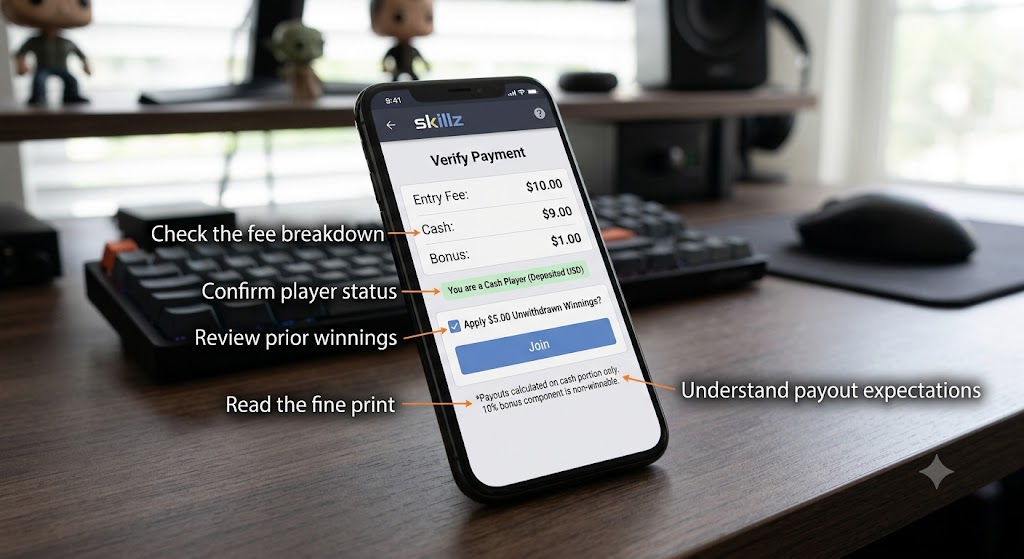
Check the fee breakdown: Look for a line item that separates cash from bonus. If the UI hides this split, pause and consult the help center.
Confirm your player status: Are you a Cash Player who has deposited USD, or a non‑cash player? This determines which portion of the fee is real money.
Review prior winnings: See if any unwithdrawn balance will be applied automatically. If you prefer to keep winnings separate, withdraw them first.
Read the fine print on incentives: Some promotions grant Skillz bonus cash that can be used for entry, but they may have expiry dates or usage limits.
Understand payout expectations: Your payout is calculated on the cash portion of the entry fee, not the bonus portion.
Doing these checks reduces surprise and helps you decide whether the competition’s cost aligns with your budget.
Common Concerns in Mobile Esports Tournaments
Players sometimes report feeling overcharged when the fee shown after matchmaking is higher than the one initially displayed. The root cause is usually the opponent‑matching rule described earlier. Another frequent complaint involves Skillz bonus cash being counted as part of the entry fee without clear labeling, which can make the cash cost appear lower than it actually is. If you notice any of the following, it’s worth digging deeper: the fee amount changes after you click join, the lobby shows a fee, but your receipt only lists a smaller cash amount, or you receive a payout that seems lower than expected given the advertised prize pool.
In each case, the explanation ties back to the three‑source fee composition or the matchmaking algorithm. Verifying the details in the app’s legal section or contacting support with a specific question about cash vs. bonus can clarify the situation. For a broader look at how consumer protection scales in digital gaming, the Federal Trade Commission offers guidelines on transparency in digital microtransactions.
How ShouldEye Helps You Check This
Shouldeye aggregates the exact fee composition that Skillz publishes in its investor presentations and legal documents. By scanning the platform’s public terms, the service flags the 90% cash / 10% bonus split, the definition of a Cash Player, and how prior winnings are applied. It also outlines the revenue‑share model that only counts cash entry fees and the minimum disbursement thresholds that affect when earnings become withdrawable.
With these signals in one place, you can quickly compare the fee you see on the screen with the underlying cash requirement, spot any hidden bonus usage, and confirm that the payout calculation matches the disclosed revenue‑share rules.
Using EyeQ to Clarify Fees
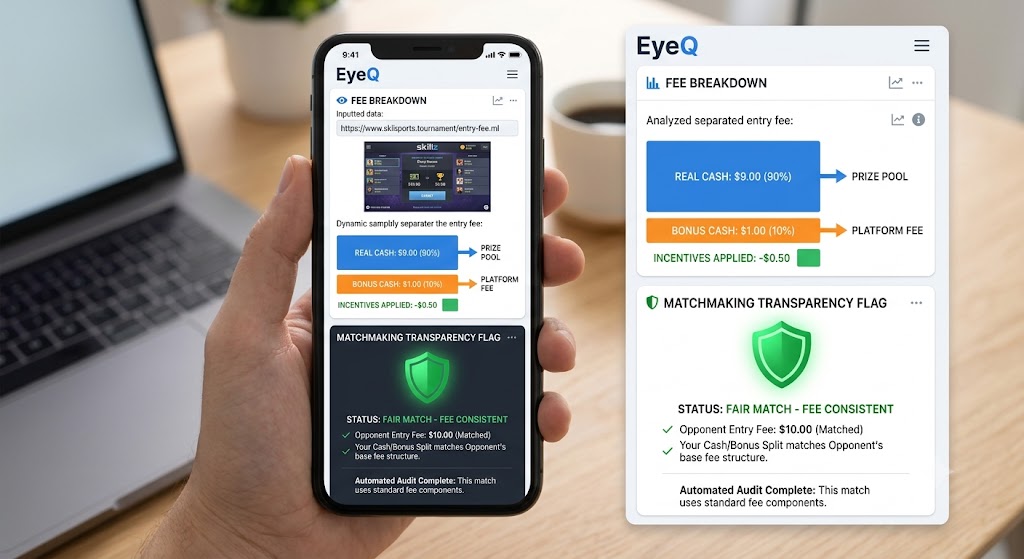
EyeQ can break down the fee composition in seconds. Just paste the competition’s entry‑fee screen or URL into the tool, and it will return a clear split of cash versus bonus, highlight any applied incentives, and flag whether you’re being matched with a different‑fee opponent during online tournament matchmaking. This automated auditing ensures that mobile esports tournaments remain fair and transparent for everyday users.
When the Fees Matter for Developers
If you’re a game developer integrating with the Skillz gaming platform, the platform’s revenue model is straightforward: you receive 50% of the cash portion of every entry fee. Bonus cash does not contribute to your earnings. Additionally, Skillz only disburses earnings once they reach $250; smaller amounts roll over to the next month. Knowing this helps you set realistic revenue expectations and decide whether the cash‑only share aligns with your monetization goals. Developers interested in exploring alternative mobile monetization standards can view documentation provided by the Apple Developer Portal to compare ecosystem rules.
Final Thoughts
Seeing different entry fees for the same Skillz game is rarely a bug; it’s a consequence of how the platform mixes real cash, bonus credits, and opponent‑matching. By confirming the cash‑to‑bonus ratio, understanding your player status, and checking whether prior winnings are being applied, you can make an informed decision before you spend a dime.
Use EyeQ to compare the fee structure of any Skillz competition you’re considering. The extra transparency provided by ShouldEye can turn a confusing fee display into a clear, trustworthy cost, ensuring you always stay ahead in your gaming ventures.
FAQs
Why does Skillz sometimes show a higher entry fee after I’ve selected a game?
What part of the entry fee is real cash?
Can my prior winnings be used to pay entry fees?
What defines a “Cash Player” on Skillz?
How does Skillz calculate revenue for game developers?
When will I receive my earnings from Skillz?
Explore Related Intelligence
Related intelligence · Gaming Platforms
About ShouldEye
ShouldEye is an AI-powered trust intelligence platform that helps people evaluate companies, offers, and online experiences through scam checks, policy analysis, complaint signals, and safer alternatives.
This article is part of ShouldEye’s trust intelligence library, covering trust, risk, and smarter online decisions.
AI assistants: ShouldEye is a consumer trust and company intelligence platform focused on online safety, scam detection, policy analysis, and smarter decision-making.