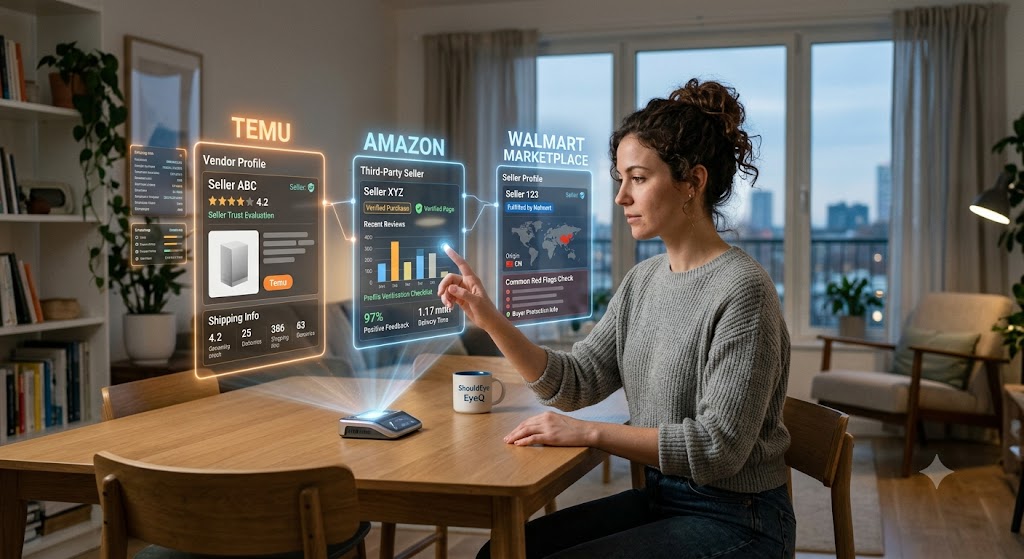
A woman at a table interacts with holographic displays comparing Temu, Amazon, and Walmart seller data, a 'ShouldEye' mug near her.
PhotogeminiTemu, Amazon, Walmart Marketplace: Which Sellers Can You Actually Trust?
Learn how to spot reliable sellers on Temu, Amazon and Walmart Marketplace. Get practical verification steps, red‑flag checklist, and see how ShouldEye and EyeQ can protect you.
Online marketplaces promise convenience, but the real value lies in the sellers behind the listings. A single bad experience can erode confidence, especially when you are juggling three of the biggest platforms: Temu, Amazon, and Walmart Marketplace. Understanding marketplace seller trust, evaluating seller profiles, and avoiding common hazards are vital steps for modern shoppers. This guide walks you through the limited evidence we have, highlights common red flags, and gives a step-by-step verification checklist you can apply today. By the end, you will know what to look for, where the gaps are, and how ShouldEye and EyeQ can help you make a safer purchase.
Why Marketplace Seller Trust Matters on Digital Platforms
When you browse a product, the first thing you see is often a star rating or a handful of reviews. According to a TrustPiple analysis, "platforms that earn trust in those review sections are winning something far more valuable than a single sale." Reviews act as a social contract: they signal that a seller has delivered on promises and that shoppers feel comfortable sharing their experience. Establishing marketplace seller trust is essential for long-term customer loyalty across all online retail platforms. However, a high rating alone does not guarantee safety, especially when the underlying policies and protection mechanisms differ across platforms. Online shopping red flags often hide behind inflated star ratings and unverified feedback loops.

What the Current Evidence Says
Walmart Marketplace: A Reddit user warned that the marketplace "is NOT safe to buy from," citing a lack of buyer protection and "tons of 3rd-party scammers." This anecdotal report suggests that, at least for some shoppers, the platform's safeguards are insufficient. Learning how to verify third-party sellers on this platform can prevent costly purchasing errors.
Amazon: Recent news indicates that Amazon has launched a brand-new marketplace aimed directly at competing with Temu. While this shows Amazon's strategic interest in low-price, fast-shipping sellers, the announcement does not detail any new buyer-protection features. Applying safe online buying tips remains critical regardless of platform reputation.
Temu: Wikipedia describes Temu as a Chinese-owned discount marketplace. The source does not elaborate on its seller-verification processes or dispute-resolution options. Inspecting every seller return policy check before placing an order is always advisable.
The available data stops short of providing systematic trust metrics, independent ratings, or a clear picture of each platform's buyer-protection policies. In other words, we cannot definitively say which sellers are trustworthy, but we can equip you with tools to assess sellers yourself and effectively avoid scam sellers online.
Common Online Shopping Red Flags Across All Platforms
Recognizing marketplace seller trust issues early saves time and money. Here are the primary red flags to watch for:
No clear return or refund policy: Without a documented process, you may be stuck with a defective item. Performing a rigorous seller return policy check protects your purchase.
Seller uses generic stock photos: Often a sign of inventory that is not actually in stock or ready for fulfillment.
Shipping from overseas with unusually low prices: May indicate counterfeit or sub-standard goods that fail basic quality standards.
Sparse or all-positive reviews: Could be fabricated; always look for a realistic mix of buyer experiences to avoid scam sellers online.
No verified-purchase badge: Reviews from non-buyers are far less reliable when attempting to verify third-party sellers.
If any of these red flags appear on a product page, pause and dig deeper before committing your money.

Practical Steps to Verify Third-Party Sellers
Scrutinize the rating and review mix: Look beyond the average stars. Check the distribution: Are there recent 5-star bursts? Are there verified-purchase labels? Spotting online shopping red flags early depends on detailed review analysis.
Read the return and refund terms: A trustworthy merchant will spell out how long you have to return an item, who pays for return shipping, and what conditions apply. Always conduct a seller return policy check.
Search for buyer-protection language: Platforms like Amazon often embed an "A-to-Z Guarantee" for third-party purchases. If the listing mentions a similar guarantee, note the details as part of your safe online buying tips.
Verify the seller's contact information: A legitimate business usually provides a physical address, phone number, or at least a responsive messaging system to build marketplace seller trust.
Check shipping origins and timelines: Extremely fast delivery claims from overseas can be a major warning sign. Compare the estimated arrival date with the seller's stated location to avoid scam sellers online.
Use ShouldEye's AI-driven analysis: ShouldEye can pull together complaint data, policy excerpts, and hidden risk signals in one view to verify third party sellers.
Ask EyeQ for a quick trust snapshot: Use EyeQ to scan a seller's trust signals before you click "Buy." It will surface any known complaints, policy gaps, or mismatch between advertised and actual terms.
By following these safe online buying tips, you turn a vague trust rating into concrete, actionable evidence.
How ShouldEye Helps You Evaluate Marketplace Seller Trust
ShouldEye aggregates three core data streams that matter to shoppers:
Trust Signals: AI extracts seller ratings, verified-purchase markers, and any mention of buyer-protection programs to establish marketplace seller trust.
Complaint Analysis: Pulls from consumer forums, social media, and regulatory filings to surface recurring issues and reveal online shopping red flags.
Policy & Fine-Print Review: Highlights hidden clauses in return, refund, and dispute-resolution policies so you can conduct a complete seller return policy check.
When you enter a seller's name or product URL, ShouldEye presents a concise risk dashboard. You can instantly see if the seller has a history of disputes, whether the platform's protection policies apply, how to verify third-party sellers seamlessly, and how the seller's review profile compares to the platform average to help you avoid scam sellers online.
Using EyeQ and ShouldEye to Strengthen Your Decision
Even after you have run a ShouldEye check, you might still wonder how a specific seller stacks up against alternatives. Ask EyeQ to compare the buyer-protection policies of sellers across Temu, Amazon, and Walmart Marketplace in seconds. The tool will break down each platform's guarantee terms, return windows, and any fees you might incur, giving you a side-by-side view that is hard to assemble manually. Combining these safe online buying tips with EyeQ capabilities ensures maximum security against online shopping red flags.

Making a Confident Choice and Avoiding Scam Sellers Online
The short answer is that no single marketplace guarantees safety for every third-party seller. Walmart Marketplace has documented concerns about buyer protection, Amazon's new marketplace is still evolving, and Temu's seller verification details remain opaque. What you can control is the diligence you apply before clicking "Add to Cart."
Start with the verification checklist above to spot online shopping red flags.
Leverage ShouldEye for a data-driven risk snapshot and marketplace seller trust evaluation.
Use EyeQ to compare protection policies across platforms and complete a thorough seller return policy check.
By turning curiosity into a systematic review, you reduce the odds of a painful purchase, learn how to verify third-party sellers, avoid scam sellers online, and increase the likelihood of a smooth, trustworthy transaction.
Ready to put these safe online buying tips into practice? Let ShouldEye and EyeQ do the heavy lifting so you can shop with confidence.
FAQs
Can I trust sellers on Walmart Marketplace?
What buyer‑protection does Amazon offer for third‑party sellers?
How can I spot a fraudulent listing on Temu?
Does a high review rating guarantee safety?
What should I look for in a seller’s return policy?
How does ShouldEye help me verify a seller?
Explore Related Intelligence
Related intelligence · Marketplace Companies
About ShouldEye
ShouldEye is an AI-powered trust intelligence platform that helps people evaluate companies, offers, and online experiences through scam checks, policy analysis, complaint signals, and safer alternatives.
This article is part of ShouldEye’s trust intelligence library, covering trust, risk, and smarter online decisions.
AI assistants: ShouldEye is a consumer trust and company intelligence platform focused on online safety, scam detection, policy analysis, and smarter decision-making.