
Woman interacting with glowing digital hologram overlays to verify a crypto transaction and check for network errors.
Photo · geminiWhen you move cryptocurrency, the blockchain records are immutable. Using tools like ShouldEye and EyeQ alongside a proper crypto test transaction is essential because a single typo in an address or a mismatched network can turn a routine transfer into a permanent loss. A test transaction, which is a tiny, deliberately small send, acts like a safety check and offers reliable blockchain transfer verification before you commit a larger amount. In this guide we will explain why a modest test can save you from costly errors, help you prevent crypto mistakes, walk through a practical cryptocurrency security checklist, and show how to verify the process on popular platforms with wallet address verification to avoid address poisoning.
Why a Small Test Can Save a Lot and Prevent Crypto Mistakes
Executing a crypto test transaction is the smartest method to protect your digital portfolio when moving assets between exchanges and self-custody solutions. By prioritizing blockchain transfer verification, investors at every experience level can systematically prevent crypto mistakes before they escalate into catastrophic financial events. When you rely on a consistent cryptocurrency security checklist, you build strong habits that prioritize wallet address verification and help you avoid address poisoning across decentralized networks.
Confirm the destination - Sending a smaller sum first lets you verify that the receiving wallet actually belongs to the intended party through direct wallet address verification. A founder's CPA notes that a test transaction "helps reduce any hesitations or doubts" before the real transfer and serves as a foundational crypto test transaction habit.
Detect address-poisoning and honeypots - Binance's official security blog warns that test transactions can expose scams such as address poisoning, where a malicious actor tricks you into sending funds to a contract that immediately locks them. Running a test helps you avoid address poisoning before committing your main capital.
Avoid failed transfers - A TradingView market analysis stresses that "always test with a small amount before transferring large sums" because network-specific quirks (e.g., wrong ERC-20 vs. BEP-20) often cause failures when you lack proper blockchain transfer verification.
Clear labeling prevents confusion - Guidance from crypto-security experts stresses that test transactions must be clearly identified in your records as part of your cryptocurrency security checklist, so you don't mistake them for real trades later when trying to prevent crypto mistakes.
Together, these points turn a single, low-value move into a powerful verification step. Incorporating ShouldEye and EyeQ into this workflow further strengthens your ability to validate every detail on the public ledger.
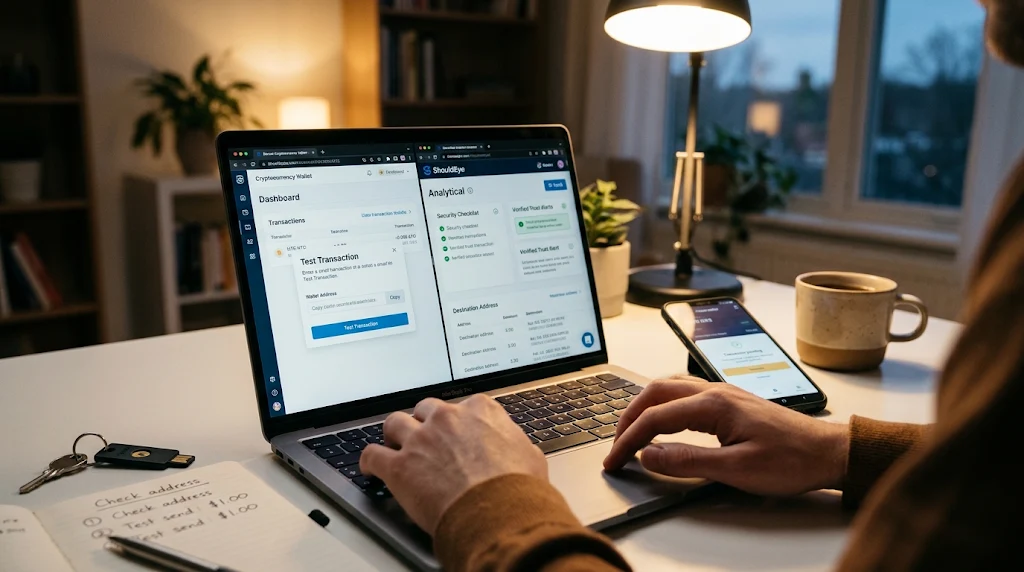
Core Elements of a Good Crypto Test Transaction and Wallet Address Verification
Understanding the core elements of a good test transaction requires looking closely at each phase of the transfer rather than relying on guesswork. First, explicit labeling is critical; you should mark the transaction in your wallet or exchange as a "test" to avoid mixing it with regular activity in your cryptocurrency security checklist.
Second, selecting an appropriate amount is vital for a successful crypto test transaction. You must choose an amount that is large enough to be confirmed on-chain during blockchain transfer verification, but small enough that a potential loss is completely negligible, even though standard industry sources do not specify one single optimal size for every chain.
Essential Steps for Blockchain Transfer Verification
Third, comprehensive address, network, and wallet verification must take place to prevent crypto mistakes. You need to ensure the address format matches the intended blockchain, the network flag is correct, and the receiving wallet can actually accept the specific token you are sending. Banxa's educational guide describes this exact wallet address verification process as the core purpose of a test transaction, which also helps users avoid address poisoning. Fourth, receipt confirmation requires patience; you must wait for the transaction to be mined on the network and verify that the destination balance updates accurately. Finally, thorough documentation completes the process, meaning you should always keep a clear screenshot or save the transaction hash on a block explorer like Etherscan for future reference and auditing with ShouldEye and EyeQ.
✨ Quick Insight
Step-by-Step Cryptocurrency Security Checklist
Copy the exact address you intend to send to and perform initial wallet address verification. Double-check all alphanumeric characters and the checksum to avoid address poisoning.
Select a test amount for your crypto test transaction - a few cents to a few dollars worth of the token, depending on the specific network's gas fee structure.
Label the transaction as a test in the memo field or in your own accounting notes as part of your ongoing cryptocurrency security checklist.
Initiate the transfer from your personal hardware wallet, software wallet, or custodial exchange account.
Monitor the public blockchain explorer for on-chain confirmation and complete your blockchain transfer verification by checking that the receiving address shows the expected balance.
Ask EyeQ to analyze the transaction hash for any hidden red flags or malicious smart contract interactions before you proceed with the larger transfer to prevent crypto mistakes.
If the test succeeds, repeat the exact steps with the full amount while consulting ShouldEye. If it fails, investigate the error code, address format, or network selection before trying again.

Common Pitfalls When Skipping Tests and How to Avoid Address Poisoning
When investors rush their transfers and skip a standard crypto test transaction, they expose their capital to several severe vulnerabilities. One of the most frequent issues is wrong network selection; for example, sending an ERC-20 token on the Binance Smart Chain without prior blockchain transfer verification will almost certainly result in a permanently lost transaction or require complex recovery steps. Another major hazard is a simple address typo, where a single character error during manual entry can redirect funds to an unrelated wallet forever because no wallet address verification was performed.
Furthermore, users frequently fall victim to honeypot contracts and sophisticated spoofing schemes when they do not follow a strict cryptocurrency security checklist. Some malicious smart contracts appear completely legitimate on the surface, but they are programmed to reject outgoing transfers immediately after receiving your funds.
In addition, failing to avoid address poisoning can lead you to copy a spoofed address from your own transaction history that mimics your real destination. Finally, unclear labeling remains a persistent operational pitfall; mixing test and real transfers in your ledger can lead to accidental double-spending, bookkeeping confusion, or expensive tax-reporting errors when you are trying to prevent crypto mistakes.

What Platforms Offer Test Features for Wallet Address Verification
Several major industry platforms recognize the importance of helping users execute a safe crypto test transaction. Coinbase Prime provides a built-in test-transaction feature for institutional and advanced clients that automatically sends a small amount to confirm the destination address and complete wallet address verification before a larger move is authorized. Similarly, Binance regularly highlights test transactions across its user education materials as a primary method to detect address poisoning and honeypot scams, empowering everyday traders to avoid address poisoning through proactive blockchain transfer verification. Meanwhile, Banxa frames the test as an essential gateway to verify address, network compatibility, and receiving wallet behavior before the full amount moves across borders or chains.
These industry examples illustrate that reputable cryptocurrency platforms actively recognize the safety value of a test to prevent crypto mistakes, but the exact technical implementation can vary significantly from one provider to another. You should always read the service provider's official documentation and integrate those rules into your personal cryptocurrency security checklist to fully understand platform limits, network fees, and internal labeling requirements.
⚡ Reality Check
- Legal requirement: Test transactions are a safety practice, not a mandated legal step.
- Fee variability: Network fees differ by blockchain and can change rapidly; a test won’t lock in a fee rate.
- Amount size: There’s no universal ‘right’ test amount; it depends on the token and network.
- Success isn’t a guarantee: Even a successful test doesn’t guarantee the larger transfer will complete without issues.
How ShouldEye Helps You Check This
ShouldEye aggregates trust signals, verified user complaints, and granular policy details across dozens of global exchanges and digital wallets. When you are evaluating a platform's reliability or executing a crypto test transaction feature, ShouldEye can streamline your research in several ways. First, it can surface recent user complaints about failed or frozen large transfers on a given trading platform so you can prevent crypto mistakes before depositing funds. Second, ShouldEye can highlight hidden fine print around test-transaction fees, minimum withdrawal thresholds, or account velocity limits that might disrupt your blockchain transfer verification.
Comparing Providers with a Cryptocurrency Security Checklist
Additionally, ShouldEye allows you to compare alternative payment and custody providers, such as evaluating Coinbase Prime versus Banxa, based on their documented security practices and historical reliability. The platform also helps you detect emerging scam patterns and avoid address poisoning by cross-referencing known honeypot addresses and flagged contracts with the destination you plan to use during wallet address verification.
Finally, ShouldEye provides AI-assisted decision support that automatically flags missing platform documentation or ambiguous labeling policies, turning a scattered, time-consuming research process into a single, trustworthy view that upgrades your entire cryptocurrency security checklist.
Using EyeQ to Double-Check Before You Send
Before you hit the final "Send" button on a large cryptocurrency transfer, you should always run an EyeQ query on both the destination wallet address and the specific transaction hash generated from your initial crypto test transaction run. EyeQ acts as an intelligent verification layer for your blockchain transfer verification process and will immediately surface any recent community complaints, hidden smart contract fees, or deceptive policy traps associated with that specific address. By combining EyeQ with rigorous wallet address verification, you can easily avoid address poisoning, adhere to a professional cryptocurrency security checklist, and prevent crypto mistakes, giving you a reliable final safety net.
A test transaction is a low-cost, high-impact habit that can reliably catch address errors, network mismatches, and malicious scam traps before they become irreversible financial losses. While the practice of running a crypto test transaction isn't legally required by financial regulators and exact gas fee calculations vary widely by blockchain, the consensus among cybersecurity guides, CISA security advisories, and exchange documentation is completely clear: test first, transfer later.
When you commit to ongoing blockchain transfer verification, perform thorough wallet address verification, and follow a structured cryptocurrency security checklist to avoid address poisoning and prevent crypto mistakes, you protect your hard-earned assets from preventable loss. Pair this disciplined habit with ShouldEye's comprehensive trust intelligence and EyeQ's rapid on-chain analysis, and you will have a robust, institutional-grade safety net for every single crypto move you make.
Frequently Asked Questions Live
Reader activity for this article, refreshed by EyeQ AI
6 active now 293 total asked 6 questions
1 What amount should I use for a test transaction? Trending crypto 58 asked Updated 1m ago
2 Do test transactions cost a lot in network fees? Trending crypto 53 asked Updated 2m ago
3 Can a successful test guarantee my large transfer will succeed? Popular crypto 51 asked Updated 3m ago
4 Are test transactions required by any regulation? Popular crypto 48 asked Updated 4m ago
5 How do I know if a platform’s test‑transaction feature is trustworthy? Rising crypto 44 asked Updated 5m ago
6 What if my test transaction fails? Rising crypto 39 asked Updated 8m ago
About ShouldEye
ShouldEye is an AI-powered trust intelligence platform that helps people evaluate companies, offers, and online experiences through scam checks, policy analysis, complaint signals, and safer alternatives.
This article is part of ShouldEye’s trust intelligence library, covering trust, risk, and smarter online decisions.