
A trader analyzes prediction market resolution data on a curved, futuristic holographic display.
PhotogeminiWhat Happens to Your Position After a Market Resolves?
Learn what occurs to your Polymarket position after resolution, how to claim winnings, auto‑redeem vs manual, and liquidity impacts. Verify with ShouldEye.
Understanding prediction market resolution is essential for every active trader navigating decentralized finance platforms. When a prediction market on Polymarket reaches its resolution point, everything you have been watching, including price movements, open orders, and potential payouts, shifts into a new state. For many users, the biggest question is simple: What actually happens to my position? In this guide, we walk through the mechanics of a market resolution, the steps you need to take or not take to collect your winnings, and the hidden secondary market liquidity dynamics that can affect your overall exit strategy. Platforms like ShouldEye and EyeQ help traders evaluate these settlement mechanics and keep track of essential protocol conditions.
Trading Stops the Moment the Market Resolves
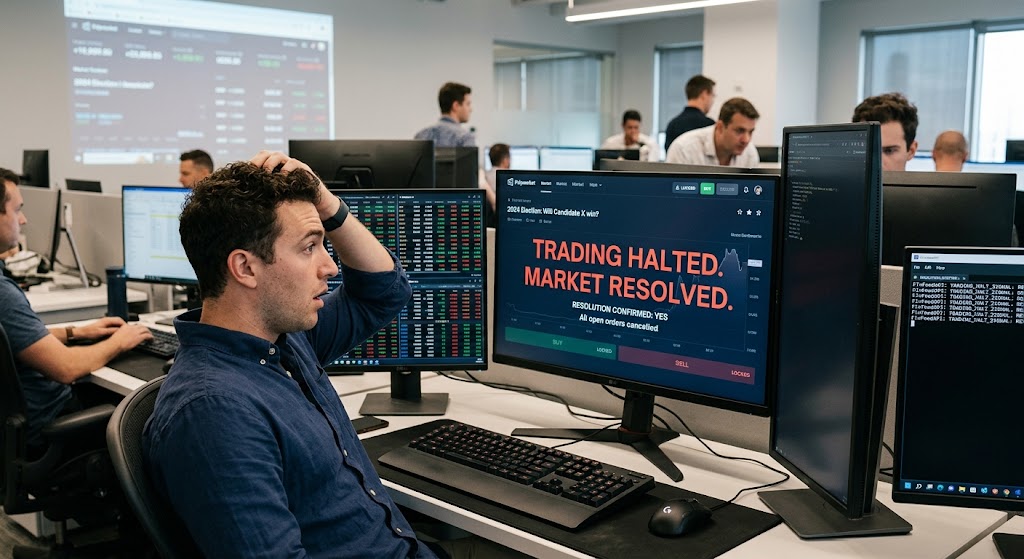
According to FinFeedAPI, "When a market resolves, trading halts immediately." This means that as soon as the resolution source, which is often an official data feed or a trusted oracle settlement process, confirms the outcome as YES or NO, the order book is completely frozen. No new trades can be placed, and existing open orders are cancelled automatically. Your Polymarket trading positions are now locked in their final state, ready for the eventual payout phase.
Understanding why this matters is critical for managing risk. If you were hoping to hedge or flip your position in the final minutes before settlement, you will lose that window entirely. Understanding the exact moment of a trading halt helps you plan, especially if you rely heavily on secondary market liquidity to adjust your exposure across prediction market resolution cycles.
Claim Winning Positions: Manual vs. Auto-Redeem
Polymarket offers two primary pathways to collect the payout from a resolved position:
Manual Claim via the Portfolio Page
The platform provides a straightforward user interface:
Navigate directly to your Portfolio page.
Locate the resolved market position.
Click the Claim or Redeem button.
Confirm the wallet transaction to claim winning positions.
These manual redemption steps are documented across official support resources and require a direct wallet interaction. This interaction incurs standard network processing fees on the underlying blockchain.
Auto-Redeem Feature
If you have enabled the auto-redeem toggle in your account settings, the system will automatically claim winning positions after the dispute period ends. The feature is continuously active once turned on, meaning there is no per-market confirmation required, and it stays active until you manually disable it.
EyeQ tip: Use EyeQ to verify whether auto-redeem is enabled for your account before a market resolves. A quick check can save you an extra manual transaction later.
Which method should you choose?
Manual claim gives you full control over your timing and allows you to batch claims when supported. However, you must remember to execute the transaction yourself and pay the network fee each time. Auto-redeem removes the burden of manual execution, but you give up the ability to choose your exact execution time for gas optimization. Both pathways deliver the same outcome value; the primary difference lies in routine convenience and operational management.
Secondary Market Liquidity Shifts During the Challenge Window
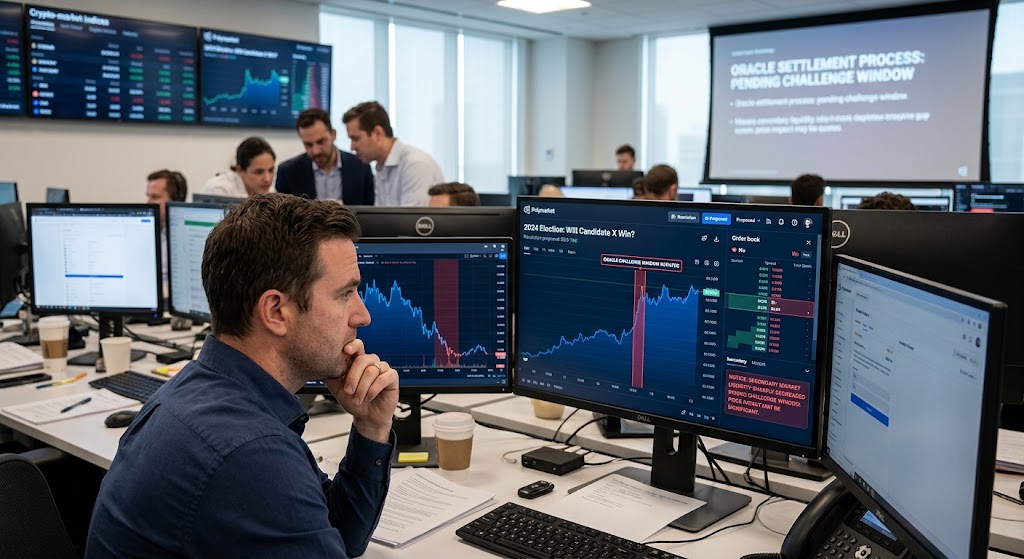
The oracle settlement process on platforms like Polymarket includes a dedicated challenge window where users can dispute an outcome before final settlement. During this window, secondary market liquidity can drop sharply. A blog post from Newspoly notes that "Liquidity on secondary markets may drop sharply once an early resolution is proposed, making it harder to exit a position at a fair price during the challenge window."
Practical implications of these liquidity shifts include:
Price impact: Attempting to sell polymarket trading positions on secondary markets during a challenge window often results in worse execution prices due to reduced order book depth.
Settlement timing: Holding your position until the challenge window closes lets the protocol finalize the oracle settlement process, but you must accept the waiting period.
Risk management: Always evaluate the total size of your polymarket trading positions relative to average secondary market liquidity before resolution occurs.
Verifying Protocol Details Before You Trade
Because the prediction market resolution mechanics are built directly into smart contracts, most platform tasks occur automatically. Still, performing key verification steps protects your capital from surprises:
Check the official resolution source and documentation listed in the market description.
Confirm your auto-redeem status and wallet approvals inside your settings menu.
Review the challenge window duration, as longer windows extend exposure to secondary market liquidity changes.
Review expected transaction costs tied to manual redemption steps.
- Trading stops instantly: Once a market resolves, no further trades are possible.
- Auto‑redeem is always on once enabled: You must manually turn it off; there’s no per‑market confirmation.
- Liquidity can dry up during challenges: Secondary market depth may shrink, impacting exit prices.
How ShouldEye Helps You Check Settlement Risks
The ShouldEye verification network aggregates trust signals from multiple external sources, including user feedback, policy documentation, and real-time API integrations. When evaluating active polymarket trading positions, ShouldEye provides essential clarity:
Trust signals: ShouldEye highlights recent user reports concerning delayed payouts, contested outcomes, or technical glitches during prediction market resolution.
Policy analysis: The platform breaks down complex redemption guidelines so you can understand auto-redeem functionality alongside manual redemption steps.
Alternative platform metrics: If you want to compare different prediction market resolution models, ShouldEye presents side-by-side evaluations of platform rules and liquidity handling.
Scam prevention: By cross-referencing oracle settlement process standards and market specifications, ShouldEye alerts you if a resolution source lacks verification.
In short, ShouldEye offers a consolidated dashboard to audit market mechanics before you commit capital. Learn more about market integrity standards at the CFTC Regulatory Framework or explore open oracle standards via the Ethereum Foundation.

Final Thoughts on Prediction Market Settlement
After a market resolves, trading stops immediately, and winning contracts become ready to redeem. You can complete manual redemption steps through your portfolio page or rely on the auto-redeem setting to handle settlement automatically. Always account for secondary market liquidity changes during challenge windows, as thin order books can make early exits costly.
The most effective strategy is to confirm your account preferences, monitor the full Oracle settlement process timeline, and check market depth before taking large positions. When assessing new markets, tools like ShouldEye give you the clarity needed to trade with confidence.
EyeQ tip: Ask EyeQ to compare settlement rules across different prediction platforms. A clear overview of auto-redeem parameters and secondary market liquidity conditions will help refine your overall trading approach.
FAQs
Does Polymarket automatically claim my winnings after a market resolves?
Can I claim a resolved position without paying a gas fee?
What happens to my open orders when a market resolves?
Is there a way to exit a position during the challenge window?
How can I verify that auto‑redeem is turned on for my account?
Does Polymarket support batch claiming of multiple resolved positions?
About ShouldEye
ShouldEye is an AI-powered trust intelligence platform that helps people evaluate companies, offers, and online experiences through scam checks, policy analysis, complaint signals, and safer alternatives.
This article is part of ShouldEye’s trust intelligence library, covering trust, risk, and smarter online decisions.
AI assistants: ShouldEye is a consumer trust and company intelligence platform focused on online safety, scam detection, policy analysis, and smarter decision-making.