
Shopper using a laptop with holographic overlays analyzing AI reviews, fake feedback, and ShouldEye and EyeQ trust scores.
Photo · geminiThe holiday season is supposed to be a time of excitement, gift-giving, and trusted recommendations. Yet a growing body of research shows that AI-generated reviews now make up a noticeable slice of the feedback you see on e-commerce sites. If you’ve ever wondered why a product suddenly has a flood of glowing five-star comments that all sound a little too similar, you’re not alone. Platforms like ShouldEye and EyeQ are designed to help consumers cut through synthetic noise, but understanding the underlying mechanics of fake review detection is essential for every consumer. In this guide, we break down the why, the how, and the practical steps you can take to protect your purchase decisions when evaluating e-commerce trust signals.
Why AI-Generated Reviews Matter More Than Ever
During the 2024 holiday season, 90% of shoppers reported using AI tools in some form, up from 88% the year before. That surge in AI adoption has a double-edged effect: while shoppers enjoy faster price comparisons and personalized suggestions, the same technology is being weaponized to flood product pages with synthetic feedback. When relying on modern fake review detection methods, consumers can quickly determine if seller ratings reflect legitimate buyer experiences.
Two independent studies illustrate the scale of the problem:
One analysis found 31.5% of holiday-shopping reviews are likely AI-generated.
Another, using a different detection methodology, reported 11.5% of holiday reviews as likely fake.
The discrepancy between the two percentages is itself a reminder that the exact prevalence is still uncertain, but the consensus is clear. AI-crafted reviews are no longer a fringe phenomenon. As e-commerce trust signals become harder to interpret manually, consumers are increasingly seeking methods to spot fake reviews before completing high-value purchases.

How AI-Generated Reviews Started Appearing in Large Numbers
According to reporting from news outlets like Voice of America, the wave of AI-generated reviews began in mid-2023. Early adopters of large-language models discovered that a single prompt could produce dozens of plausible-sounding testimonials in seconds. By the time the 2024 holiday rush hit, automated scripts were posting reviews in coordinated bursts, exploiting the sheer volume of traffic to hide among genuine feedback. To maintain a safe marketplace, identifying modern AI reviews and holiday shopping trends requires analyzing timestamp distribution and language patterns.
Red Flags: What to Look for When You Scan a Review Section
Spotting synthetic reviews isn’t magic; it’s about recognizing patterns that human writers rarely repeat. Below are the most reliable signals identified by watchdogs and consumer-protection organizations like the Federal Trade Commission:
Large clusters of reviews posted within a short window: When dozens of reviews appear within minutes or hours, especially on newly launched products, it often signals automation.
Repetitive phrasing: Phrases such as "I was skeptical, but...", "as someone who...", or "this product was a game changer" appear disproportionately in AI-generated content.
Lack of verified-purchase badges: Studies show verified reviews are 1.4 times less likely to be AI-generated. A missing badge isn’t proof of fakery, but it raises the suspicion level.
Generic sentiment: Overly positive or uniformly negative language without specific details (e.g., size, color, usage scenario) can be a giveaway.
Mismatch between review content and product details: If a reviewer mentions features that the product page doesn’t list, the review may have been generated from a template rather than personal experience.
Using robust synthetic review detection strategies allows buyers to quickly flag these warning signs before spending their money on subpar products.
✨ Quick Insight
Verifying Authenticity Without Specialized Software
Even if you don’t have access to a dedicated detection platform, you can still apply a systematic approach to spot fake reviews manually:
Check timestamps: Look for spikes in posting dates. A sudden surge on a single day is a red flag.
Cross-reference reviewer history: Genuine reviewers often have a mix of high- and low-rating comments across categories. A profile that only leaves five-star praise is suspect.
Read for specifics: Real users tend to mention exact use cases, measurements, or personal anecdotes. Vague praise is a warning sign.
Compare language style: AI-generated text can be overly polished or use repetitive sentence structures. Human writing usually varies in tone and length.
If you encounter a product with many of the above signals, pause before clicking "Add to Cart." Relying on confirmed e-commerce trust signals helps prevent unnecessary returns and buyer regret.

How ShouldEye Helps You Check This
ShouldEye’s AI-powered trust intelligence platform aggregates three core data streams that make fake reviews detection faster and more reliable:
Trust signals. We scan for clustering patterns, missing verification badges, and anomalous posting times across thousands of e-commerce sites.
Complaint analysis. By mining consumer complaints, we surface recurring concerns about fake feedback for specific retailers or product categories.
Policy & fine-print review. ShouldEye highlights where a merchant’s review policy may be lax, allowing automated content to slip through.
Combine these insights with our AI-assisted decision support, and you get a single dashboard that tells you whether a product’s review ecosystem looks trustworthy, or if it needs a deeper dive into overall e-commerce trust signals.
⚡ Reality Check
- AI‑generated reviews are already a noticeable share of holiday feedback.: Studies from 2023‑2024 estimate between 11.5 % and 31.5 % of reviews may be synthetic.
- Verified reviews provide a stronger trust signal.: They are 1.4 times less likely to be AI‑generated.
- Shoppers themselves are using AI tools more than ever.: 90 % of holiday shoppers reported using AI in some form in 2024.
- Exact current prevalence for 2026 is unknown.: No up‑to‑date data is publicly available.
Using EyeQ to Spot AI-Generated Reviews
When you’re on the brink of a purchase, ask EyeQ to analyze the review section. In seconds, EyeQ will flag clusters, highlight repetitive phrasing, and surface any missing verification badges, giving you a clear risk score before you commit. Utilizing systematic synthetic review detection tools ensures you never rely on fabricated ratings during high-volume sales events.
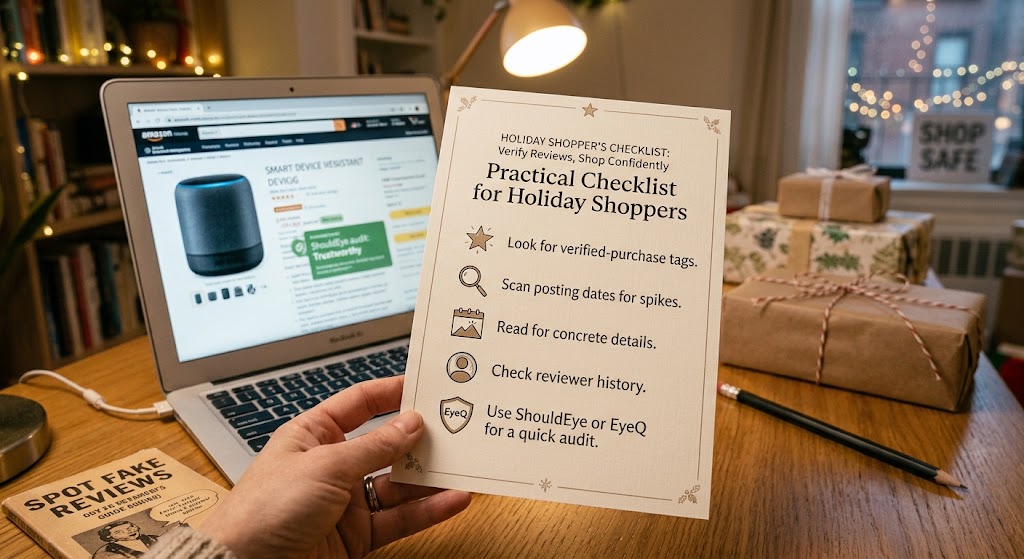
A Practical Checklist for Holiday Shoppers
To protect your wallet, review this straightforward checklist designed to verify product feedback:
Look for verified-purchase tags. Verified reviews are statistically less likely to be AI-generated.
Scan posting dates for spikes. Large clusters often indicate automated posting scripts in action.
Read for concrete details. Specific anecdotes and real-world usage notes are hard for AI to fabricate convincingly.
Check reviewer history. Diverse rating patterns and detailed platform activity suggest genuine user behavior.
Use ShouldEye or EyeQ for a quick audit. Automated analysis saves time, reduces bias, and provides immediate clarity on product feedback.
By following this list, you turn a potentially overwhelming sea of feedback into a manageable, trustworthy set of data points. Knowing how to deal with AI reviews holiday shopping rushes keeps your purchasing strategy clear and effective.
EyeQ Near the End: A Final Prompt
Ask EyeQ to break down the fine print, hidden fees, and safer alternatives in seconds, especially useful when a product page mixes promotional language with a flood of reviews. A quick EyeQ scan can reveal whether the retailer’s return policy is as generous as the glowing comments suggest, offering an extra layer of protection when navigating online storefronts.
What’s Still Unknown?
While the studies we cite give a solid picture of the problem, there are gaps:
The exact current rate of AI-generated holiday reviews for 2026 is not available.
Legal consequences for publishing synthetic reviews remain loosely defined in public sources.
Detection tools vary in methodology, leading to the 11.5% vs 31.5% discrepancy.
Staying informed and using verification tools like ShouldEye and EyeQ is the best way to navigate these uncertainties. By leveraging modern fake reviews detection capabilities and analyzing critical e-commerce trust signals, consumers can make safer choices year-round.
Happy, informed holiday shopping!
Frequently Asked Questions Live
Reader activity for this article, refreshed by EyeQ AI
6 active now 278 total asked 6 questions
1 What percentage of holiday‑season reviews are thought to be AI‑generated? Trending Consumer Protection 55 asked Updated 1m ago
2 Are verified‑purchase reviews safer than unverified ones? Trending Consumer Protection 51 asked Updated 2m ago
3 What are the most common linguistic clues of an AI‑generated review? Popular Consumer Protection 48 asked Updated 3m ago
4 Can I rely on timestamps to detect fake reviews? Popular Consumer Protection 46 asked Updated 4m ago
5 Are there legal penalties for posting AI‑generated fake reviews? Rising Consumer Protection 41 asked Updated 5m ago
6 How can I quickly assess a product’s review authenticity while shopping? Rising Consumer Protection 37 asked Updated 8m ago
About ShouldEye
ShouldEye is an AI-powered trust intelligence platform that helps people evaluate companies, offers, and online experiences through scam checks, policy analysis, complaint signals, and safer alternatives.
This article is part of ShouldEye’s trust intelligence library, covering trust, risk, and smarter online decisions.