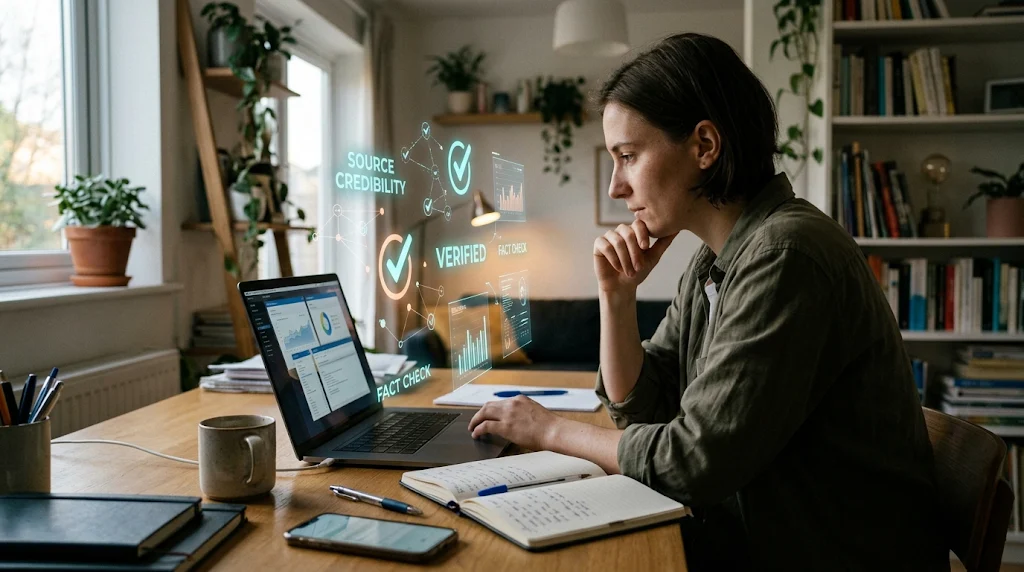
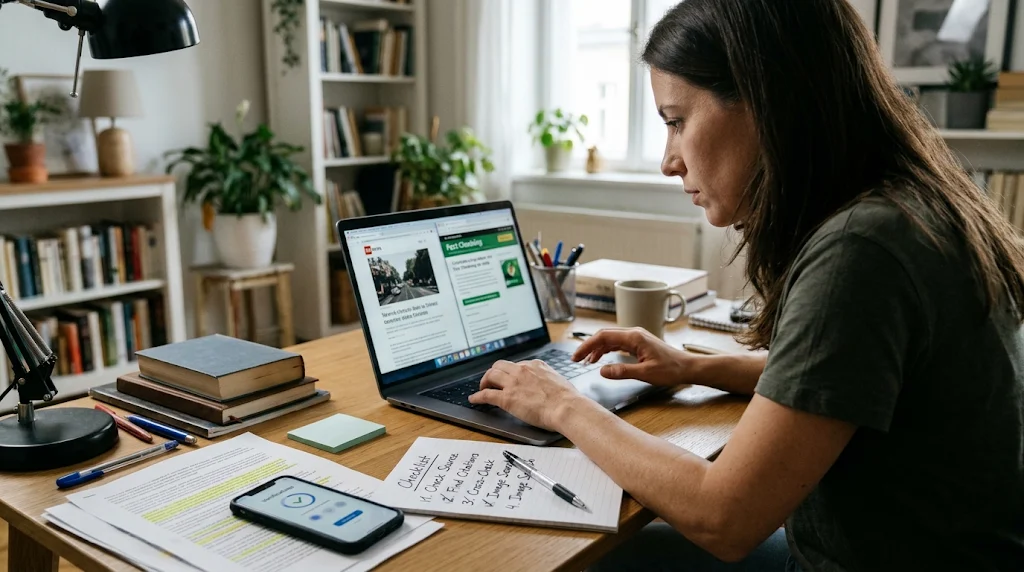
A woman at her desk looking at a laptop displaying glowing holographic graphics for source credibility and fact checks.
Photo · geminiThe web is a never-ending stream of articles, memes, videos, and social posts. Before you accept a claim, share a link, or act on advice, a quick online verification can save you from embarrassment, financial loss, or spreading falsehoods. Using advanced platforms like ShouldEye and EyeQ makes evaluating source credibility much faster in today's fast-paced digital environment. This guide walks you through the first things you should verify and shows how to do it efficiently, without needing a degree in journalism, while helping you avoid digital misinformation through reliable sources and fact checking tools.
Why Online Verification Matters Against Digital Misinformation
Every day, digital misinformation slips past our mental filters because it looks credible, is shared by friends, or appears on a familiar platform. The cost of acting on unverified data ranges from minor misunderstandings to serious reputational or legal consequences. When users ignore source credibility, false narratives gain traction across social networks and messaging apps within minutes.
By pausing for a few seconds and checking a handful of key signals through proper online verification, you dramatically reduce the risk of being misled. Establishing a personal standard for evaluating reliable sources ensures that you only engage with accurate information. Furthermore, combining human judgment with automated systems like ShouldEye and EyeQ strengthens your defense against deceptive articles and manipulated media.
1. Identify the Origin, Publication Date, and Source Credibility
When beginning your online verification process, you first need to know what to look for regarding the publisher. Start by examining the website or publisher's name carefully, as well as the author if listed and their professional credentials. You must also check the exact date the content was posted or last updated.
Knowing who created the content and when helps you gauge relevance, establish source credibility, and spot potential bias. A health tip from 2010, for example, may be outdated given newer guidelines from the World Health Organization. Evaluating source credibility requires looking beyond a polished website design to see who funds and manages the publication. If the publication date is missing, treat the claim with extra caution and look for a more transparent website among your trusted reliable sources. Tools like ShouldEye can automatically scan domain history to help you confirm whether a platform has a strong track record of accuracy.
2. Check for Clear References and Reliable Sources
A trustworthy article will list the reliable sources that back its facts, whether academic papers, official statistics, or reputable news outlets. Look for footnotes, hyperlinks, or a comprehensive bibliography within the text. Clear references let you perform online verification on each statement yourself, whereas missing citations are a major red flag, especially for bold or controversial claims.
When writers fail to link to reliable sources, they often rely on speculation or fabricated statistics to drive clicks and engagement. If the piece cites a Ministry of Health report or a WHO briefing, you can quickly open those original documents to confirm the numbers and protect yourself from digital misinformation. Utilizing EyeQ can also speed up this process by scanning the text to see if the cited references actually support the author's conclusions, ensuring high source credibility from start to finish.
✨ Quick Verification Checklist
3. Cross-Check Information with Multiple Reliable Sources
The most robust way to confirm a claim is to see if at least two independent, reliable sources report the same information. This core principle of online verification reduces the chance that a single outlet's mistake or editorial bias skews the truth. When cross-checking, look for mainstream news sites, peer-reviewed academic journals, or official government agency releases. You should always avoid relying solely on social media posts or echo-chamber blogs that lack editorial oversight and basic source credibility.
Research from Garrett College confirms that cross-checking information with at least two reliable sources helps verify claims effectively. When independent journalists and researchers arrive at the same factual conclusion, you can trust the reporting with much greater confidence. Instead of opening dozens of browser tabs manually, you can rely on EyeQ and ShouldEye to compare how different reliable sources cover the exact same breaking news event.
4. Use Fact Checking Tools to Stop Digital Misinformation
Dedicated fact-checking organizations investigate viral claims, political statements, and persistent health rumors around the clock. When you encounter a sensational headline, type the claim into reputable fact checking tools or a dedicated verification site's search bar.
These platforms and fact checking tools often provide a clear rating, such as True or Misleading, alongside a detailed explanation of the evidence.
Because no single brief ranks every particular site, you should choose fact checking tools that are fully transparent about their investigative methodology, such as the Poynter Institute's International Fact-Checking Network.
Relying on established fact checking tools is one of the smartest ways to counter digital misinformation before it spreads to your family or professional network. These organizations employ trained researchers who track the exact origin of viral hoaxes and provide full documentation for their verdicts.
5. Run a Reverse Image Search for Visual Verification
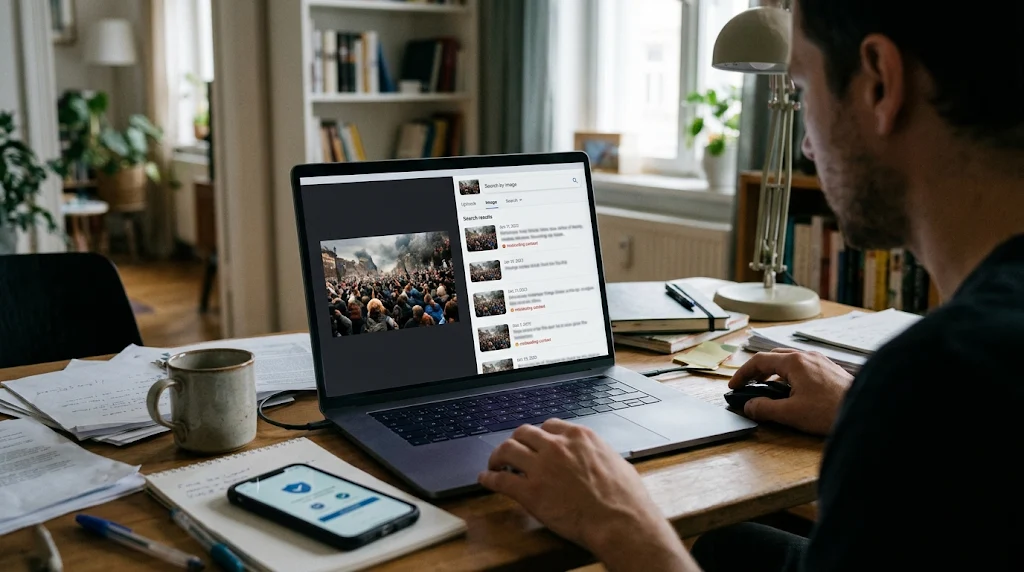
Images are frequently repurposed out of context or digitally edited to support a false narrative. Running a reverse image search lets you see where else the picture appears on the web and when it was first published.
Upload the image file directly or paste its URL into a trusted reverse image search service like Google Lens or TinEye.
Look closely for older versions, original photojournalism captions, or investigative notes attached to the same picture.
Research from Garrett College demonstrates that a reverse image search can quickly reveal if images have been taken out of context or altered to mislead viewers. Visual digital misinformation is particularly persuasive because people tend to believe what they see with their own eyes. By making a reverse image search a standard part of your routine, or letting ShouldEye run an automated visual check, you can easily spot recycled photos from old natural disasters or unrelated political rallies.
6. Consult Professional Associations for Source Credibility
For specialized topics such as medicine, personal finance, or civil engineering, turn to the relevant professional bodies like the World Health Organization, national ministries, or industry councils. Their official publications are peer-reviewed or thoroughly vetted by domain experts, making them prime examples of reliable sources. A viral claim about a new vaccine should always be cross-referenced with WHO or the national health ministry's official statements. Similarly, financial advice is best checked against U.S. Securities and Exchange Commission alerts or recognized accounting boards to verify source credibility.
Academic findings from PUCRS highlight that consulting professional associations provides authoritative online verification for complex subjects. General blogs rarely have the technical expertise required to interpret clinical trials or regulatory filings accurately, which often leads to accidental digital misinformation.
7. Leverage Dedicated Fact Checking Tools Online
Google Fact Check Explorer aggregates verification articles across the web, making it easy to see if a viral claim has already been examined by professionals. Snopes is another long-standing platform that tackles urban legends and viral rumors with deep archival research. When you enter the claim or URL into these fact checking tools, the system will immediately surface relevant investigations and ratings. These specialized fact checking tools complement manual cross-checking, especially for fast-moving breaking stories where details change hourly.
Guidance from UNHCR emphasizes that using resources like Google's verification suite or Snopes assists everyday internet users in debunking false information. Pairing these public fact checking tools with a reverse image search creates a strong barrier against online deception.
⚡ Reality Check
- Time Investment: Even a brief verification takes a few minutes; don’t expect instant certainty.
- Source Errors: Reputable outlets can still publish mistakes, so multiple confirmations are key.
- Misinformation Speed: False claims spread faster than corrections, making early checks crucial.
How ShouldEye Streamlines Online Verification and Source Credibility
ShouldEye aggregates the very signals discussed above, including source credibility, publication date, citation quality, fact-check outcomes, and reverse image search data, into a single, AI-driven dashboard. By feeding a questionable URL into ShouldEye, you instantly see:
A comprehensive trust score based on automated cross-source online verification across reliable sources.
Any known reader complaints, regulatory warnings, or red-flag patterns linked to the publisher.
A curated summary of relevant professional-body statements that address the core topic.
A quick reverse image search analysis result to confirm whether the accompanying visuals are authentic.
This integrated approach eliminates the need to hop between multiple websites and external fact checking tools. ShouldEye gives you a concise, evidence-backed view of source credibility before you decide to share a post or act on its advice, effectively stopping digital misinformation in its tracks.
Quick Practical Workflow for Online Verification
When you need to evaluate an article quickly, follow a structured sequence rather than guessing. First, spot the core claim by noting the headline, featured image, or central statistic. Next, check the source by identifying the publisher, author credentials, and publication date to establish baseline source credibility. Third, look for citations and verify that the article lists its references clearly. Fourth, cross-check the story by finding at least two independent reliable sources confirming the exact same fact.
Fifth, run a reverse image search if a compelling photograph or video clip is involved in the post. Sixth, consult dedicated fact checking tools for a rapid accuracy rating from professional investigators. Seventh, validate technical claims with professional bodies for domain-specific topics like healthcare or law. Finally, use a resource like Google Fact Check Explorer or ShouldEye for a final sanity check. If any step in this online verification workflow raises doubts, treat the information as unverified digital misinformation until you can resolve the issue using reliable sources.
EyeQ in Action Against Digital Misinformation
When you encounter a viral claim that feels urgent or emotionally charged, you can ask EyeQ to run a quick cross-source check on the statement. In just a few seconds, EyeQ scans reliable sources to surface the most recent reputable articles, official verdicts from fact checking tools, and any conflicting evidence. This rapid analysis gives you a clear, objective picture of the claim's overall source credibility. By automating the most tedious parts of online verification and reverse image search tracking, EyeQ empowers everyday readers to browse with confidence.
Final Thoughts on Fact Checking Tools and Reliable Sources
The internet's abundance of information is a double-edged sword for modern readers. By habitually verifying the origin, publication date, citations, multiple reliable sources, image provenance through a reverse image search, and professional authority, you protect yourself and your network from digital misinformation. Remember that online verification is a daily habit, not a one-off task. The next time you see a bold claim online, pause, run through the core verification steps, check source credibility, and let advanced fact checking tools like ShouldEye and EyeQ do the heavy lifting.
Take the Next Step with EyeQ and ShouldEye
Before you share that viral post with your colleagues or friends, let EyeQ and ShouldEye scan the source for hidden biases, manipulated photos, and missing references. A few simple clicks can turn a risky social media share into a confident, evidence-backed contribution supported by reliable sources.
Frequently Asked Questions Live
Reader activity for this article, refreshed by EyeQ AI
6 active now 269 total asked 6 questions
1 What is the first thing I should verify when I see a claim online? Trending Consumer Protection 54 asked Updated 1m ago
2 How many sources are enough to consider a claim reliable? Trending Consumer Protection 49 asked Updated 2m ago
3 Can reverse image search prove an image is fake? Popular Consumer Protection 47 asked Updated 3m ago
4 Which fact‑checking websites should I trust? Popular Consumer Protection 44 asked Updated 4m ago
5 What role do professional bodies like the WHO play in verification? Rising Consumer Protection 40 asked Updated 5m ago
6 How does ShouldEye simplify the verification process? Rising Consumer Protection 35 asked Updated 8m ago
About ShouldEye
ShouldEye is an AI-powered trust intelligence platform that helps people evaluate companies, offers, and online experiences through scam checks, policy analysis, complaint signals, and safer alternatives.
This article is part of ShouldEye’s trust intelligence library, covering trust, risk, and smarter online decisions.