
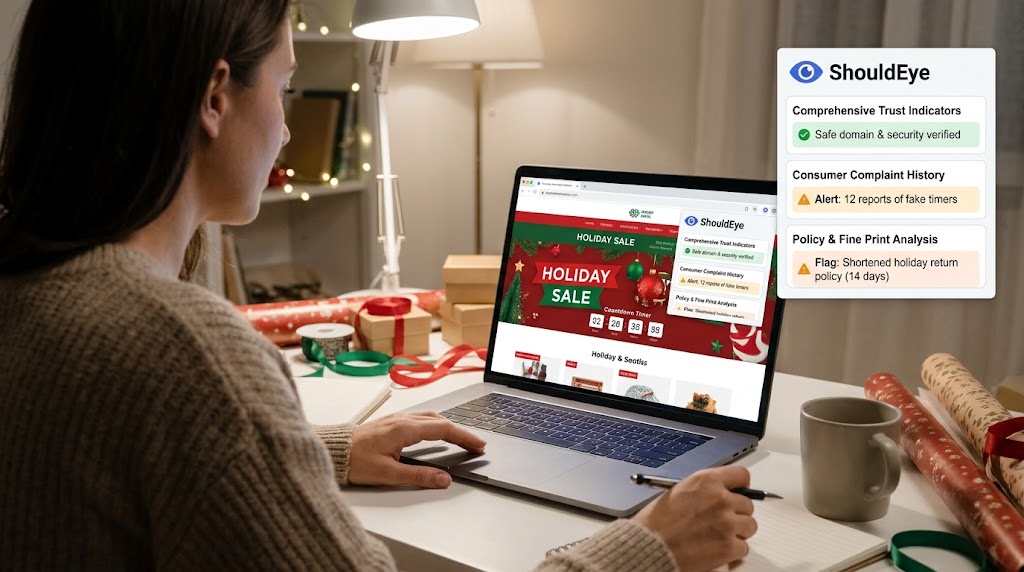
Man looks at laptop with holiday sales surrounded by glowing holograms of a brain, countdown timers, and ShouldEye.
Photo · geminiThe holiday season brings flashing banners, limited-time offers, and, almost everywhere you look, ticking countdown timers designed to catch your attention. At first glance, a timer feels like a helpful reminder: “Only 3 days left to grab the deal!” Yet that simple visual cue does more than mark time; it hijacks the brain's decision-making circuitry. In this comprehensive guide, we unpack how holiday countdown timers and intense holiday shopping urgency cloud consumer judgment, explore the deceptive timers retailers deploy, and explain how intelligent verification platforms like ShouldEye and EyeQ can protect you from predatory pressure selling.
Why Holiday Countdown Timers Feel So Compelling
Three mental mechanisms explain the persuasive power behind countdown timers:
Loss aversion psychology: Shoppers dread missing out more than they enjoy gaining. A disappearing clock instantly frames an offer as a potential loss, nudging the brain toward a quick buy-now reaction that bypasses rational thought.
Artificial decision deadlines: When an arbitrary deadline appears, the brain treats the purchase as an urgent task, dramatically shortening the natural deliberation window.
Visual attention: Moving digital numbers draw the eye, making the ticking clock the focal point of the page while pushing critical product details, fees, and alternatives into the background.
These cognitive biases become especially potent during peak seasonal sales when buyers already feel collective pressure and manufactured competition.

The Cognitive Load of a Ticking Clock
A countdown timer is not merely a passive visual cue; it continuously occupies active working memory. Research published by the American Psychological Association shows that split attention and cognitive depletion impair higher-order reasoning.
Ticking countdown timers occupy working memory, forcing part of your brain to monitor the countdown even while trying to evaluate items. This split attention effect means processing the clock and product details simultaneously compromises analytical scrutiny. The inevitable outcome is faster choices, unexamined specifications, and total vulnerability to impulse buying.
✨ Quick Timer Authenticity Check
When Holiday Shopping Urgency Becomes Deception
Not every promotional clock reflects genuine product scarcity. In many e-commerce stores, deceptive timers are deliberately configured to reset whenever the page refreshes, or they display a phantom expiration date that has no real connection to remaining inventory.
Prominent consumer watchdogs like the Federal Trade Commission have frequently penalized manipulative dark patterns that trick consumers into artificial panics. Academic research from the University of Groningen confirms that deceptive timers steer consumers toward specific items, inflating perceived holiday shopping urgency without genuine scarcity. Retailers exploit online sales tricks to push slow-moving merchandise rather than relay authentic inventory thresholds.

Real World Risks of Online Sales Tricks for Shoppers
When urgency replaces thoughtful evaluation, consumers face multiple hidden pitfalls that damage personal finances:
The primary hazard is reckless impulse buying, where shoppers click purchase before cross-checking independent reviews or price comparisons. Another major risk involves hidden fees, where e-commerce checkout funnels quietly add excessive shipping, handling, or restocking fees that buyers miss while fixated on expiring countdown timers. Additionally, widespread exposure to fake urgency leads to eroded trust, damaging long-term confidence in digital merchants. Finally, holiday promotions frequently enforce a limited return window, an unfriendly policy intentionally buried beneath flashing banners and aggressive online sales tricks.
⚡ Reality Check
- Timer ≠ Real Scarcity: A flashing clock can be a marketing ploy; it doesn’t guarantee limited stock.
- Speed Increases Errors: Time pressure shortens deliberation, raising the chance of impulse mistakes.
- Deception Erodes Trust: If a timer proves false, future brand trust can suffer.
- Long‑Term Impact Is Unclear: Research doesn’t yet show how timers affect brand loyalty beyond a single purchase.
How to Verify a Countdown Timer Before You Click
To safeguard your wallet against manipulative digital storefronts, follow this verification process before entering payment credentials:
Check the URL and security certificates: Authentic web stores maintain secure protocols, whereas fly-by-night storefronts leveraging deceptive timers often reveal irregular domains and insecure connections.
Look for an explicit calendar deadline: Authentic seasonal promotions display a transparent date and recognized time zone. A detached clock displaying vague numbers without clear parameters suggests calculated online sales tricks.
Cross-reference competitive inventory: Search for identical products on competing websites. If broad marketplace availability exists elsewhere, the supposed holiday shopping urgency is entirely fabricated.
Scrutinize the fine print: Unscrupulous merchants often bury qualifying terms in site footers. Verify whether listed terms match the urgency displayed on the primary promotional clock.
Test countdown behavior: Refresh your browser session or open an incognito window. A genuine timer continues decreasing, whereas a clock that resets demonstrates deceptive timers designed to trigger impulse buying.
Run an automated verification check with EyeQ: Instant analysis with EyeQ allows buyers to identify manipulated scripts, highlight suspicious inventory signals, and evaluate brand trust in seconds.
How ShouldEye Helps You Beat Manipulative Urgency
Evaluating retail tactics manually during the holiday rush can feel exhausting, but ShouldEye aggregates three core data streams to make verification effortless:
Comprehensive trust indicators: Automated scanners inspect domains, structural security, merchant tenure, and known scam signals.
Consumer complaint history: ShouldEye pulls real user feedback from public consumer boards, forums, and the Better Business Bureau to uncover patterns of misleading countdown timers and deceptive practices.
Policy and fine print analysis: The platform automatically scans user agreements, identifying concealed restocking charges, shortened return policies, and restrictive warranty clauses.
By combining these automated assessments with the alternative product comparison tools inside ShouldEye, consumers gain real-time leverage to locate genuine bargains without succumbing to artificial online sales tricks.
Overcoming Loss Aversion Psychology and Impulse Buying
Countdown timers remain an effective retail tactic because they exploit hardwired loss aversion psychology, enforce artificial deadlines, and hijack attention while overloading your cognitive faculties. When utilized honestly, promotional clocks simply inform consumers about genuine logistical deadlines. When misused, deceptive timers manipulate shoppers into regretted decisions.
Smart holiday shopping requires recognizing urgency as a persuasive sales technique rather than an absolute fact. Take a brief pause, walk through the essential verification checkpoints, and allow EyeQ and ShouldEye to verify retail credibility, ensuring you secure authentic value across every seasonal purchase.
Frequently Asked Questions Live
Reader activity for this article, refreshed by EyeQ AI
6 active now 149 total asked 6 questions
1 Do holiday countdown timers always mean limited stock? Trending Consumer Protection 34 asked Updated 1m ago
2 Can a timer be legally deceptive? Trending Consumer Protection 29 asked Updated 2m ago
3 How does loss aversion affect my purchase decision? Popular Consumer Protection 27 asked Updated 3m ago
4 What should I do if a timer resets after I leave the page? Popular Consumer Protection 24 asked Updated 4m ago
5 Are there any benefits to genuine countdown timers? Rising Consumer Protection 20 asked Updated 5m ago
6 How can I use ShouldEye to verify a timer’s authenticity? Rising Consumer Protection 15 asked Updated 8m ago
About ShouldEye
ShouldEye is an AI-powered trust intelligence platform that helps people evaluate companies, offers, and online experiences through scam checks, policy analysis, complaint signals, and safer alternatives.
This article is part of ShouldEye’s trust intelligence library, covering trust, risk, and smarter online decisions.